BCG Case Interview Guide: 2026 Format & Strategies
Updated April 2026·18 min read
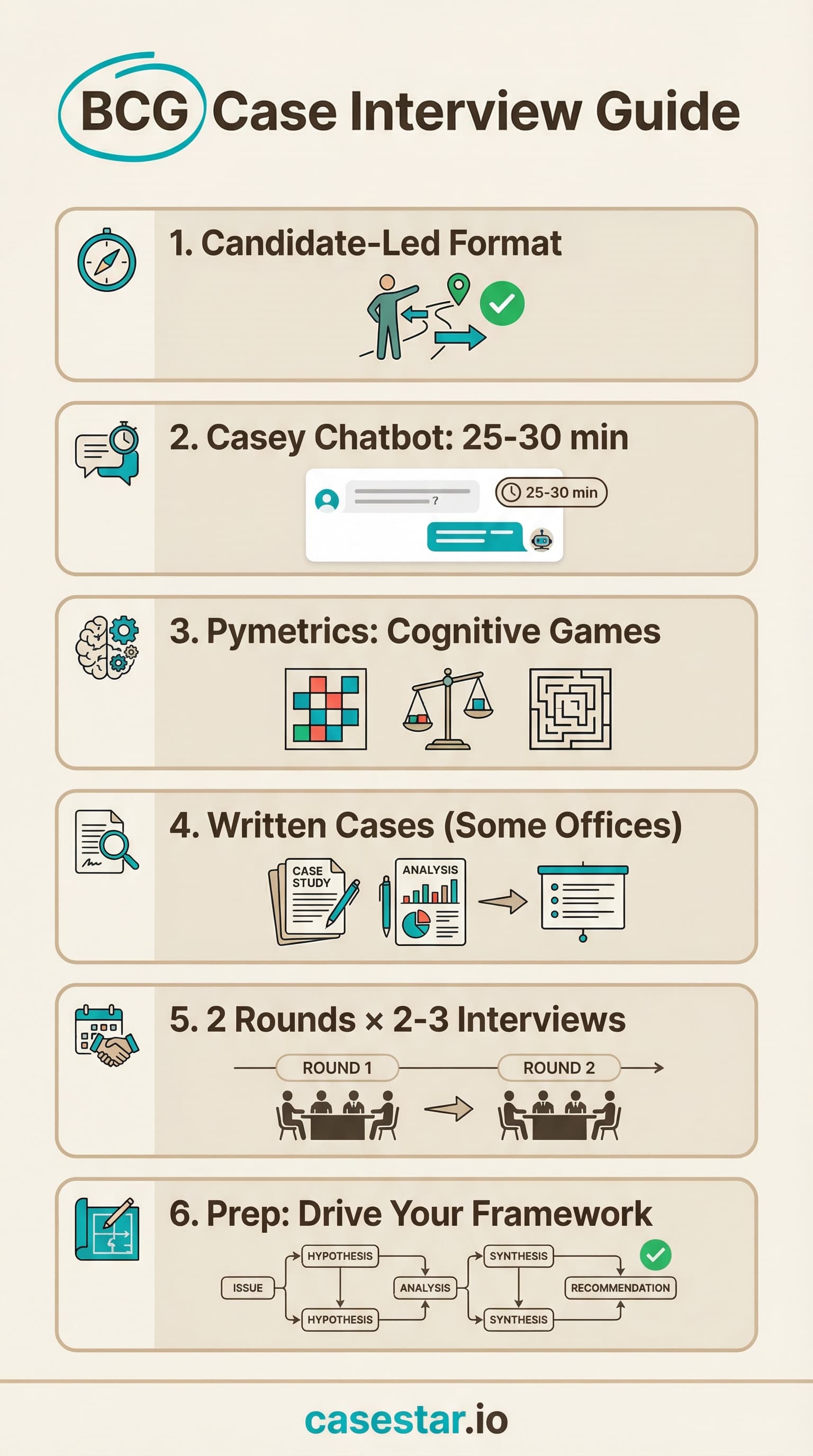
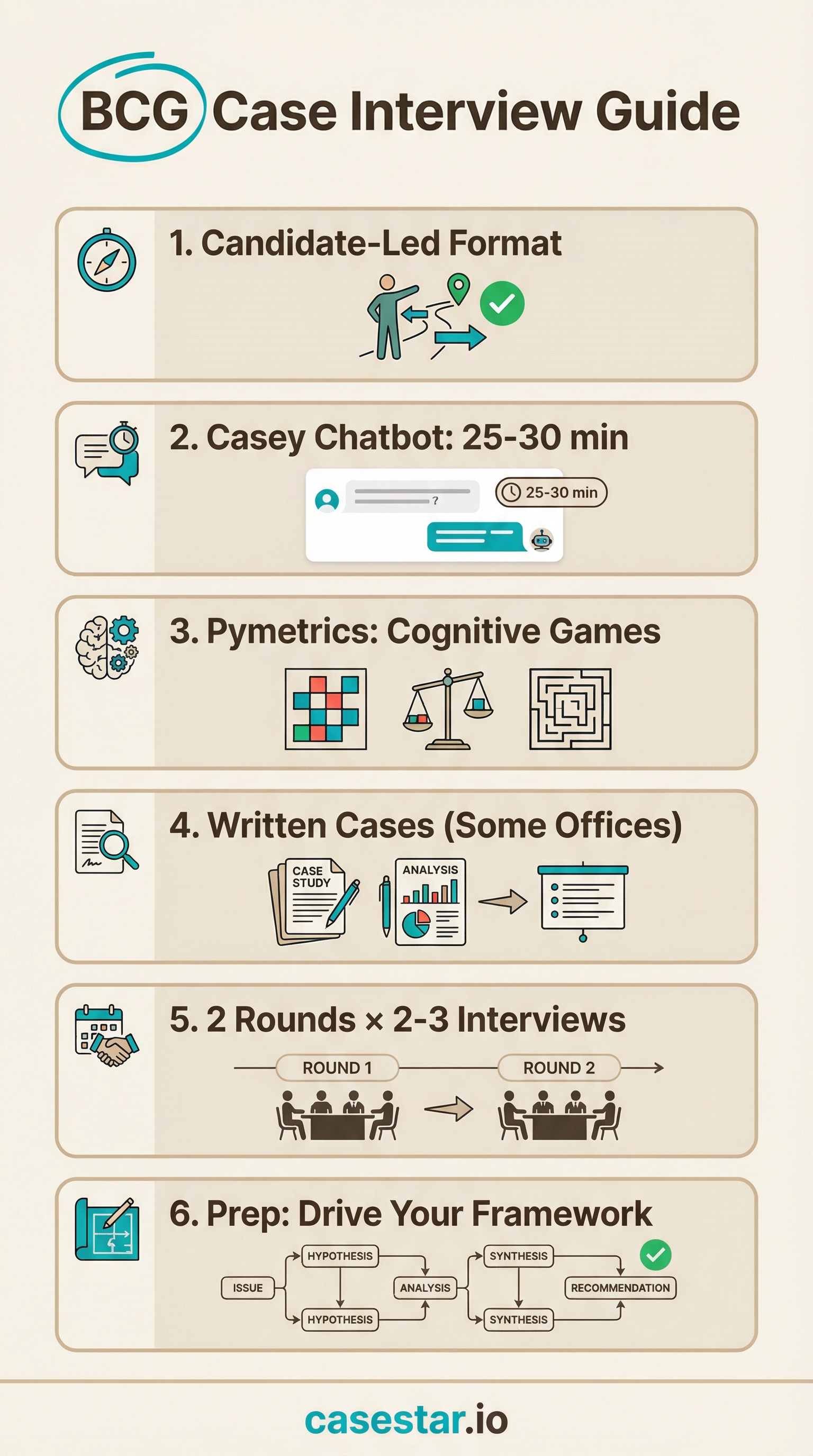
BCG uses candidate-led cases where you drive the analysis, plus the Casey chatbot (30 min) for online screening. Unlike McKinsey, you choose what to analyze and when. Expect 2-3 interviews per round with behavioral fit woven throughout rather than a separate PEI.
Executive Summary: BCG is defined by the candidate-led case format—you must drive the analysis. Recruiting for 2026 heavily utilizes the Casey Chatbot for screening. Success requires autonomous problem-structuring and showing strong "teammability" during the conversational fit portion.
Official Resources:BCG Careers & Interview Preparation
Contents
What is the BCG interview process?
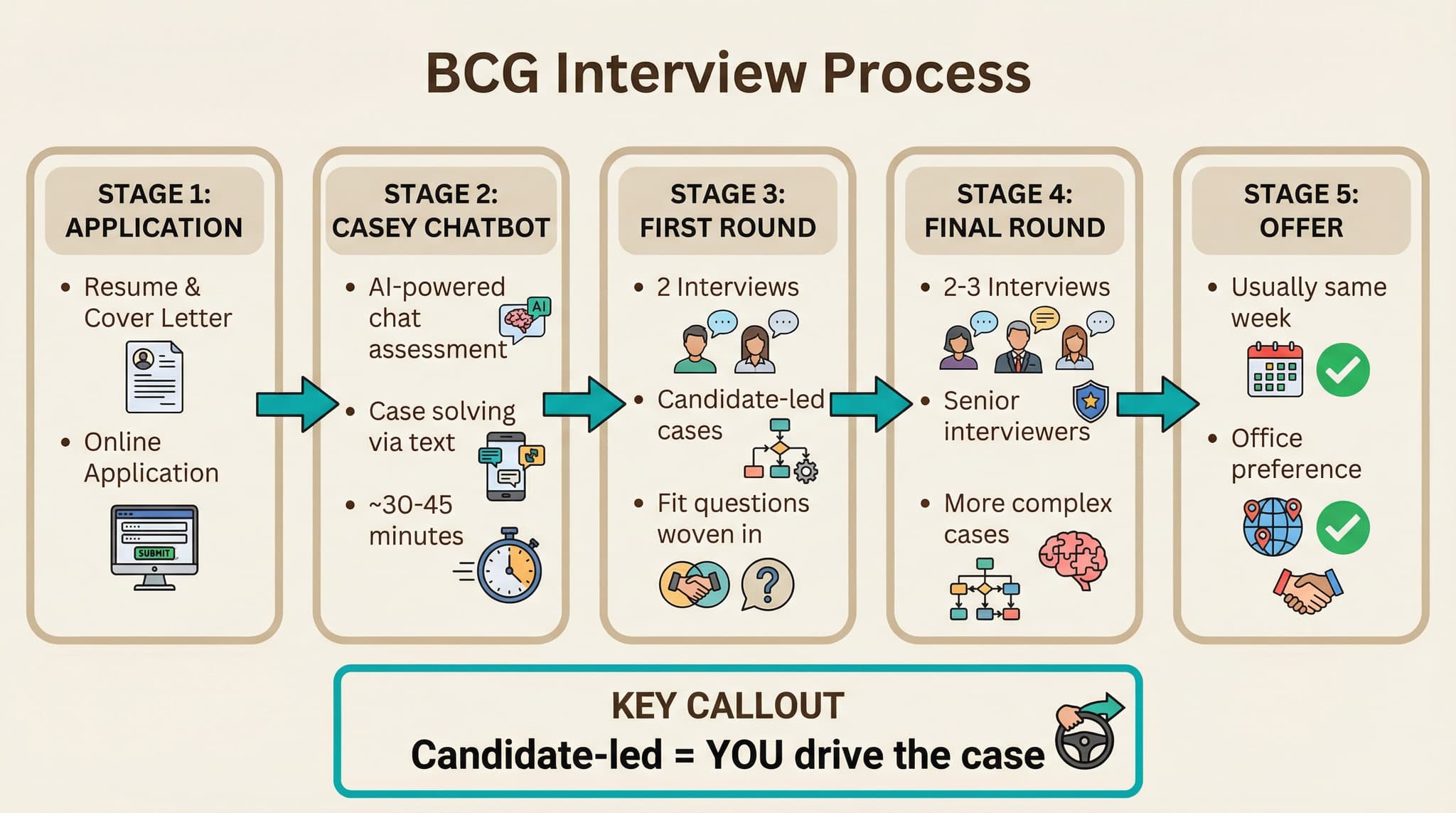
Boston Consulting Group seeks "intellectual curiosity" and the ability to work independently. The 2026 process is rigorous and typically follows this path:
- Online Assessment: The Casey Chatbot (combined in some offices with Pymetrics games — confirm with your recruiter) screens for quant speed and structuring logic.
- First Round: 2 back-to-back interviews (25-35 minutes each) with Consultants or Project Leaders.
- Final Round: 2-3 interviews with Partners, often diving deeper into creative brainstorming.
- Written Case: Reserved for specific offices (common in Europe/Asia), testing data synthesis.
Each case interview typically runs 25-35 minutes on the case itself plus 10-15 minutes of fit questions. The fit portion at BCG is more conversational than McKinsey's structured PEI but still evaluates leadership, teamwork, and motivation.
What is the Candidate-Led Format?
BCG uses a candidate-led interview style. This means you control the direction of the case. After receiving the problem, you decide how to structure your analysis, what questions to ask, and which areas to explore first.
In practice, a candidate-led case works like this:
- The interviewer presents a business problem
- You take 60-90 seconds to think, then present your framework
- You choose which branch to explore first and explain why
- You ask specific questions to get data for your analysis
- You drive through the case, requesting information as needed
- The interviewer provides data when you ask the right questions
- You synthesize findings and present your recommendation
This format rewards candidates who can think independently and stay organized. Your framework is not just a starting point; you return to it throughout the case to track progress and decide next steps.
Key difference: In McKinsey's interviewer-led format, the interviewer guides you through specific questions. At BCG, silence after you finish a thought means you should decide what to do next. Do not wait for direction.
BCG vs McKinsey vs Bain
The three firms test similar skills but use different interview approaches. Understanding these differences helps you prepare appropriately.
| Aspect | BCG | McKinsey | Bain |
|---|---|---|---|
| Case format | Candidate-led | Interviewer-led | Candidate-led |
| Online assessment | Casey chatbot (+ Pymetrics in some offices) | Solve game (Sea Wolf + Redrock digital assessment) | SOVA test or similar |
| Behavioral weight | ~30% of evaluation | ~50% (PEI is heavily weighted) | ~30% of evaluation |
| Behavioral format | Conversational, multiple short stories | PEI: 15-20 min deep dive on one story | Conversational, focus on teamwork |
| Written case | Some offices (Europe, Australia, Asia) | Rarely | Some offices |
| Framework importance | High - you rely on it throughout | Medium - starting point only | High - similar to BCG |
| Typical rounds | 2 rounds (2 + 2-3 interviews) | 2 rounds (2 + 2-3 interviews) | 2-3 rounds depending on office |
If you are interviewing at multiple firms, practice both styles. The candidate-led approach (BCG/Bain) requires more independence, while McKinsey's format demands comfort with rapid pivots and direct questions.
Casey chatbot assessment
Casey (recently rebranded in some offices as the BCG HireQuotient assessment) is BCG's online case interview tool. It presents a business scenario through a chat interface and asks you questions about how to approach and solve the problem.
What to expect (2026 Update)
- Duration: 25-35 minutes total
- Format: Interactive chatbot with 6-8 sequential questions
- End Task: A 60-90 second video recording of your final recommendation
- Content: Unified business case with data and exhibits
- Constraints: Cannot revisit previous questions; high time pressure
CaseStar's BCG assessment simulators are currently paused. Follow your invitation for the assessment format and any official familiarisation resources. You can still practise BCG case interviews on CaseStar.
Types of questions
Structuring questions
Which areas would you explore to understand this problem? Select the most relevant options.
Data interpretation
Review this chart showing sales trends. What is the year-over-year growth rate for Product A?
Calculations
Given the cost structure and volume projections, what would be the break-even point?
Recommendation
Based on your analysis, should the client proceed with this investment? Explain your reasoning.
How to prepare for Casey
- Practice timed case solving. Casey does not let you pause indefinitely.
- Work on mental math speed. You cannot use a calculator.
- Get comfortable reading charts and extracting insights quickly.
- Practice clear, concise written explanations for recommendation questions.
- BCG provides a practice version of Casey. Complete it before your real test.
Note: Casey results factor into whether you advance to interviews, but strong interview performance can sometimes compensate for a weaker Casey score. Treat it seriously but do not panic if you feel it went poorly.
Pymetrics games (where still used)
Pymetrics is one of the assessments BCG has used as part of its online screen. Coverage varies by office and year — some regions still run the Pymetrics suite, others rely primarily on the Casey chatbot, and some have moved toward a proctored BCG Cognitive Test for numerical and logical reasoning. Confirm with your BCG recruiter which assessment your target office is running this cycle.
What Pymetrics measures (when included)
- Attention: How well you focus and avoid distractions
- Memory: Working memory and pattern recognition
- Risk tolerance: How you evaluate uncertain outcomes
- Decision-making speed: How quickly you process information
- Emotional intelligence: Reading facial expressions and emotions
- Fairness preferences: How you balance outcomes between parties
How to approach Pymetrics
Unlike Casey, Pymetrics games cannot be directly practiced because the algorithm compares your responses to successful BCG consultants. Trying to game the system usually backfires. Instead:
- Take the games when you are well-rested and focused
- Use a reliable computer with stable internet
- Complete all games in one sitting (about 25 minutes total)
- Answer authentically rather than trying to guess what they want
- Maintain steady attention throughout; consistency matters
Pymetrics is not a pass/fail test in the traditional sense. Your profile is compared against traits of successful consultants at BCG. If you do not advance past Pymetrics, you can typically reapply after a waiting period.
Written case interviews
Some BCG offices include a written case interview, particularly in Europe (London, Paris, Munich, Amsterdam), Australia, and parts of Asia. This format tests your ability to work independently with complex materials.
Written case format
- Materials: 10-30 pages including case background, data exhibits, financial statements, and market research
- Time: 60-90 minutes to read, analyze, and prepare
- Deliverable: Written notes or slides for a presentation
- Presentation: 10-15 minutes presenting to interviewers followed by Q&A
How to approach written cases
First 10 minutes: Skim everything
Get a sense of what materials you have before diving deep. Identify the main question and flag key exhibits.
Next 30-40 minutes: Analyze
Focus on the data most relevant to answering the main question. Do not try to analyze everything; prioritize ruthlessly.
Final 15-20 minutes: Structure your presentation
Organize your findings into a clear narrative. Lead with your recommendation, then support with evidence.
Check with your recruiter whether your office uses written cases. If yes, practice reading and synthesizing dense materials under time pressure.
Interview rounds and structure
BCG interviews typically occur over two rounds, though some offices add a third round for experienced hires or partner-track roles.
First Round
- 2 interviews, each 25-35 minutes
- Interviewers: Consultants and Managers (typically 2-5 years at BCG)
- Format: Case (25-35 min) + Fit questions (10-15 min)
- Location: Usually virtual or at local office
Final Round
- 2-3 interviews, each 25-35 minutes
- Interviewers: Principals and Partners (senior leadership)
- Format: Similar structure but may include written case in some offices
- Location: Often in-person at office
- May include office visit and informal interactions
Fit questions at BCG
Unlike McKinsey's deep-dive PEI format, BCG fit questions are more conversational. Expect questions across several areas:
- Leadership: Describe a time you led a team through a challenge
- Influence: Tell me about convincing someone to change their mind
- Teamwork: How have you handled conflict with a team member?
- Motivation: Why consulting? Why BCG specifically?
- Career: Walk me through your resume and key decisions
Prepare 4-5 stories from your experience that can flex to cover different question types. Practice telling them concisely, around 2-3 minutes each.
How to prepare specifically for BCG
While core case skills transfer across all consulting interviews, BCG has specific elements worth targeting.
1. Master candidate-led driving
Practice cases where you control the direction. After presenting your framework, decide which branch to explore and ask specific questions without waiting for prompts. Get comfortable with silence after your interviewer provides data. That silence means: what do you want to do next?
Practice: Framework building drills
2. Build strong frameworks
Your framework matters more at BCG because you navigate by it throughout the case. Learn to build custom structures quickly, and practice referencing your framework when transitioning between analysis areas. Avoid generic templates that do not fit the specific problem.
3. Prepare for Casey
Complete BCG's practice Casey before your real test. Focus on reading charts quickly, doing calculations without a calculator, and writing clear recommendation justifications. Time yourself on practice cases to build speed.
Practice: Mental math drills
4. Practice written cases if relevant
If your office uses written cases, practice reading 15-20 pages of business material and synthesizing key points in under an hour. Focus on identifying what matters versus what is noise. Structure presentations with a clear recommendation upfront.
5. Prepare conversational fit stories
BCG fit questions are less structured than McKinsey PEI, so prepare stories that work across multiple themes. Have 2-3 minute versions ready, and be prepared for follow-up questions that dig into specifics. You can refine your delivery using our behavioral practice mode. Authenticity matters; rehearsed-sounding answers stand out negatively.
6. Know BCG's work
Familiarize yourself with BCG's publications, recent work, and industry focuses. Be ready to discuss why BCG specifically, referencing their approach to consulting, culture, or specific practice areas relevant to your interests.
Suggested preparation timeline
Weeks 1-2
Foundation: Learn case formats, start mental math drills, practice 4-5 solo cases. Complete the online screen your office uses (Casey, Pymetrics where still run, or the BCG Cognitive Test) if required.
Weeks 3-4
Skill building: Focus on candidate-led format, start mock interviews, complete Casey practice. Begin preparing fit stories.
Weeks 5-6
Integration: Increase mock frequency, refine weak areas, practice written cases if applicable. Polish fit stories until they flow naturally.
Practice with CaseStar
CaseStar's voice-powered practice platform offers candidate-led case practice with instant feedback. Practice driving cases independently, building frameworks, and developing mental math speed.
Start practicingFAQ
What is the BCG Casey chatbot test?
Casey is BCG's online case assessment. It presents a business case through a chat interface with multiple-choice, numerical, and open-text questions. The test takes 25-30 minutes and evaluates problem-solving, quantitative skills, and logical reasoning.
How is BCG's interview format different from McKinsey?
BCG uses candidate-led format where you drive the structure and decide what to analyze. McKinsey uses interviewer-led format with more directed questions. At BCG, your framework matters more; at McKinsey, the PEI (behavioral) weighs more heavily.
Does BCG have written case interviews?
Some offices do, particularly in Europe, Australia, and parts of Asia. You receive a packet of materials (10-30 pages), analyze for about an hour, then present your findings. Check with your recruiter about your specific office.
How many interview rounds does BCG have?
Typically two rounds: first round with 2 interviews and final round with 2-3 interviews. Some offices add a third round for senior hires. Each interview runs 25-35 minutes of case plus 10-15 minutes of fit questions.
Does BCG still use the Pymetrics assessment?
Pymetrics is one of several screens BCG has used. Where still run, it consists of short cognitive games measuring traits like attention, risk tolerance, and decision-making (about 25 minutes). Coverage varies by office and year — many regions now lean primarily on the Casey chatbot. Confirm with your BCG recruiter which assessment your target office is running this cycle.
How should I prepare specifically for BCG?
Focus on driving cases independently since BCG uses candidate-led format. Build strong frameworks you can navigate throughout the case. Practice Casey with timed online cases. If your office has written cases, practice reading exhibits quickly and structuring presentations.
Prepare for BCG interviews
CaseStar offers interactive case practice designed for candidate-led interviews. Build your framework skills, practice mental math, and get instant feedback.
Try it freeSave this guide
Updated April 2026