Case Interview Prep: The Complete Guide
Updated April 2026·20 min read
Summary: Case interviews test your ability to solve business problems out loud. Prepare for 4-8 weeks. Do 20-30 cases with feedback. Practice mental math and structuring as separate skills. Build custom frameworks instead of memorizing templates.
Contents
What is a case interview
A case interview is typically a 25-35 minute conversation (45 minutes at McKinsey when PEI is bundled) where you solve a business problem out loud. The interviewer gives you a scenario, something like: "Our client is a retail bank seeing declining profits. What should they do?"
Your job is to structure the problem, ask clarifying questions, analyze data, do calculations, and arrive at a recommendation. You do this while thinking out loud so the interviewer can follow your reasoning.
There is no single correct answer. Two candidates can give different recommendations and both pass, or give the same recommendation and one fails. The evaluation is about your thinking process, not the conclusion.
How firms differ: McKinsey vs BCG vs Bain
The three firms run their interviews differently. This matters for how you prepare.
| Aspect | McKinsey | BCG / Bain |
|---|---|---|
| Interview style | Interviewer-led | Candidate-led |
| Who controls pace | The interviewer | You |
| Your framework | Starting point, then they redirect | Main structure throughout |
| Feel | Rapid Q&A, frequent pivots | Structured exploration |
| Behavioral portion | PEI: 15-20 min deep dive into one story (~50% of evaluation) | Fit questions woven throughout (~30% of evaluation) |
| Online assessment | Solve game (Sea Wolf + Redrock analysis) | BCG: Casey chatbot. Bain: SOVA test |
For McKinsey: Practice being interrupted and redirected. Practice answering direct questions without relying on your framework as a crutch. Prepare 3 behavioral stories for the PEI (Personal Experience Interview).
For BCG/Bain: Practice driving the case yourself. Get comfortable deciding what to analyze next without prompts. Prepare shorter behavioral examples.
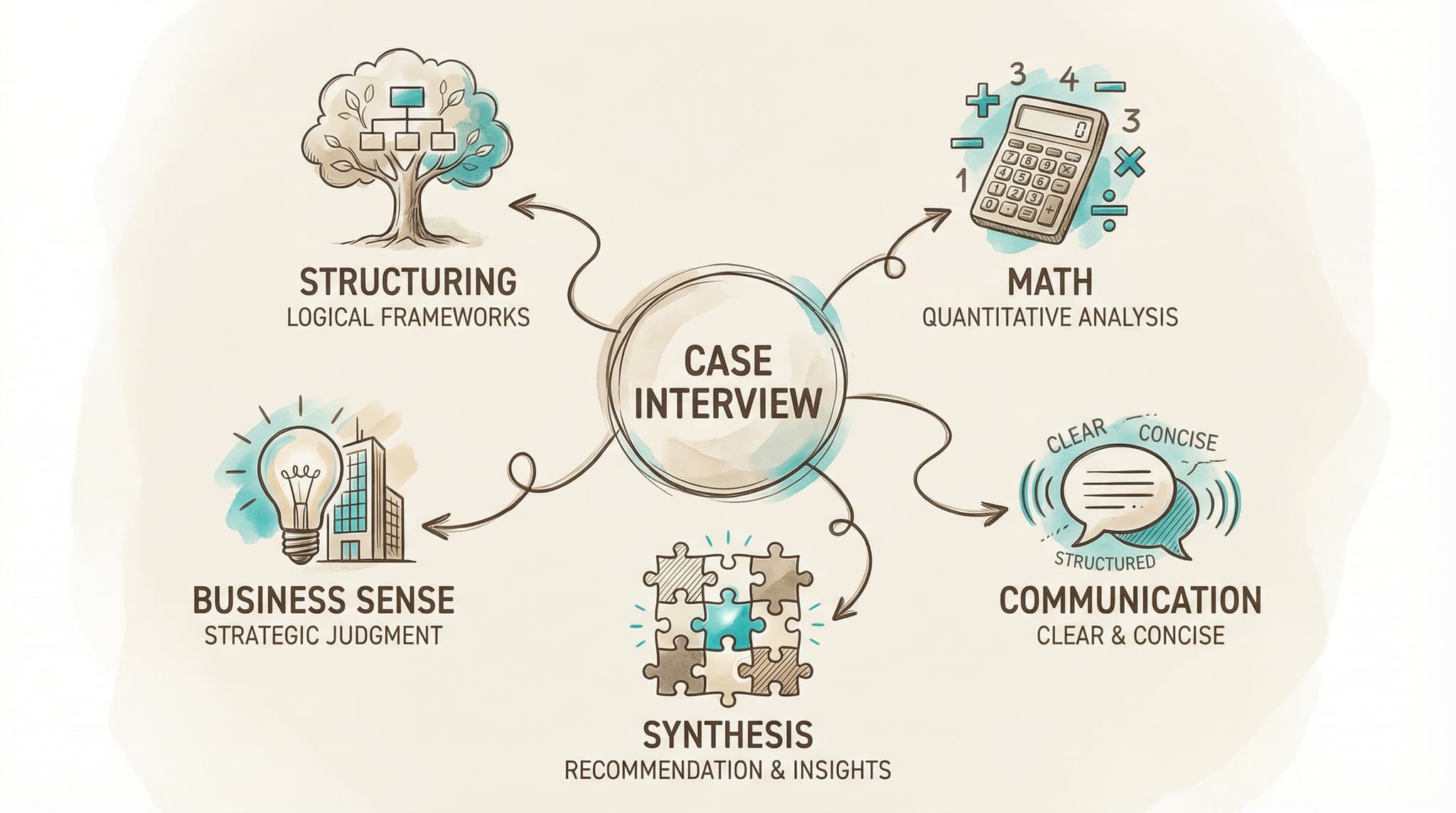
The 6 skills being tested
Case interviews evaluate these six skills. Each requires different practice.
1. Structuring
Breaking a messy problem into organized pieces. Interviewers want to see you build a structure that fits this specific problem, not apply a generic template. Learn the principles (why profitability cases examine revenue and costs), then build custom structures.
Practice: Structuring drills
2. Mental math
Calculating things like "15% of $847 million" in your head while talking. The math itself is not hard. Doing it under pressure while explaining your approach is what trips people up. This skill improves with dedicated practice, not just from doing cases.
Practice: Mental math drills
3. Business judgment
Do your answers make sense? If you propose 40% cost cuts in one year or 50% market share in a competitive market, that signals poor judgment. You need enough intuition to sanity-check your conclusions against how businesses actually work.
4. Communication
Explaining your thinking clearly. Consultants communicate with clients constantly. If you cannot walk someone through your logic in an interview, they will not trust you with clients. This means speaking in structured points, signposting your reasoning, and keeping explanations concise.
5. Creativity / Brainstorming
Generating ideas when asked questions like "What are ways our client could increase revenue?" Average candidates give 3-4 obvious answers. Strong candidates generate 8-10 specific ideas across different categories. This skill is undertrained by most candidates.
6. Synthesis
Pulling everything together into a recommendation. Many candidates do solid analysis but give weak endings. Interviewers want a clear answer with reasoning, not "it depends" or a list of considerations without a conclusion.
Practice: Synthesis exercises
These skills do not improve equally from case practice. You might do one math calculation per case. In 15 minutes of dedicated drills, you can do 20+. Target your weak areas directly.
Common mistakes
Memorizing frameworks
The "profitability framework" rarely fits real cases perfectly. Interviewers notice when you force-fit a template. Learn the underlying logic instead, and build structures from the specifics of each case.
Practicing silently or in writing
The interview is a conversation, not a written exam. If you practice by writing out answers, you will freeze when you need to think out loud. Practice verbally from the start.
Only practicing with peers
Peers are learning too. They often say "that was good" when an actual interviewer would push back. Get feedback from people who know what good looks like: current consultants, experienced coaches, or coaching tools trained on real interview standards.
Underestimating behavioral
At McKinsey, the PEI is roughly half your evaluation. Many candidates spend 90% of prep time on cases. Prepare 3-4 stories covering leadership, impact, and influence. Use our behavioral interview simulator to practice telling them until they flow naturally.
Skipping clarifying questions
Jumping straight to a framework without understanding the problem. Take 30-60 seconds to ask about the objective, timeline, and context. This shows you think before acting.
How to practice
Split your time
A common mistake is doing only full cases. Instead, split your practice:
- 40% component drills: Mental math, structuring, market sizing. Target specific skills efficiently.
- 20% solo case practice: Work through cases alone to learn patterns and build familiarity.
- 40% live practice with feedback: Mock interviews with partners, coaches, or voice practice tools. The feedback is what makes you improve.
Daily drills (15-20 minutes)
Start each prep session with focused skill work:
- Mental math: percentages, multiplication, division with large numbers. Do these out loud.
- Structuring: take a random business problem and build a framework in 2 minutes. No templates.
- Market sizing: estimate things (gas stations in your city, market size for dog food).
- Chart interpretation: find business charts online and extract 2-3 insights in under a minute.
Case practice (3-4 per week)
Quality over quantity:
- Set up like a real interview. Timer on. No notes visible.
- Solve completely. Do not pause to look things up.
- Review after: Where did you struggle? What would you do differently?
- Track patterns. After 10 cases, you will see recurring weaknesses. Target them.
Mock interviews (1-2 per week)
Options:
- Case partners: free, but feedback quality varies.
- Current consultants: best feedback, hard to find.
- Paid coaches: $100-300 per session, experienced.
- Voice practice: realistic cases with instant feedback, available anytime.
Tip: Record your mock interviews. Watching yourself reveals habits you did not know you had: filler words, nervous gestures, unclear explanations.
Timeline
Most candidates need 4-8 weeks with 15-20 hours per week.
Weeks 1-2: Foundation
- Learn the case interview format
- Understand different case types
- Start daily mental math drills
- Do 3-4 solo cases to get familiar
Weeks 3-4: Skill building
- Identify weak areas from initial practice
- Focus drills on specific weaknesses
- Start mock interviews (1-2 per week)
- Continue solo cases (2-3 per week)
Weeks 5-6: Integration
- Increase mock interviews (2-3 per week)
- Work on timing and pacing
- Practice behavioral stories
Weeks 7-8: Polish
- Full mock interviews under realistic conditions
- Fine-tune weak areas based on feedback
- Practice firm-specific formats
- Light practice day before, then rest
If you only have 2-3 weeks
Not ideal, but focus on: (1) one case type deeply rather than everything superficially, (2) mental math drills daily, (3) live practice from day one. Accept that you are taking a risk.
FAQ
How long does it take to prepare?
4-8 weeks with 15-20 hours per week. This includes 20-30 cases with feedback plus time for drills.
How many cases should I do?
20-30 with quality feedback beats 100 solo cases. The feedback matters more than volume.
Do I need to memorize frameworks?
No. Memorized frameworks often backfire. Learn the principles and build custom structures for each case.
Can I prepare in 2 weeks?
Possible but risky. Focus on one case type, prioritize mental math, and do live practice from day one.
Should I practice alone or with partners?
Both. Solo builds familiarity. Partner practice builds communication and pressure tolerance. Partner practice is essential.
What mental math do I need?
Percentages, multiplication/division with large numbers, unit conversions (millions to billions). Practice doing these while explaining your approach out loud.
Start practicing
CaseStar offers voice-powered case practice with instant feedback.
Try it freeSave this guide
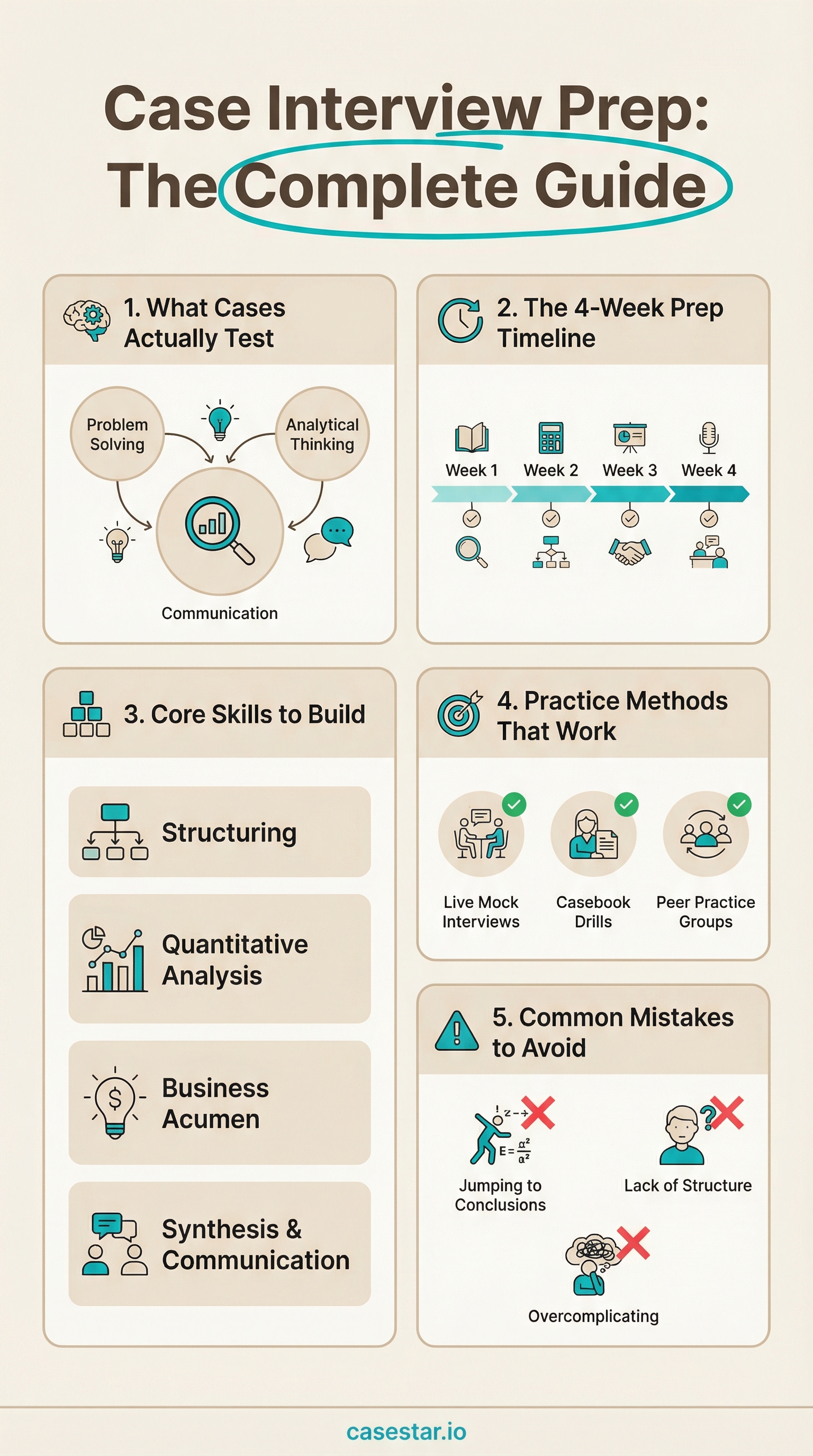
Download the infographic version for quick reference or sharing.

Last updated: April 2026