Deloitte S&O Case Interview Guide: Format, Tips & Preparation
Updated April 2026·16 min read
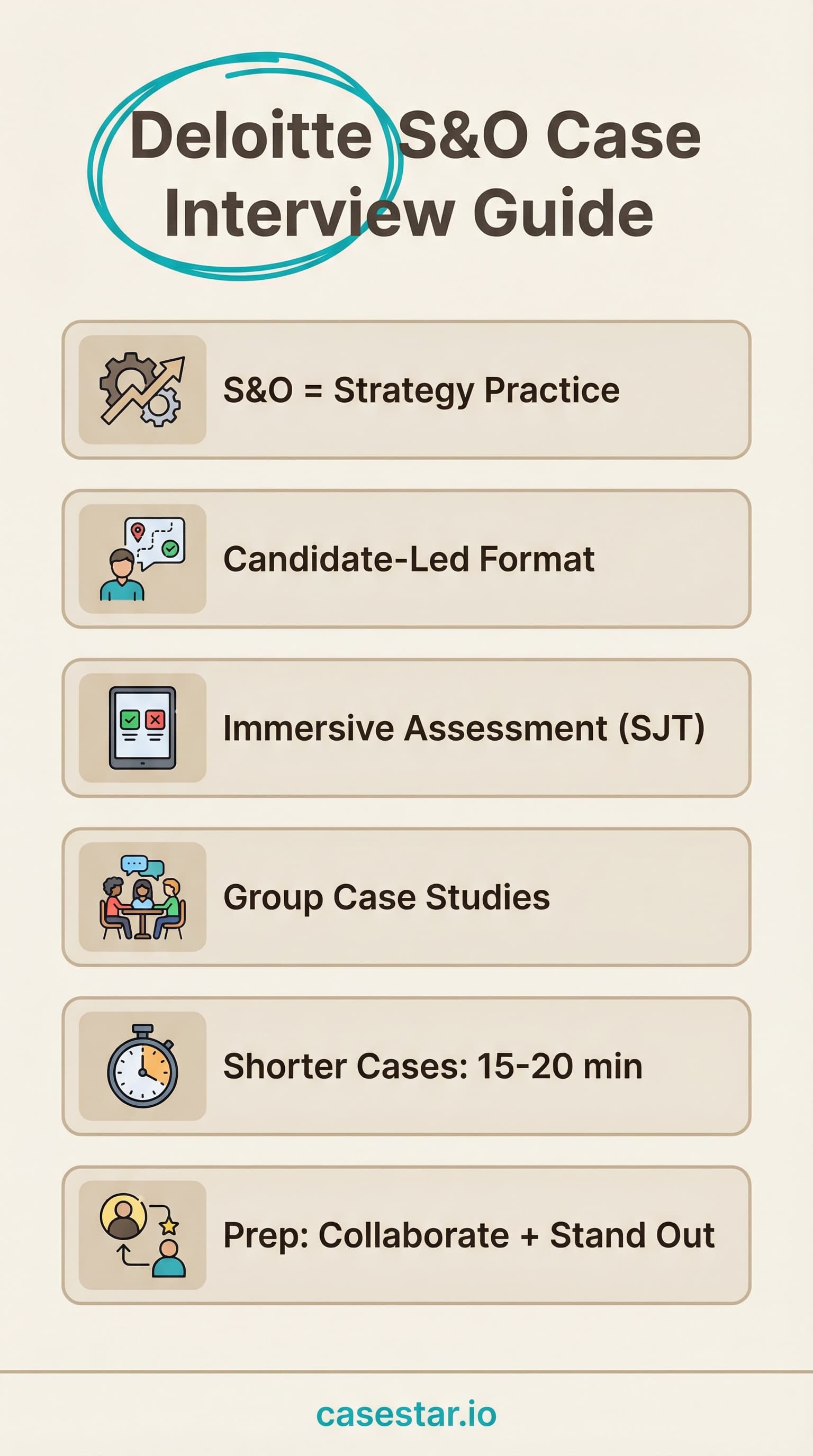
Summary: Deloitte Strategy & Operations uses candidate-led case interviews that tend to be shorter (15-20 minutes) than MBB cases. The interview process includes the Deloitte Immersive Online Assessment for some roles, 2-3 interview rounds, and potentially group case studies at assessment centers. Deloitte S&O has particular strength in technology, M&A, and human capital consulting. Prepare by practicing structured problem-solving and strong mental math.
Official Resources:Deloitte Careers & Interview Preparation
Contents
What is Deloitte Strategy & Operations?
Deloitte Strategy & Operations (S&O) is Deloitte's strategy consulting practice. Among the Big 4 consulting arms, Deloitte's consulting revenue is the largest, and S&O represents their premium strategy offering that competes directly with McKinsey, BCG, and Bain on corporate strategy engagements.
The practice grew significantly through the acquisition of Monitor Group in 2013, bringing in expertise in corporate strategy and competitive analysis. Today, Deloitte S&O works across industries on projects including:
- Corporate strategy: Growth strategies, market entry, portfolio optimization
- M&A advisory: Due diligence, integration planning, synergy capture
- Operations improvement: Supply chain, cost reduction, process optimization
- Technology transformation: Digital strategy, AI implementation, cloud migration
- Human capital: Organization design, workforce transformation, talent strategy
Deloitte's size provides certain advantages. The firm can staff larger transformations that require hundreds of consultants, and clients often engage Deloitte for implementation work that follows strategy projects. This creates opportunities for consultants to see their recommendations through to execution.
Interview format
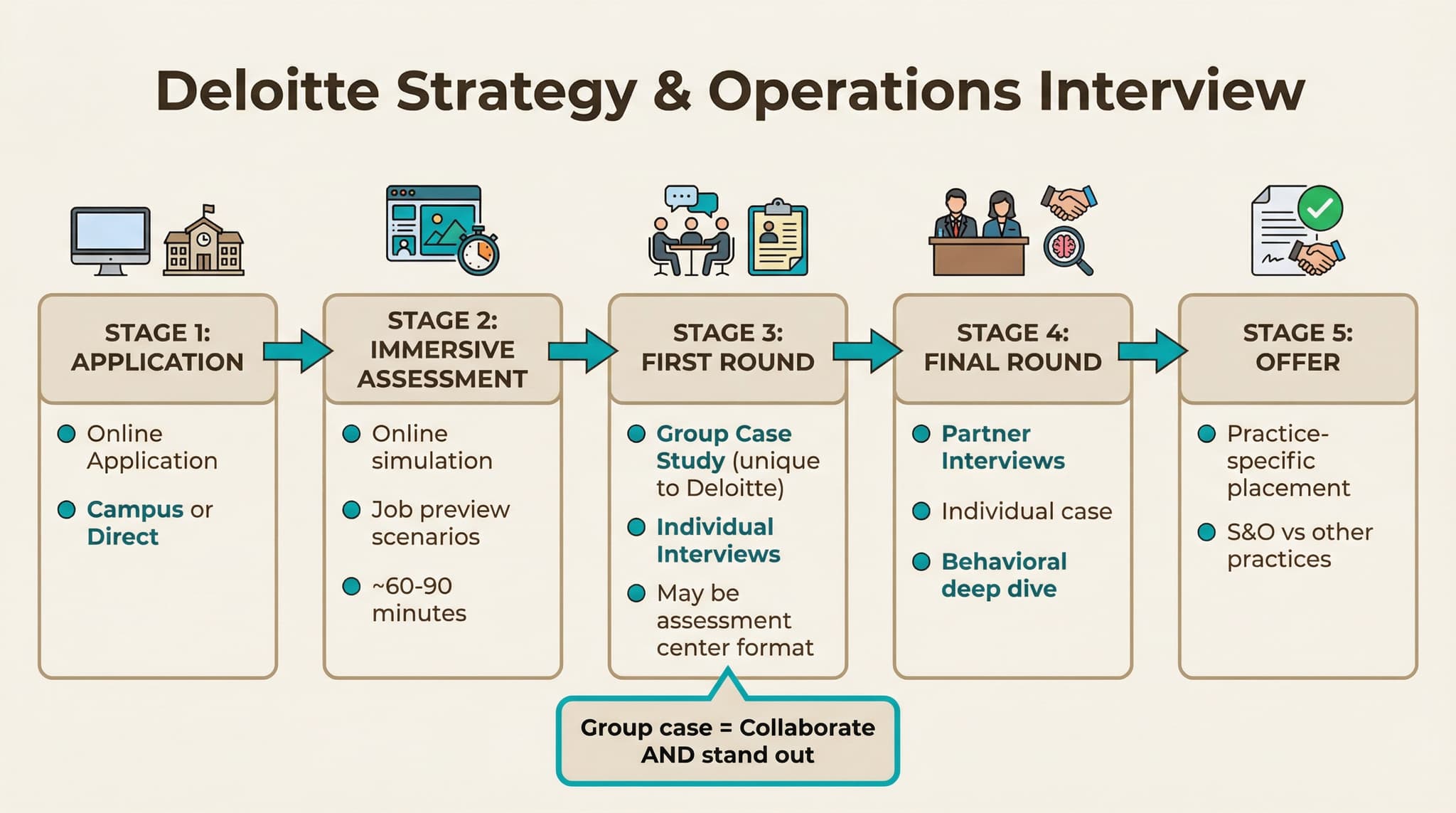
Deloitte S&O interviews typically follow a 2-3 round structure, though this varies by office and role level. The process can be conducted virtually or in-person depending on location and current circumstances.
First Round
- 1-2 interviews, each 45-60 minutes
- Interviewers: Managers and Senior Consultants
- Format: Case interview (15-20 min) + Behavioral questions (25-30 min)
- May be virtual or in-person
Final Round
- 2-3 interviews with Partners and Directors
- Similar format but cases may be more complex
- Greater emphasis on fit and motivation
- Often includes office visit and informal interactions
Assessment Center (some offices)
- Full-day event combining multiple evaluation methods
- Includes: Group case study, individual cases, partner interviews
- Common for graduate programs in UK, Europe, and Australia
- Assessors observe both individual and team performance
Case interview structure
Deloitte uses a candidate-led case format similar to BCG and Bain. You receive a business problem and drive the analysis independently. The interviewer provides information when you ask relevant questions and may redirect if you get off track.
A notable difference from MBB: Deloitte case interviews tend to be shorter, typically 15-20 minutes compared to 25-30 minutes at McKinsey or BCG. This means you need to move efficiently through the case structure.
- Problem statement (1-2 minutes) - Interviewer presents the case
- Clarifying questions (1 minute) - Quick questions about objectives and context
- Structure (2-3 minutes) - Present your framework
- Analysis (8-12 minutes) - Work through the case, request data, perform calculations
- Recommendation (2 minutes) - Synthesize findings and provide a clear answer
Time management tip: With shorter cases, you cannot afford to spend five minutes on your initial structure. Practice presenting frameworks in 90 seconds or less. Save time for meaningful analysis.
Deloitte Immersive Online Assessment
Deloitte uses an immersive online assessment for some consulting roles, particularly at the analyst and consultant levels. This assessment replaced traditional numerical and verbal aptitude tests at many offices and evaluates candidates through realistic workplace scenarios.
What to expect
- Duration: ~60 minutes (untimed but exhaustive)
- Platform: Developed by Cappfinity
- Components: Situational Strengths, Numerical, Verbal, and Job Simulation
- Format: Scenario prompts, written responses, and interactive email-style tasks
- Outcome: Assesses your alignment with Deloitte's core "strengths" profile
How the assessment works
You work through workplace scenarios involving clients, team members, and managers. After each scenario, you choose how you would respond. A newer component is the Job Simulation, which asks you to draft emails, prioritize a "to-do" list, and interpret live data sets to prove you can handle day-to-day consulting tasks.
Scenario example: Client conflict
A client questions your analysis methodology during a presentation. What do you do? Options range from defending your approach to acknowledging concerns and proposing follow-up.
Scenario example: Team dynamics
A colleague misses a deadline that affects your workstream. How do you handle the situation? Options include escalating, covering the work yourself, or addressing directly with the colleague.
Scenario example: Ethical dilemma
You discover an error in data that was already shared with the client. How do you proceed? Options balance transparency, speed of correction, and stakeholder management.
How to approach the assessment
- Think like a consultant: Prioritize client service, professional communication, and collaborative problem-solving
- Avoid extremes: Responses that are overly aggressive or completely passive typically score lower
- Consider multiple stakeholders: Good answers often balance client needs, team dynamics, and firm reputation
- Be consistent: The assessment looks for patterns in your judgment; inconsistent responses raise flags
- Manage your time: You have limited time per scenario; read carefully but do not overthink
Not all Deloitte offices use this assessment. Check with your recruiter about which evaluations apply to your specific application.
Case interview types at Deloitte
Deloitte S&O case interviews cover standard consulting scenarios, with some emphasis on areas where Deloitte has particular strength. Expect cases across these categories:
Profitability cases
A company's profits are declining. Diagnose whether the issue is revenue-side, cost-side, or both. Identify root causes and recommend solutions. These test your ability to break down P&L components and perform quick calculations.
M&A and due diligence
Should a company acquire a target? Evaluate strategic fit, synergy potential, and integration risks. Deloitte's strong M&A practice means these cases appear frequently. Focus on both quantitative valuation and qualitative strategic assessment.
Market entry and growth
A company wants to enter a new market or launch a new product. Assess market attractiveness, competitive dynamics, and the client's capabilities. Develop a go-to-market strategy with specific recommendations.
Operations and cost optimization
Identify opportunities to improve efficiency, reduce costs, or optimize supply chain. These cases often involve analyzing operational data and prioritizing improvement initiatives based on impact and feasibility.
Digital and technology transformation
Given Deloitte's technology focus, expect cases involving digital strategy, technology implementation decisions, or evaluating emerging technologies. These test both business judgment and technology awareness.
Industry focus
Deloitte organizes work by industry sectors. Common case industries include:
- Financial services (banking, insurance, asset management)
- Technology, media, and telecommunications
- Consumer products and retail
- Healthcare and life sciences
- Energy, resources, and industrials
- Government and public sector
Group case studies
Some Deloitte offices include group case studies as part of their assessment centers, particularly for graduate and analyst hiring. This format evaluates both your analytical abilities and how you work with others.
Group case format
- Team size: 4-6 candidates working together
- Materials: Business case with data exhibits (similar to individual cases)
- Time: 45-60 minutes to analyze and prepare
- Deliverable: Group presentation of recommendations
- Observers: Assessors watch the discussion and presentation
What assessors evaluate
Group cases test a different set of skills than individual interviews. Assessors observe:
Analytical contribution
Do you add substantive insights? Can you interpret data and build logical arguments? Quality matters more than quantity of contributions.
Collaboration style
Do you build on others' ideas? How do you handle disagreements? Effective consultants integrate diverse perspectives rather than dominating or withdrawing.
Time and process management
Does the group stay on track? Who helps structure the discussion and ensure the team reaches a conclusion? This does not mean being the loudest voice.
Presentation skills
Can you communicate clearly under pressure? How do you handle questions from assessors? Groups typically divide the presentation among members.
How to approach group cases
- Contribute early: Make a substantive point in the first few minutes to establish presence
- Listen actively: Reference and build on what others say rather than waiting to speak
- Suggest structure: Early on, propose how to divide the work or organize the discussion
- Stay professional: Treat other candidates as colleagues, not competitors to beat
- Manage your airtime: Aim for roughly equal contribution; neither dominating nor silent
- Focus on group success: A weak group presentation reflects poorly on everyone
Common mistake: Some candidates try to "stand out" by dominating discussion or criticizing others' ideas. This backfires. Assessors value candidates who improve the group's output, not those who seek individual attention at the team's expense.
Deloitte S&O vs MBB interviews
If you are interviewing at both Deloitte and MBB firms, understanding the differences helps you adjust your preparation.
| Aspect | Deloitte S&O | MBB |
|---|---|---|
| Case format | Candidate-led | Varies (McKinsey: interviewer-led; BCG/Bain: candidate-led) |
| Case length | 15-20 minutes | 25-30 minutes |
| Online assessment | Immersive situational judgment | Solve game (McKinsey), Casey (BCG), SOVA (Bain) |
| Group cases | Yes (some offices) | Rare |
| Behavioral emphasis | Significant (integrated with case) | McKinsey: separate PEI (~50%); BCG/Bain: integrated (~30%) |
| Typical rounds | 2-3 rounds | 2 rounds |
| Common case topics | Tech transformation, M&A, operations | Growth strategy, market entry, profitability |
The core skills tested are similar across all these firms. Strong structuring, clear communication, and solid quantitative skills matter everywhere. The differences are in format and emphasis rather than fundamental requirements.
How to prepare for Deloitte S&O
Preparing for Deloitte requires the same foundational skills as other consulting interviews, with some adjustments for format differences.
1. Master efficient case-solving
With 15-20 minute cases, you need to be efficient. Practice presenting frameworks in 90 seconds. Get comfortable moving quickly through analysis without sacrificing rigor. Avoid spending excessive time on any single area.
Practice: Framework building drills
2. Build mental math speed
Shorter cases mean less time for calculations. Practice percentages, growth rates, and break-even calculations until they become automatic. Deloitte interviewers expect quick, accurate math without excessive explanation.
Practice: Mental math drills
3. Prepare for the Immersive Assessment
If your office uses the online assessment, understand that it tests professional judgment, not technical knowledge. Think about how consultants balance client service, teamwork, and ethical considerations. Be authentic but thoughtful in your responses.
4. Practice group dynamics
If you might face a group case study, practice collaborative problem-solving with others. Focus on contributing substantively while helping the group succeed. Consider organizing practice sessions with other candidates.
5. Prepare behavioral stories
Deloitte places significant weight on behavioral fit. Prepare 4-5 stories covering leadership, teamwork, problem-solving under pressure, and handling failure. Use our behavioral mode to ensure each story demonstrates specific actions and outcomes.
6. Understand Deloitte's business
Know what differentiates Deloitte S&O. Understand their technology focus, implementation capabilities, and industry strengths. Be ready to articulate why Deloitte specifically, not just "consulting in general."
Suggested preparation timeline
Weeks 1-2
Foundation: Learn case frameworks, start mental math drills, practice 3-4 solo cases. Complete online assessment if required.
Weeks 3-4
Skill building: Start mock interviews with focus on time management. Practice group case dynamics if applicable. Begin preparing behavioral stories.
Week 5+
Refinement: Increase mock frequency, focus on weak areas. Polish behavioral stories. Research Deloitte S&O specifically for fit questions.
Practice with CaseStar
CaseStar's voice-powered practice platform offers candidate-led case practice with instant feedback. Build your structuring skills, practice mental math, and develop the efficiency needed for shorter Deloitte cases.
Start practicingFAQ
What is Deloitte Strategy & Operations (S&O)?
Deloitte S&O is Deloitte's strategy consulting practice, the largest consulting arm among the Big 4 by revenue. It offers services comparable to MBB firms, with particular strength in technology, M&A, and operations. The practice grew through the acquisition of Monitor Group in 2013.
What is the Deloitte Immersive Online Assessment?
A video-based situational judgment test where you watch workplace scenarios and choose how to respond. It takes 45-60 minutes and evaluates professional judgment, teamwork, and problem-solving approach. Not all offices use this assessment.
How long are Deloitte case interviews?
Deloitte case interviews typically run 15-20 minutes, shorter than MBB cases (25-30 minutes). This requires efficient structuring and quick analysis. The remaining interview time focuses on behavioral questions.
Does Deloitte use group case studies?
Some offices do, particularly for graduate programs in UK, Europe, and Australia. Groups of 4-6 candidates analyze a case together and present recommendations. Assessors evaluate both individual contribution and collaboration skills.
How many interview rounds does Deloitte S&O have?
Typically 2-3 rounds. First round includes 1-2 interviews with managers. Final round involves 2-3 interviews with partners. Some offices use assessment centers that combine group exercises, individual cases, and partner conversations in a single day.
Prepare for Deloitte S&O interviews
CaseStar offers interactive case practice designed for candidate-led interviews. Build efficient structuring skills, practice mental math, and get instant feedback.
Try it freeSave this guide
Updated April 2026