Mental Math for Case Interviews: Techniques That Work
Updated April 2026·12 min read
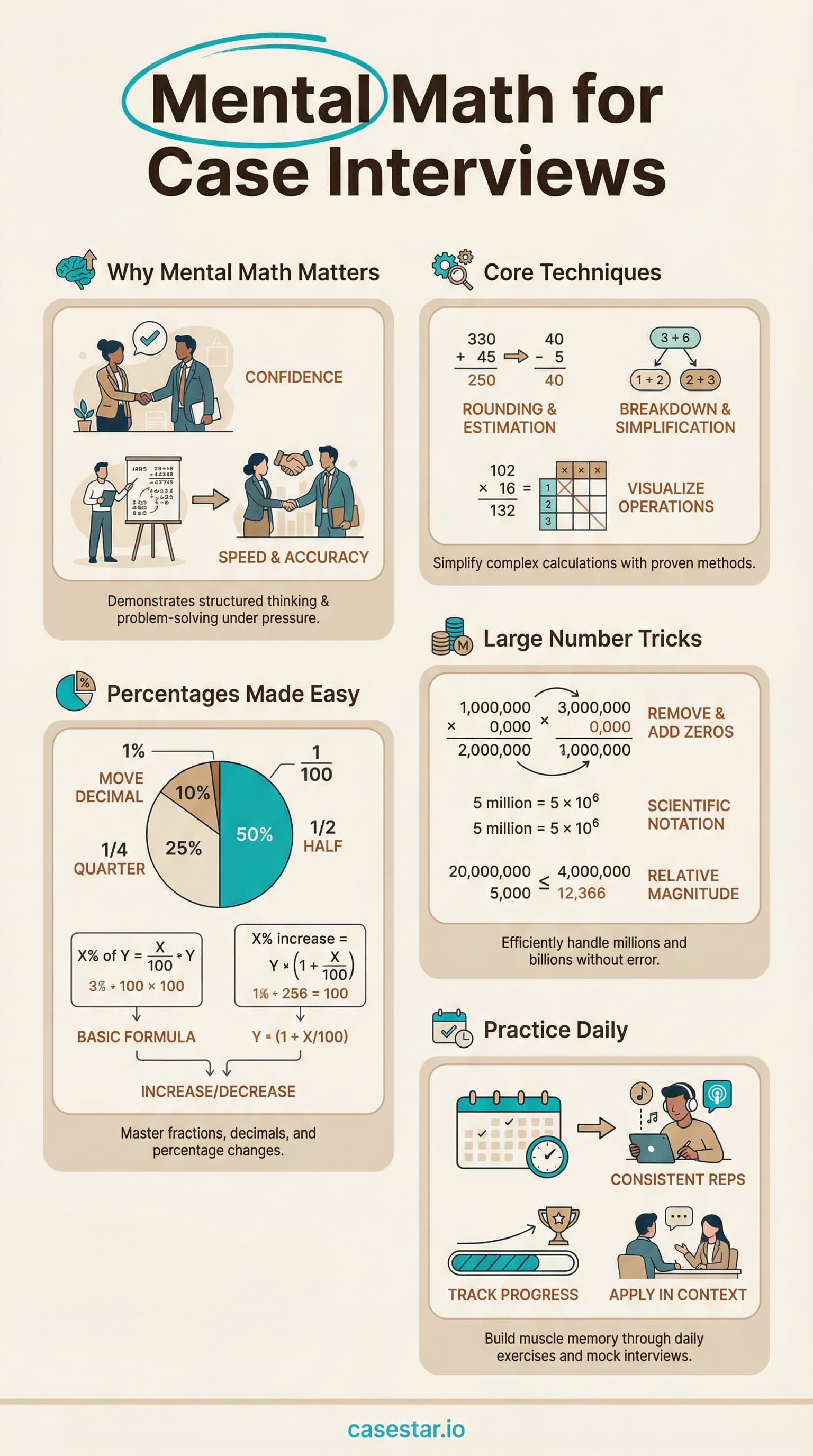
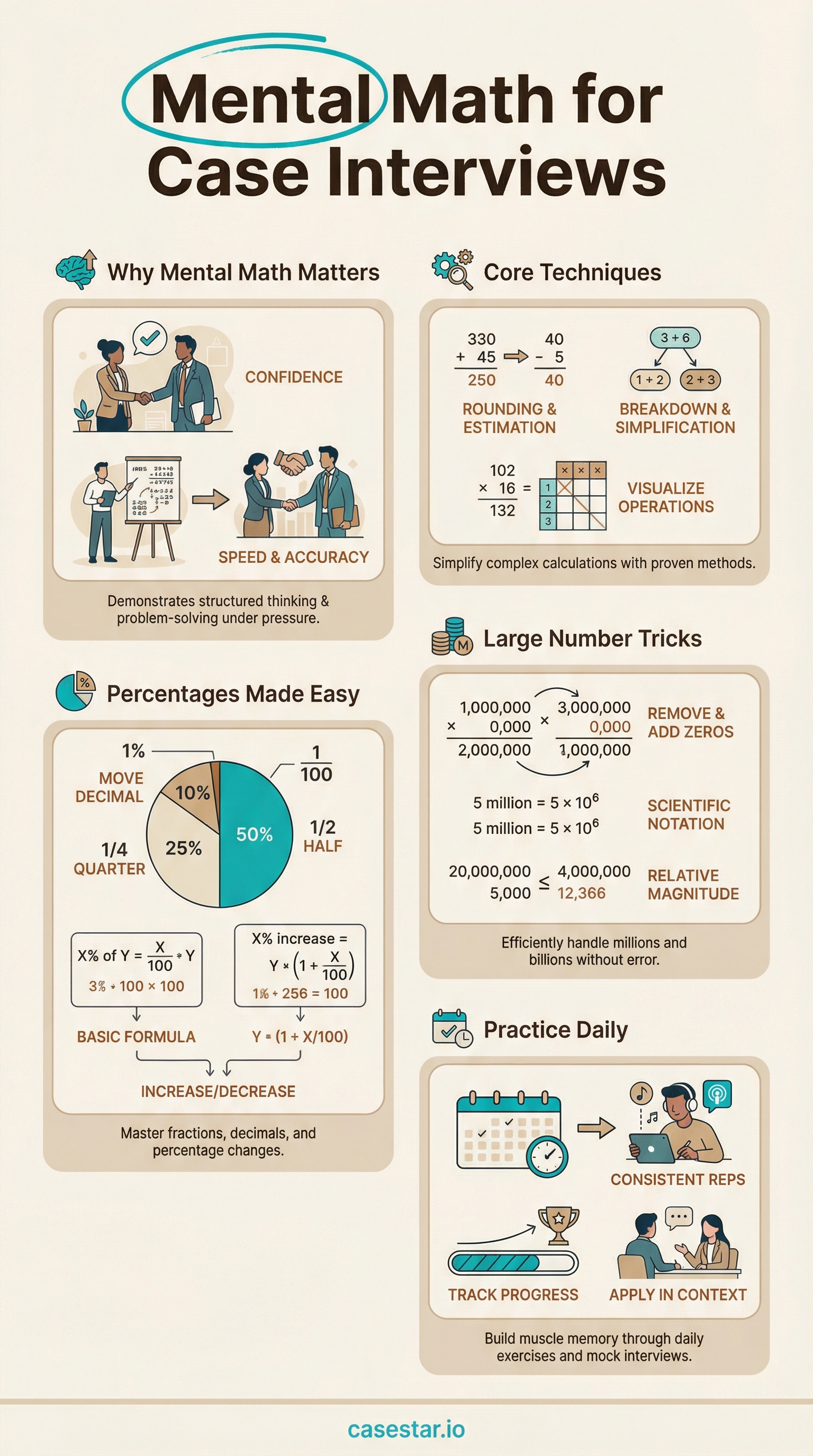
Summary: Mental math in case interviews is not about being a human calculator. It is about handling typical business calculations quickly and confidently while explaining your approach. Master rounding, break down complex calculations, and practice daily until the math becomes automatic.
Contents
Why mental math matters in case interviews
Every case interview involves calculations. You will estimate market sizes, calculate profitability, analyze growth rates, and work through break-even scenarios. The math itself is straightforward, but doing it while thinking, talking, and managing time pressure is what trips candidates up.
When you struggle with mental math, several things go wrong. You lose time. A calculation that should take 30 seconds stretches to 2 minutes. You break the conversational flow, turning a discussion into awkward silence while you compute. And you signal to interviewers that you might struggle with the quantitative work consultants do daily.
Strong candidates handle calculations smoothly. They round numbers sensibly, break complex math into simple steps, and explain their approach while computing. The math fades into the background, letting them focus on the actual business problem.
The good news: mental math is a trainable skill. Two to three weeks of focused practice can transform your speed and confidence. Unlike business intuition, which takes time to develop, calculation speed responds quickly to deliberate practice.
Core techniques
1. Round aggressively
In case interviews, precision matters less than speed and directional accuracy. Round numbers to make calculations manageable.
Example:
Instead of calculating 17% of $847 million, calculate 17% of $850 million, or even simpler: 15% of $850 million plus a bit more. 15% of 850 = 127.5, so roughly $130-145 million.
Interviewers care that you get in the right ballpark. Saying "approximately $140 million" is better than spending 90 seconds calculating $143.99 million exactly.
2. Break down complex calculations
Never try to compute everything in one step. Split calculations into pieces you can handle.
Example:
To calculate 35 x 48, break it down:
- 35 x 48 = 35 x 50 - 35 x 2
- 35 x 50 = 1,750
- 35 x 2 = 70
- 1,750 - 70 = 1,680
This approach also helps you explain your work. Saying "I will round 48 to 50, multiply, then adjust" shows clear thinking.
3. Master percentage shortcuts
Percentages appear constantly in cases. Build a toolkit of shortcuts for common calculations.
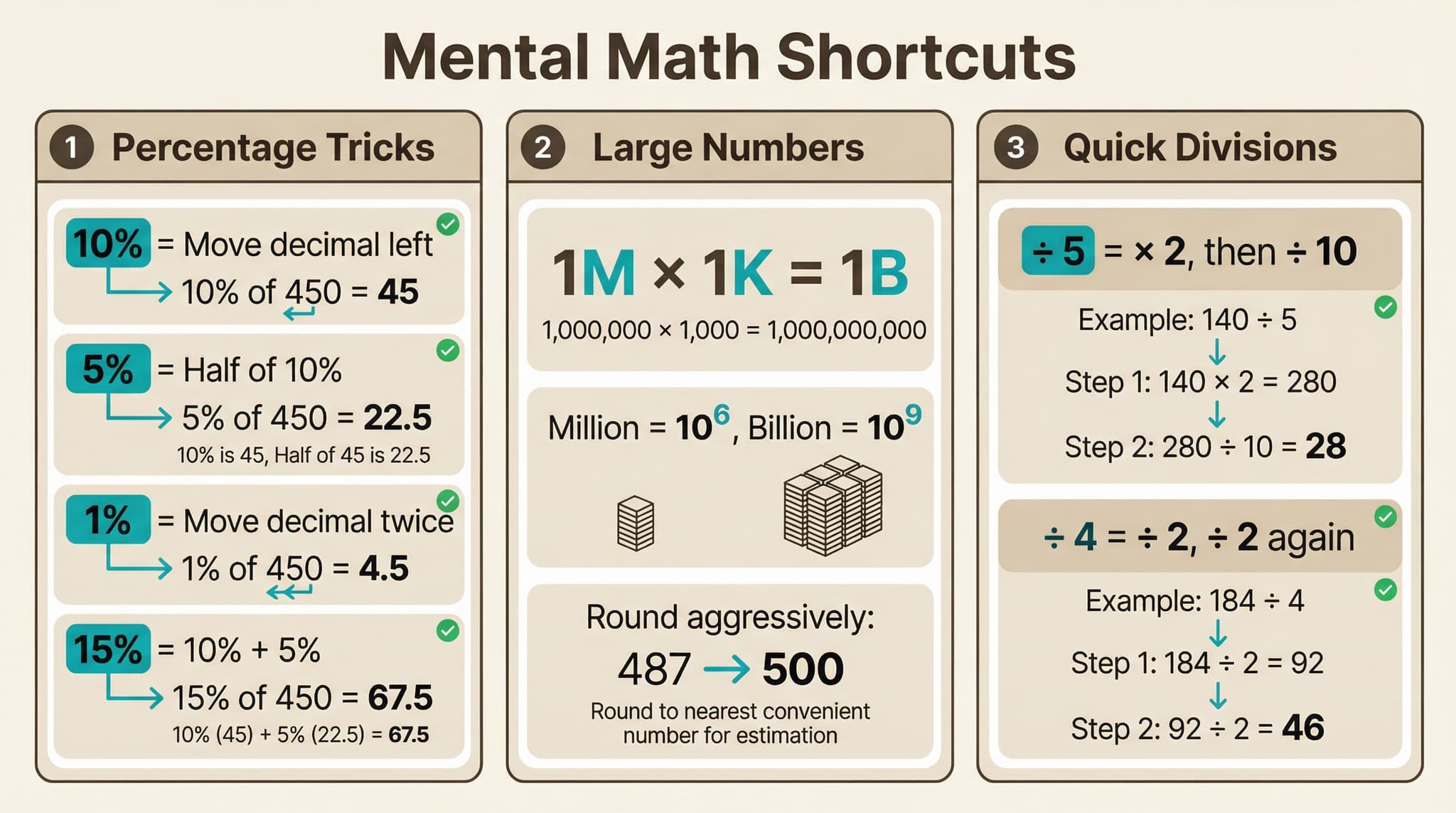
- 10%: Move decimal one place left (10% of 450 = 45)
- 5%: Half of 10% (5% of 450 = 22.5)
- 1%: Move decimal two places left (1% of 450 = 4.5)
- 25%: Divide by 4 (25% of 80 = 20)
- 33%: Divide by 3 (33% of 90 = 30)
- 15%: 10% + 5% (15% of 200 = 20 + 10 = 30)
Build any percentage from these building blocks. 23% = 20% + 3% = (2 x 10%) + (3 x 1%).
4. Handle large numbers with zeros
Case interviews involve millions and billions. Strip zeros, calculate the core math, then add zeros back.
Example:
$4.2 billion divided by 700,000 units:
- Rewrite: 4,200,000,000 / 700,000
- Cancel zeros: 4,200,000 / 700 = 42,000 / 7 = 6,000
- Answer: $6,000 per unit
Practice converting between thousands, millions, and billions until the zeros become automatic.
Calculation shortcuts table
Reference these shortcuts until they become automatic. Print this table and review it during your preparation.
| Calculation | Shortcut | Example |
|---|---|---|
| Multiply by 5 | Multiply by 10, divide by 2 | 48 x 5 = 480 / 2 = 240 |
| Multiply by 25 | Multiply by 100, divide by 4 | 36 x 25 = 3,600 / 4 = 900 |
| Divide by 5 | Multiply by 2, divide by 10 | 340 / 5 = 680 / 10 = 68 |
| Multiply by 9 | Multiply by 10, subtract original | 23 x 9 = 230 - 23 = 207 |
| Multiply by 11 | Multiply by 10, add original | 45 x 11 = 450 + 45 = 495 |
| Square numbers ending in 5 | n(n+1) then append 25 | 35² = 3x4=12, append 25 = 1,225 |
| Percentage change | (New - Old) / Old x 100 | 80 to 100 = 20/80 = 25% |
| Fractions to percentages | Know common conversions | 1/8 = 12.5%, 3/8 = 37.5% |
| Large number division | Cancel matching zeros first | 6M / 200K = 6,000 / 200 = 30 |
Common calculation types in cases
Market sizing math
Market sizing requires chaining multiple estimates together. The key is keeping track of units and order of magnitude.
Example: Annual revenue of coffee shops in Chicago
- Chicago population: ~3 million
- Coffee drinkers: 60% = 1.8 million
- Buy from shops (vs home): 40% = 720,000
- Cups per week: 3 = 2.16 million cups/week
- Weeks per year: 50 = 108 million cups/year
- Price per cup: $5 = $540 million
Learn more: Market sizing lesson
Profitability math
Profitability cases involve margins, break-even, and revenue/cost analysis.
Example: Break-even analysis
- Fixed costs: $2 million per year
- Price per unit: $50
- Variable cost per unit: $30
- Contribution margin: $50 - $30 = $20
- Break-even units: $2M / $20 = 100,000 units
Remember: Profit = Revenue - Costs = (Price x Quantity) - (Fixed + Variable). Master these relationships.
Growth and percentage changes
Growth rate calculations appear in nearly every case.
Example: Year-over-year growth
- Last year revenue: $80 million
- This year revenue: $92 million
- Change: $92M - $80M = $12M
- Growth rate: $12M / $80M = 15%
Shortcut: For small changes, percentage point differences are additive. 10% growth followed by 10% growth is approximately 21% total (not exactly 20% due to compounding).
How to practice
Daily drills (15-20 minutes)
Consistency beats intensity. Short daily sessions build speed better than occasional long cramming. Set a timer and work through calculation sets. Track your accuracy and speed over time.
Practice: Mental math drills
Talk through calculations
Practice calculating out loud, not silently. In the interview, you need to explain your approach while computing. If you only practice silently, you will struggle to do both simultaneously. Say things like: "I will round to 500, multiply by 12, that gives me 6,000…"
Use realistic case numbers
Practice with the types of numbers you will see in cases: revenue in millions, margins as percentages, market sizes in thousands or millions of people. Get comfortable with business-scale numbers, not textbook arithmetic.
Practice estimation
Before calculating precisely, estimate the answer. This builds intuition and helps you catch errors. If you estimate ~$500 million but calculate $5 billion, you know something went wrong.
Tip: Use everyday moments to practice. Estimate the bill before it arrives at dinner. Calculate tips without your phone. Estimate how many people are in a venue. These micro-practices add up.
Dealing with pressure
Interview pressure makes mental math harder. Your working memory shrinks, and calculations that feel easy at home become difficult when someone is watching and judging. Here is how to handle it.
Practice under time pressure
If you only practice in relaxed conditions, interview pressure will feel unfamiliar. Set timers during drills. Do practice cases with partners who push you. Make your practice harder than the real thing.
Write key numbers down
You are allowed pen and paper. Write down numbers the interviewer gives you so you do not have to hold them in memory while calculating. This frees mental resources for the math itself.
Take a breath before calculating
When given a calculation, take 2-3 seconds to plan your approach before diving in. This prevents the panicked rushing that causes errors. Say: "Let me work through this…" to buy yourself a moment.
Handle mistakes gracefully
Everyone makes calculation errors. The interviewer is watching how you handle it. If you catch a mistake, acknowledge it calmly: "Actually, let me recalculate that. I think I dropped a zero." This shows self-awareness, not weakness.
Common mistakes
Trying to be too precise
Calculating 17.3% of $847.2 million to exact precision wastes time and adds no value. Round to 17% of $850 million. The interview is about business judgment, not arithmetic precision.
Losing track of zeros
The most common error. Dropping or adding a zero changes your answer by 10x. Write out the full numbers when needed, and double-check unit conversions. Million to thousand means adding three zeros.
Calculating silently
Long silences while you compute create awkward pauses and hide your thinking. Talk through your approach: "So I need to find 15% of $200 million. That is $20 million plus half, so $30 million."
Not sanity-checking results
Always ask: does this answer make sense? If you calculate that a coffee shop makes $50 million in revenue, something is wrong. Build intuition for reasonable business numbers.
Skipping mental math practice
Many candidates practice only full cases, doing maybe one calculation per case. Fifteen minutes of dedicated drills gives you 20+ calculations. Target this skill directly.
FAQ
How important is mental math in case interviews?
Essential. Every case involves calculations, and struggling with math breaks your flow and eats into limited time. Strong candidates handle calculations smoothly while explaining their approach.
What level of math is required?
Basic arithmetic: percentages, multiplication, division. No calculus or statistics. The challenge is speed and accuracy under pressure, not mathematical complexity.
How long does it take to improve?
Most candidates see significant improvement in 2-3 weeks of daily practice (15-20 minutes per day). Consistency matters more than session length.
Can I use a calculator?
No. Consulting firms expect mental math or pen-and-paper calculations. Practice until typical case calculations feel natural without electronic help.
What if I make a mistake during the interview?
Acknowledge it and correct it calmly. Say something like: "Let me double-check that. I think I made an error." Interviewers expect some mistakes; they want to see how you handle them.
Should I round numbers in the interview?
Yes, within reason. Say: "I will round this to make the math cleaner" so the interviewer knows you are approximating deliberately. Round to numbers that are easy to work with (multiples of 5, 10, 25).
Practice mental math
Build speed and confidence with CaseStar's mental math drills. Timed practice with instant feedback.
Start practicingSave this guide
Updated April 2026