McKinsey Case Interview Guide (2026 Edition)
Updated April 2026·18 min read
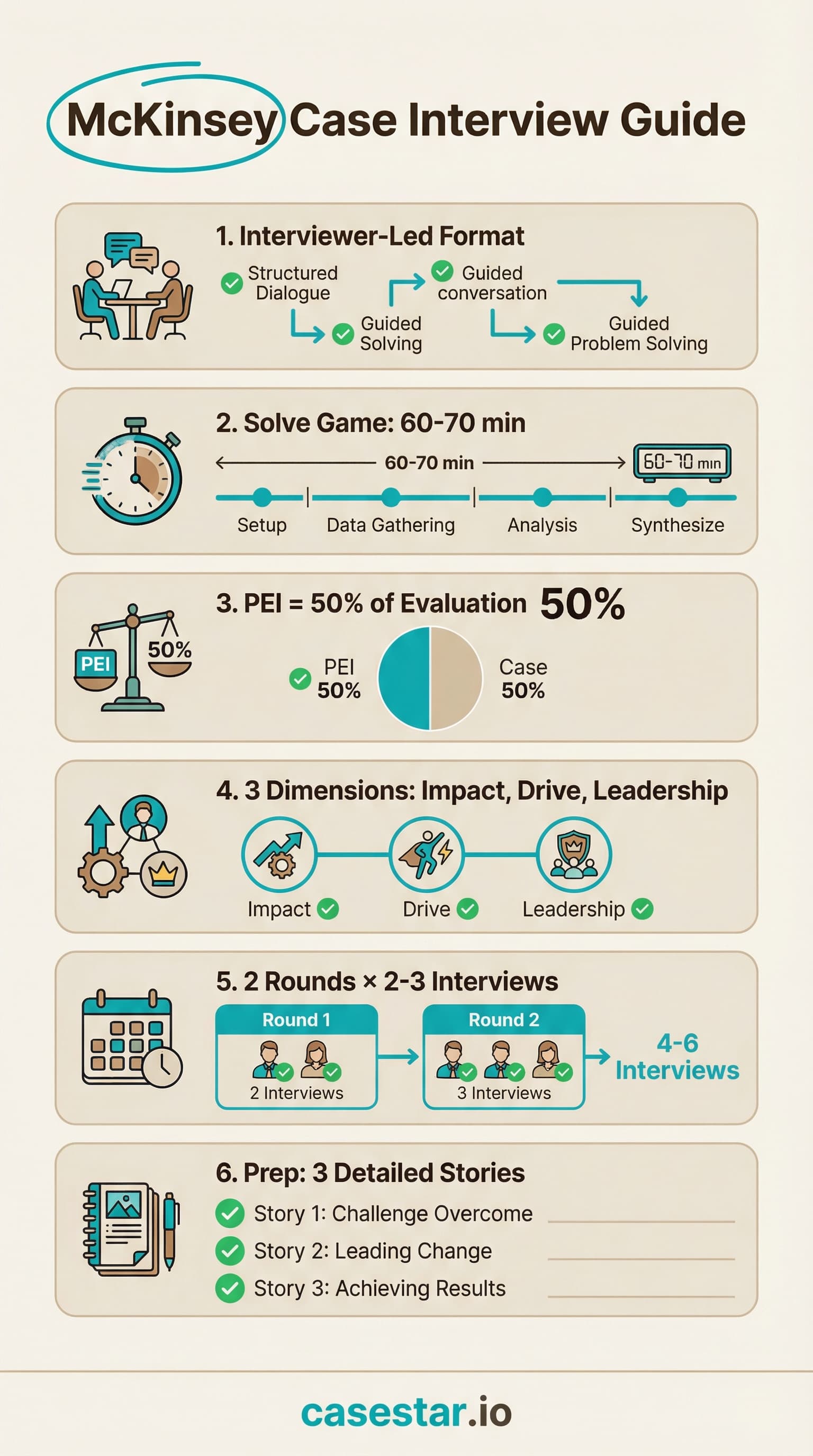
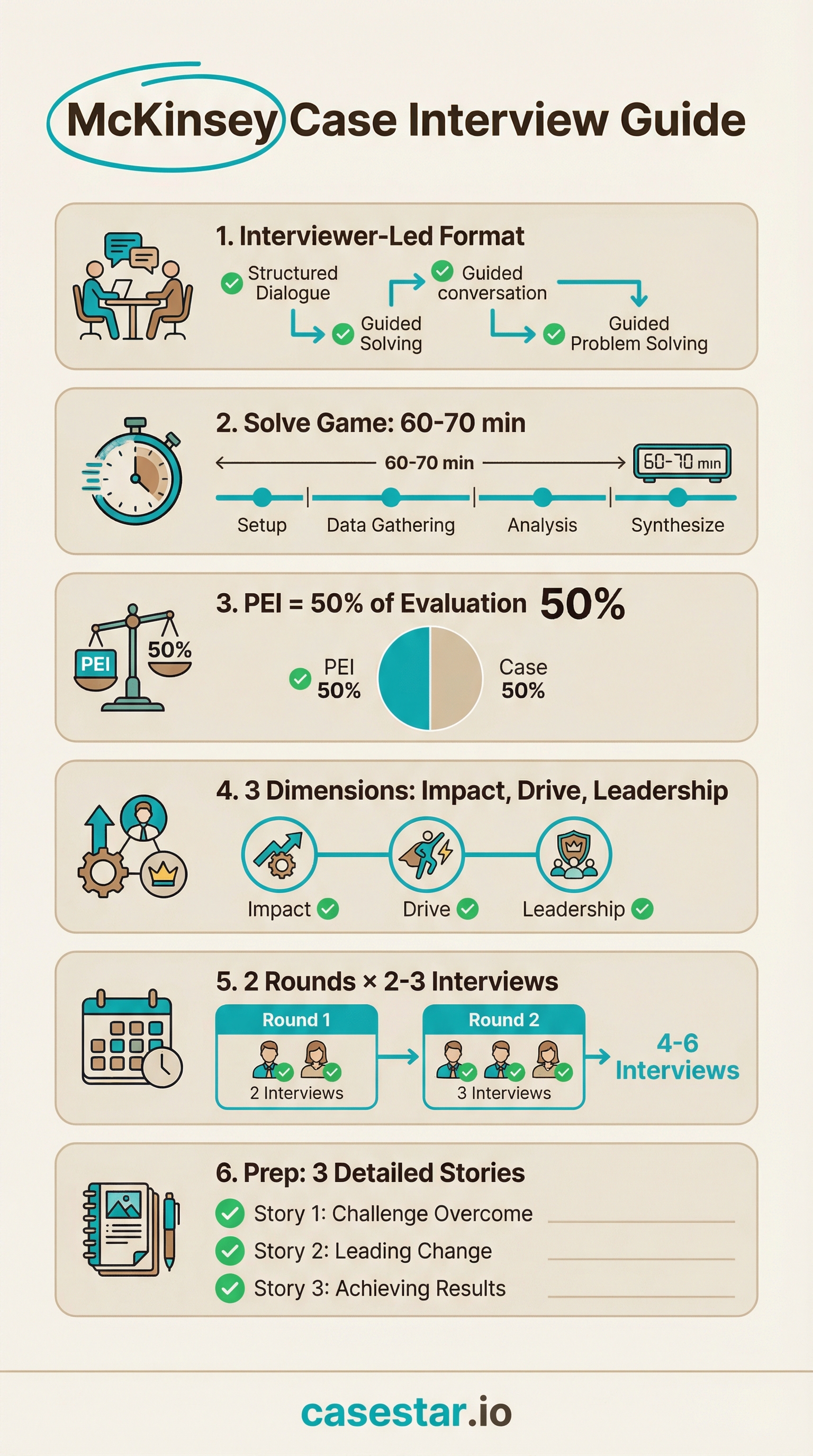
McKinsey interviews have 2 rounds with 4-6 total interviews, each combining an interviewer-led case (25 min) with a PEI behavioral deep-dive (20 min). The Solve assessment is typically required before interviews (coverage varies by region and intake year — confirm with your McKinsey recruiter). Unlike BCG and Bain, McKinsey controls the case pace—you respond to their questions rather than driving the analysis.
Executive Summary: The McKinsey interview is distinct for its interviewer-led cases (where they direct the flow) and the rigorous Personal Experience Interview (PEI), which dictates ~50% of your score. For 2026, expect continued emphasis on the Solve game digital assessment and potentially new AI-driven pilots like "Lilli."
Official Resources:McKinsey Careers & Interview Preparation
Contents
What is the McKinsey interview process?
McKinsey's interview process is arguably the most standardized of the MBB firms. It rigidly tests two things: superior problem-solving skills (via the Case) and leadership potential (via the PEI).
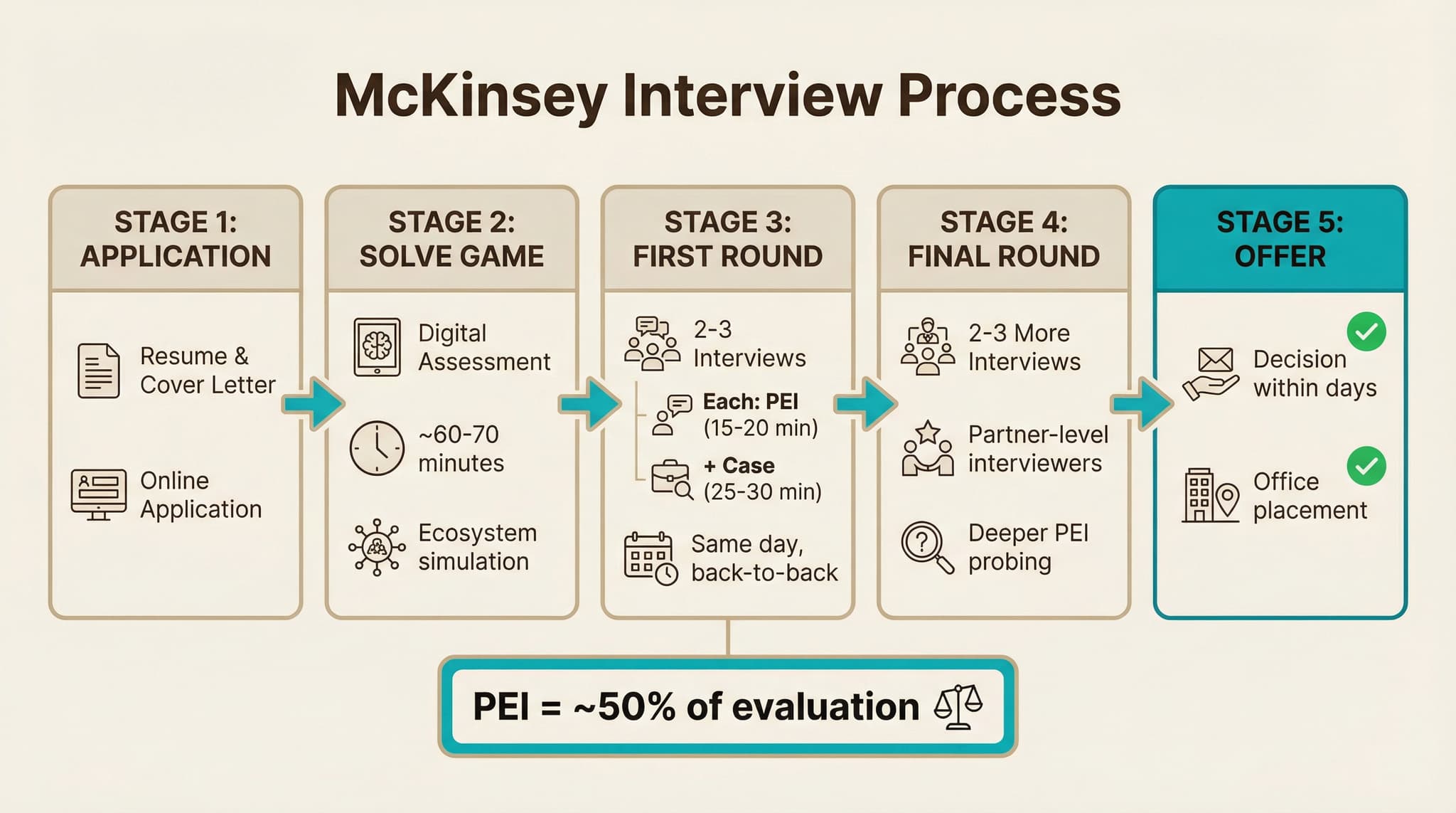
The 2026 cycle typically follows this sequence:
- Resume Screening: High academic and professional bars.
- McKinsey Solve (Digital Assessment): A gamified cognitive test (60-70 mins across 2 modules: Sea Wolf ~30 + Redrock ~35).
- Round 1: 2 interviews (often virtual, sometimes back-to-back) with Associates or Engagement Managers.
- Round 2 (Final): 2-3 interviews with Partners, focusing heavily on structured thinking and client readiness.
What is the Interviewer-led format?
Unlike BCG or Bain, where you (the candidate) drive the case, McKinsey uses an interviewer-led format. This means the interviewer holds the map.
Command & Control Style
You will still set the initial structure. However, immediately after, the interviewer will say:"Let's put that aside for a moment. I specifically want to look at the pricing risks. What are three factors here?"
This can feel jarring if you are used to "driving" the case. Your job is not to fight for the wheel, but to dive deep into the specific hole they point to, solve it, and then wait for the next direction.
A typical McKinsey case flows like this:
- Problem statement - Interviewer presents the case (1-2 minutes)
- Clarifying questions - You ask about objectives and context (1-2 minutes)
- Structure - You present your framework (2-3 minutes)
- Directed analysis - Interviewer asks specific questions, may provide data (15-20 minutes)
- Recommendation - You synthesize and conclude (2-3 minutes)
The directed analysis phase is where McKinsey cases feel different. The interviewer might ask: "What would you want to know about the competitive landscape?" After you answer, they might jump to: "Here is some data on customer segments. What do you see?" You do not control the sequence.
How to handle redirects
Being redirected does not mean you answered wrong. McKinsey interviewers have a specific path through the case they want to cover. They redirect everyone. The key is to:
- Follow their lead without appearing thrown off
- Answer the question they ask, not the one you expected
- Connect your current answer back to the overall problem when relevant
- Avoid saying "but I wanted to explore…"
Practice tip: When doing mock cases, have your partner interrupt you and redirect frequently. This builds comfort with the interviewer-led format. Many candidates prepare with candidate-led cases and then feel flustered when McKinsey interviewers take control.
Personal Experience Interview (PEI)
The PEI is a 15-20 minute behavioral interview that happens in each McKinsey interview. It is not small talk or a warm-up. It is a rigorous evaluation of your leadership capabilities based on past behavior. You should practice telling your stories out loud using our specialized PEI practice tool.
The four PEI dimensions (2025 Update)
McKinsey evaluates four core dimensions. Each interviewer will typically focus on one dimension and probe it deeply. McKinsey updated the PEI framework in mid-2025 — older prep materials may still reference the earlier three-dimension model (Personal Impact / Entrepreneurial Drive / Inclusive Leadership).
Connection
This dimension assesses your ability to listen, demonstrate empathy, and build relationships. McKinsey consultants need to understand stakeholders deeply before persuading them.
Example prompt: "Tell me about a time when you built trust with someone whose perspective differed from yours."
Drive
A time you pursued an ambitious goal and overcame obstacles to deliver. This dimension emphasizes achievement orientation and the persistence required to push through setbacks.
Example prompt: "Tell me about a time when you set a stretch goal and overcame obstacles to reach it."
Leadership
How you influence others, guide teams, and challenge the status quo. This tests whether you can mobilize people toward a shared outcome — including when it requires pushing back against the established path.
Example prompt: "Tell me about a time when you led others to challenge how something was being done."
Growth
Learning agility, self-awareness, and development orientation. It tests how you reflect on feedback, identify gaps, and deliberately develop — yourself and others — in new or ambiguous circumstances.
Example prompt: "Describe a time when feedback changed how you approached a problem."
How the PEI works
The interviewer picks one dimension and asks you to share a specific story from your past. You have about 2 minutes to give your initial answer, then they spend 10-15 minutes asking follow-up questions.
These follow-ups are probing. Expect questions like:
- "What exactly did you say in that conversation?"
- "How did they respond to that?"
- "Why did you choose that approach?"
- "What would you do differently?"
- "What was the specific outcome?"
The depth of questioning makes it hard to fabricate or embellish. Use real stories where you genuinely played a central role.
Preparing your stories
Prepare at least 4 stories, one for each dimension. Each story should have:
- Specific situation: What was the context? What was at stake?
- Your actions: What exactly did you do? What did you say?
- Quantifiable results: What changed? What were the metrics?
- Reflection: What did you learn? What would you do differently?
Practice telling each story out loud until it flows naturally. Then have someone drill you with follow-up questions. The goal is to know your stories well enough to answer any question about the details.
The Solve game
The Solve game (formerly the Problem Solving Game or PSG) is McKinsey's digital assessment. You complete it after passing the resume screen and before your first interview. It takes 60-70 minutes across 2 modules (Sea Wolf ~30 + Redrock ~35). This section covers the essentials — for module-by-module mechanics, scoring penalties, and a full prep plan, see the complete McKinsey Solve guide with Sea Wolf and Red Rock breakdowns.
The assessment modules (2026 Update)
Ecosystem Management (Retired Module)
The classic terrain-building game. Note: McKinsey retired this module globally in mid-2025 — current candidates receive Sea Wolf and Red Rock. Documented here for anyone cross-checking older prep materials.
Red Rock Study (Data Analysis)
The most core module. You act as a researcher, collecting data, performing calculations (often involving percentages and ratios), and visualizing findings to answer specific business questions.
Sea Wolf / Ocean Cleanup (New)
A newer addition where you evaluate microbes to clean up ocean sites. You must categorize microbes based on characteristics to maximize treatment effectiveness. This tests rapid categorization and decision accuracy.
Preparing for Solve
The Solve game is designed to be difficult to prepare for directly. It tests underlying cognitive abilities rather than learnable content. That said, some preparation helps:
- Practice mental math: Quick calculations under time pressure are essential for the data analysis portion. Daily math drills help.
- Get familiar with data interpretation: Practice reading charts, identifying trends, and drawing quick conclusions.
- Play logic games: Games that require systems thinking (like ecosystem simulators or resource management games) can build relevant skills.
- Take the game fresh: Do it when you are mentally sharp, not tired. Find a quiet space with no interruptions.
Note: McKinsey regularly updates the Solve game. The specific games may change, but the core skills tested (problem-solving, pattern recognition, data analysis) remain consistent. Before test day, practice the Sea Wolf module free or run a timed Red Rock data-analysis session so the mechanics don't cost you time.
Interview rounds
McKinsey typically conducts interviews in two rounds. The structure varies by office and hiring needs, but the general pattern is consistent.
First Round
2 interviews, typically with Business Analysts, Associates, and Engagement Managers. Each interview includes a case and PEI. Interviews may happen on the same day or spread across 1-2 weeks.
- Focus on fundamental problem-solving skills
- Cases may be slightly more structured
- PEI covers all four dimensions across interviews
Final Round
2-3 interviews with Partners and Associate Partners. The format is similar (case + PEI) but the bar is higher. Partners often give cases from their actual client work.
- More ambiguous problems with less structure
- Greater emphasis on business judgment
- Partners evaluate client-readiness
Between rounds
McKinsey interviewers submit independent evaluations. After first round, these are combined to make a decision. If you pass, the final round is typically scheduled within 1-3 weeks.
Decisions are usually communicated within a week of each round. Some offices are faster. If you do not hear back within 10 days, follow up with your recruiter.
McKinsey vs BCG vs Bain
If you are interviewing at multiple MBB firms, understanding these differences helps you adjust your preparation.
| Aspect | McKinsey | BCG | Bain |
|---|---|---|---|
| Case style | Interviewer-led | Candidate-led | Candidate-led |
| Who controls pace | Interviewer directs | You drive analysis | You drive analysis |
| Behavioral interview | PEI: separate 15-20 min section (~50% of eval) | Fit questions woven in (~30% of eval) | Fit questions woven in (~30% of eval) |
| Online assessment | Solve game (Sea Wolf + Redrock) | Casey (AI chatbot case) | SOVA (aptitude + video) |
| Framework role | Starting point, then they redirect | Primary structure throughout | Primary structure throughout |
| Math emphasis | High - direct calculation questions | Medium - embedded in case flow | Medium - embedded in case flow |
| Typical feel | Rapid Q&A, frequent pivots | Structured exploration | Conversational, collaborative |
Adjusting your preparation
If interviewing at all three firms:
- For McKinsey: Practice being interrupted. Prepare 4 detailed PEI stories (one per dimension). Get comfortable answering direct questions without your framework as a crutch.
- For BCG/Bain: Practice driving the case yourself. Get comfortable deciding what to analyze next. Prepare shorter behavioral examples for fit questions.
- For all three: Mental math and structuring skills are universal requirements.
How to prepare for McKinsey
McKinsey preparation requires specific focus beyond general case prep. Here is how to allocate your time.
1. Case interview preparation (50% of time)
Focus on adapting to the interviewer-led format:
- Practice redirects: Have practice partners interrupt you mid-analysis and send you to a different area.
- Answer direct questions: McKinsey interviewers often ask pointed questions like "What is 15% of $340 million?" Practice answering these quickly while explaining your approach.
- Build flexible frameworks: Your initial structure is a starting point. Do not cling to it. Learn the principles behind good structuring so you can adapt.
- Drill mental math separately: Daily practice (15-20 minutes) with percentages, large number multiplication, and division. Do these out loud.
2. PEI preparation (30% of time)
The PEI is roughly half your evaluation. Treat it seriously:
- Prepare 4 stories: One for each dimension (Connection, Drive, Leadership, Growth).
- Add specific details: Names, dates, numbers, exact words you said. Vague stories fail the probing.
- Prepare for follow-ups: Practice answering detailed questions about your stories. Have a friend drill you.
- Include metrics: "We increased revenue by 23%" is better than "We improved the business."
- Practice delivery: Tell each story out loud 10+ times until it flows naturally without sounding rehearsed.
3. Solve game preparation (10% of time)
You cannot study content for the Solve game, but you can prepare your approach:
- Practice data interpretation and chart reading
- Play games that require systems thinking
- Build mental math speed with focused drills
- Get good sleep the night before
- Take the test when you are mentally fresh
4. Business knowledge (10% of time)
You do not need to be an expert, but basic business intuition helps:
- Read business news regularly (WSJ, Economist, FT)
- Understand common business metrics (margin, CAGR, market share)
- Know basic industry dynamics for common case sectors
Weekly practice schedule for McKinsey
- Daily: Mental math drills (15-20 min)
- 3x per week: Full case practice with interviewer-led format
- 2x per week: PEI story practice with follow-up drilling
- 2x per week: Structuring exercises (10 min each)
- Daily: Business news reading (15 min)
FAQ
What is the McKinsey Solve game?
An online assessment with two current games: Sea Wolf (a microbe-combination task across ocean sites) and Redrock Study (data analysis questions). The Ecosystem Building scenario that appeared in earlier versions was phased out globally in mid-2025. The full assessment takes 60-70 minutes and tests problem-solving and pattern recognition. You cannot directly study for it, but mental math practice helps.
What is the PEI and how important is it?
The Personal Experience Interview is a 15-20 minute behavioral interview that accounts for roughly 50% of your evaluation. The interviewer picks one of four dimensions and probes deeply into a specific story from your past. Prepare 4 stories with specific details and metrics.
How is the interviewer-led format different?
In interviewer-led cases, McKinsey controls the direction. You present an initial framework, but then they direct you to specific questions and analyses. You cannot rely on your framework as a crutch. Practice being interrupted and redirected.
How many interview rounds are there?
Typically two rounds. First round has 2 interviews with junior to mid-level consultants. Final round has 2-3 interviews with partners. Each interview includes a case (25-35 minutes) and PEI (15-20 min), totalling ~45 minutes when PEI is bundled.
What are the four PEI dimensions?
Connection (listening, empathy, relationships), Drive (achievement, overcoming obstacles), Leadership (influencing others, guiding teams, challenging the status quo), and Growth (learning agility, self-awareness, development). Each interviewer focuses on one dimension. Prepare a detailed story for each.
Should I prepare differently for McKinsey vs BCG/Bain?
Yes. For McKinsey, practice interviewer-led cases with frequent redirects. Prepare 3 deep PEI stories. For BCG/Bain, practice driving candidate-led cases and prepare shorter fit examples. Mental math and structuring are important for all three.
Practice for McKinsey interviews
CaseStar offers voice-powered case and behavioral interview practice with instant feedback.
Start practicingPractice the McKinsey Solve
Free, source-caveated simulators that train Solve-style mechanics without claiming to clone McKinsey's platform.
Save this guide
Updated April 2026