Math Narration: How to Talk Through Calculations
Updated January 2026·12 min read
"I bombed the math." This appears in nearly every failed case interview debrief. But here's the thing: most math "failures" aren't about calculation ability. They're about silent struggling, unclear reasoning, or panicking after errors.
This guide teaches you to narrate math clearly—which buys you time, shows your logic, and lets you recover gracefully when things go wrong.
Contents
Why narrating math matters
In real consulting, you explain your analysis to clients. Case interviews test whether you can do this. The interviewer needs to follow your reasoning—not just see your answer.
1. It shows your logic
A wrong answer with clear reasoning often scores better than a right answer with unclear process. Interviewers evaluate how you think, not just what you calculate.
2. It buys you time
Talking through your approach gives your brain time to work. "So I need to find revenue, which is price times quantity…" isn't filler—it's thinking out loud while your mind processes.
3. It enables course correction
If you're going down a wrong path, the interviewer can redirect you early. Silent calculation means you could spend 3 minutes on an error before anyone notices.
4. It reduces perceived difficulty
When candidates go silent, interviewers assume they're struggling—even if they're not. Narrating projects confidence and control.
The 4-step narration framework
Use this structure for every calculation. It takes 10-15 seconds longer than silent math but dramatically improves how you're perceived.
1
State your approach
Before calculating, say what you're going to do.
"To find the market size, I'll estimate the number of households and multiply by average annual spending."
2
Round and simplify
Explicitly state your rounding. This shows you're being practical, not sloppy.
"I'll round 127 million households to 130 million to make the math cleaner."
3
Calculate step by step
Narrate each operation as you do it. Write intermediate results.
"130 million times $500 per year… that's 130 times 500, which is 65,000… so $65 billion."
4
Sanity check the result
Compare your answer to a benchmark. This catches order-of-magnitude errors.
"$65 billion seems reasonable for the US pet food market—I've seen similar consumer goods markets in that range."
Examples: Good vs bad narration
Question: "The client has 1,200 stores doing $850,000 in annual revenue each. What's the total revenue?"
❌ Bad narration (or no narration)
*silence for 30 seconds*
"Um… I got… 1.02 billion?"
Problems: Silent struggle, uncertain delivery, no logic shown, interviewer can't evaluate reasoning.
✅ Good narration
"So I need to multiply 1,200 stores by $850K per store. Let me round $850K to $900K to simplify—that'll give me a slight overestimate.
1,200 times $900K… I'll break this down. 1,200 times 900 is 1,200 times 9 times 100, which is 10,800 times 100, so 1.08 million. Times 1,000 for the 'K'—so about $1.08 billion.
That feels right for a mid-sized retail chain. Walmart does $600 billion, so $1 billion for 1,200 stores is reasonable."
Why it works: Shows approach, justifies rounding, walks through steps, sanity-checks result.
Note: The exact answer is $1.02 billion. The "good" example got $1.08 billion due to rounding—and that's perfectly fine. Showing clear logic with approximate numbers beats struggling silently for the exact answer.
Preventing errors under pressure
Case interview math isn't hard—it's the pressure that causes errors. These techniques reduce mistakes:
Round aggressively
487 → 500. 1,247 → 1,250 or 1,200. 18% → 20%. Simpler numbers mean fewer calculation steps and fewer places to make errors. Always state that you're rounding.
Write intermediate steps
Don't hold numbers in your head. Write them down. This frees mental capacity for the next step and gives you a record to check.
Break complex calculations into steps
Instead of 1,200 × 850, do 1,200 × 800 = 960,000, then 1,200 × 50 = 60,000, then add. More steps, but each step is easier.
Use benchmarks constantly
Know common reference points: US population (~330M), global (~8B), average household income (~$75K), typical margins by industry. If your answer is wildly off from benchmarks, you made an error.
Check units throughout
Many errors come from unit confusion—millions vs billions, percentages vs decimals. Say units out loud: "That's 50 million dollars, not 50 billion."
See our mental math guide for specific calculation techniques and shortcuts.
Recovering from mistakes
You will make errors. Everyone does. What matters is how you handle them.
When you catch your own error
This is actually good—it shows self-awareness. Simply say: "Wait, let me redo that— I think I made an error in the multiplication." Then correct it.
"Actually, I dropped a zero there. 120 times 500 is 60,000, not 6,000. So the answer should be $60 million."
When the interviewer catches it
Don't apologize profusely or panic. Thank them briefly, then correct:
"You're right, thank you. Let me redo that step. 15% of 80 is 12, not 8. So the final number should be…"
When you're not sure if you made an error
If the result seems off but you're not sure why, say so:
"I got $2 billion, but that feels high for this market. Would you like me to walk through the calculation again to check?"
Key mindset shift
A recovered error is not a failed calculation. Interviewers expect errors—they're watching how you handle them. Stay calm, acknowledge briefly, correct, and move on. Don't dwell or apologize repeatedly.
How to practice
Math narration feels unnatural at first. You need to practice it explicitly.
1. Narrate everyday calculations
Split a restaurant bill out loud. Calculate tips verbally. Estimate grocery totals while shopping. Build the habit of narrating math in low-stakes situations.
2. Record yourself during practice cases
Listen back specifically for math sections. Are you narrating or going silent? Is your reasoning clear? Do you sanity-check?
3. Do timed mental math drills—out loud
Use CaseStar's mental math drills and force yourself to explain each step. Speed comes after clarity.
4. Practice error recovery specifically
Intentionally make errors during practice and rehearse your recovery. "Let me redo that…" should feel natural, not panicked.
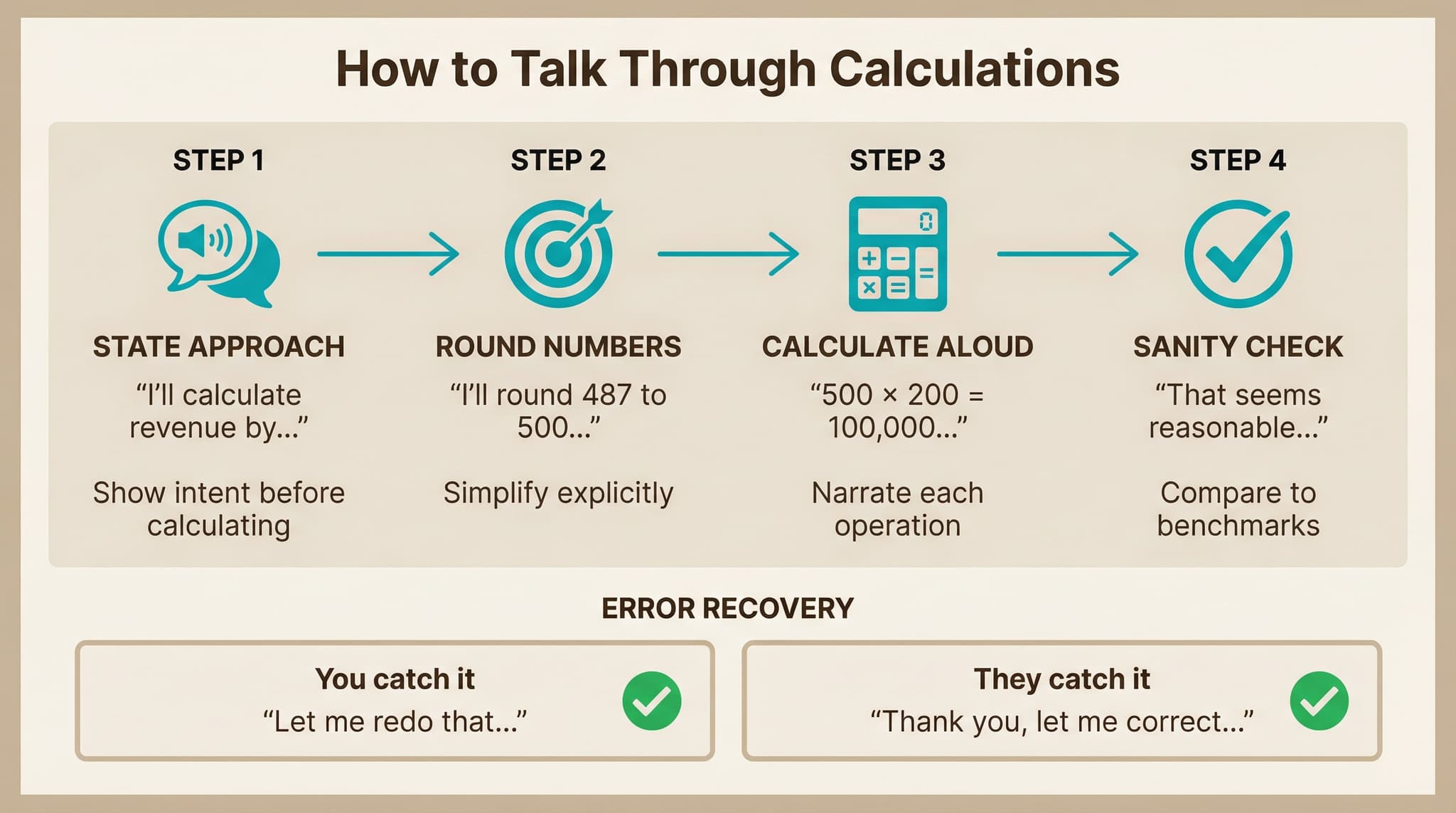
Quick reference: The 4-step framework
- State approach: "I'll calculate revenue by multiplying units by price…"
- Round and simplify: "I'll round 487 to 500 to simplify…"
- Calculate step by step: "500 times 200 is 100,000…"
- Sanity check: "$100K per store seems reasonable for this industry…"
Practice math narration with instant feedback
CaseStar's voice practice lets you work through calculations out loud and get feedback on your clarity and reasoning.
Try it freeRelated guides
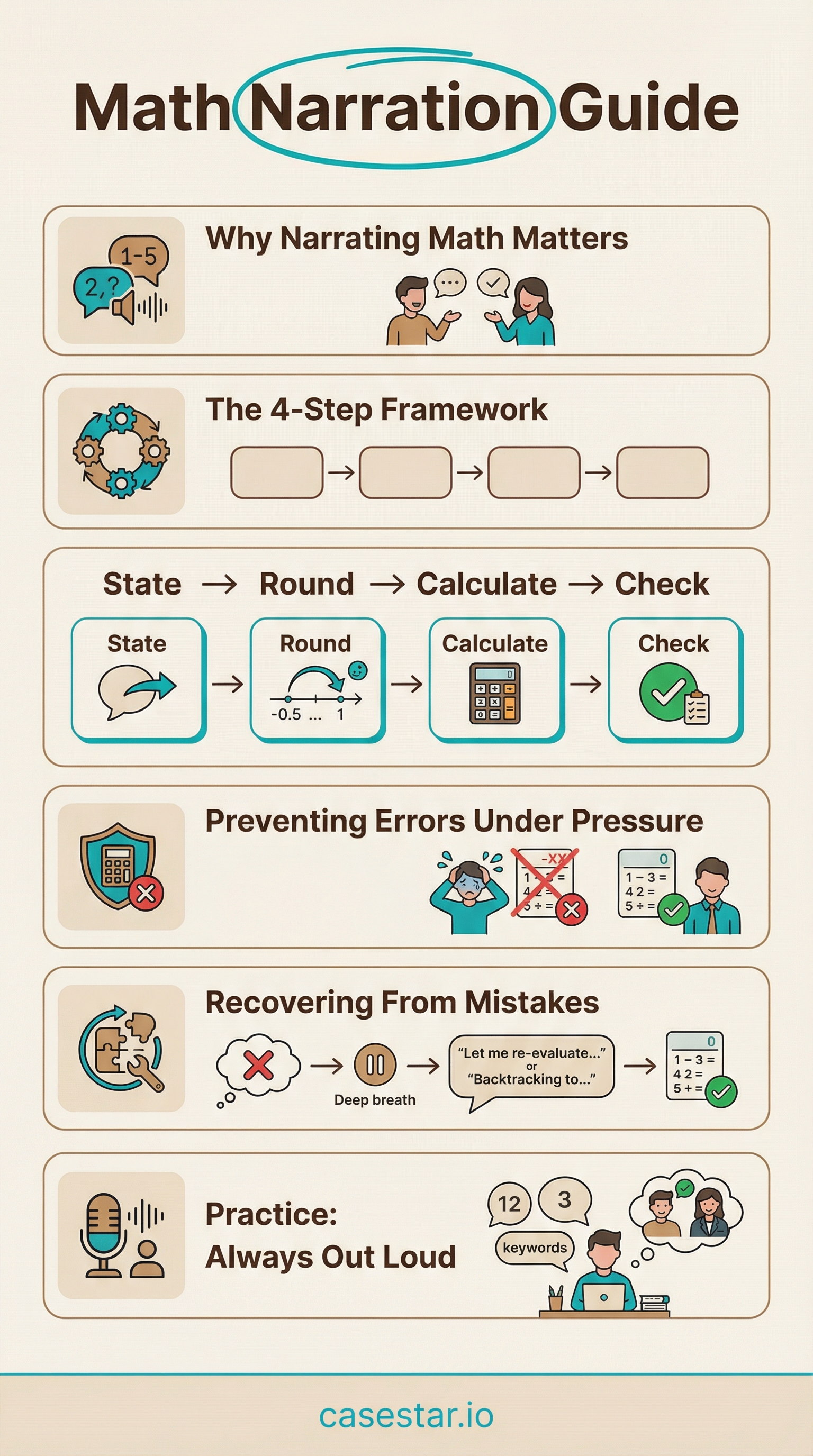
Save this guide
Download the infographic for quick reference before interviews.

Last updated: January 2026