Behavioral Interview & McKinsey PEI Guide (2026)
Updated April 2026·16 min read
Executive Summary: Behavioral interviews test how you have handled real situations. At McKinsey, the PEI is a dedicated 20-minute deep dive worth ~50% of your evaluation. At BCG and Bain, fit questions are woven throughout. Success requires preparing 4-6 detailed stories covering the four McKinsey PEI dimensions: Connection, Drive, Leadership, and Growth.
Contents
What do behavioral interviews test?
Case interviews test your analytical thinking. Behavioral interviews test something different: how you work with people, handle challenges, and drive results in messy real-world situations. Both matter equally for consulting success.
Consulting firms look for specific traits in behavioral interviews:
- Influence: Can you persuade clients and stakeholders who may be skeptical or resistant?
- Leadership: Can you guide teams, especially when you lack formal authority?
- Drive: Do you take initiative and push through obstacles without being told?
- Resilience: How do you handle setbacks, conflict, and ambiguity?
- Self-awareness: Do you learn from experience and understand your own strengths and weaknesses?
The underlying logic is simple: past behavior predicts future behavior. If you have demonstrated these traits before, you are likely to demonstrate them again as a consultant. This is why interviewers probe for specific details about what you actually did, not what you would hypothetically do.
Many candidates underestimate behavioral interviews. They spend weeks on case prep and hours on behavioral prep. This imbalance shows. At McKinsey, the PEI accounts for roughly half your evaluation. Failing the behavioral portion will end your candidacy even if your case performance is strong.
How does McKinsey PEI differ from BCG/Bain fit?
The three MBB firms all assess behavioral competencies, but their formats differ significantly. Understanding these differences helps you prepare appropriately for each.
McKinsey: Personal Experience Interview (PEI)
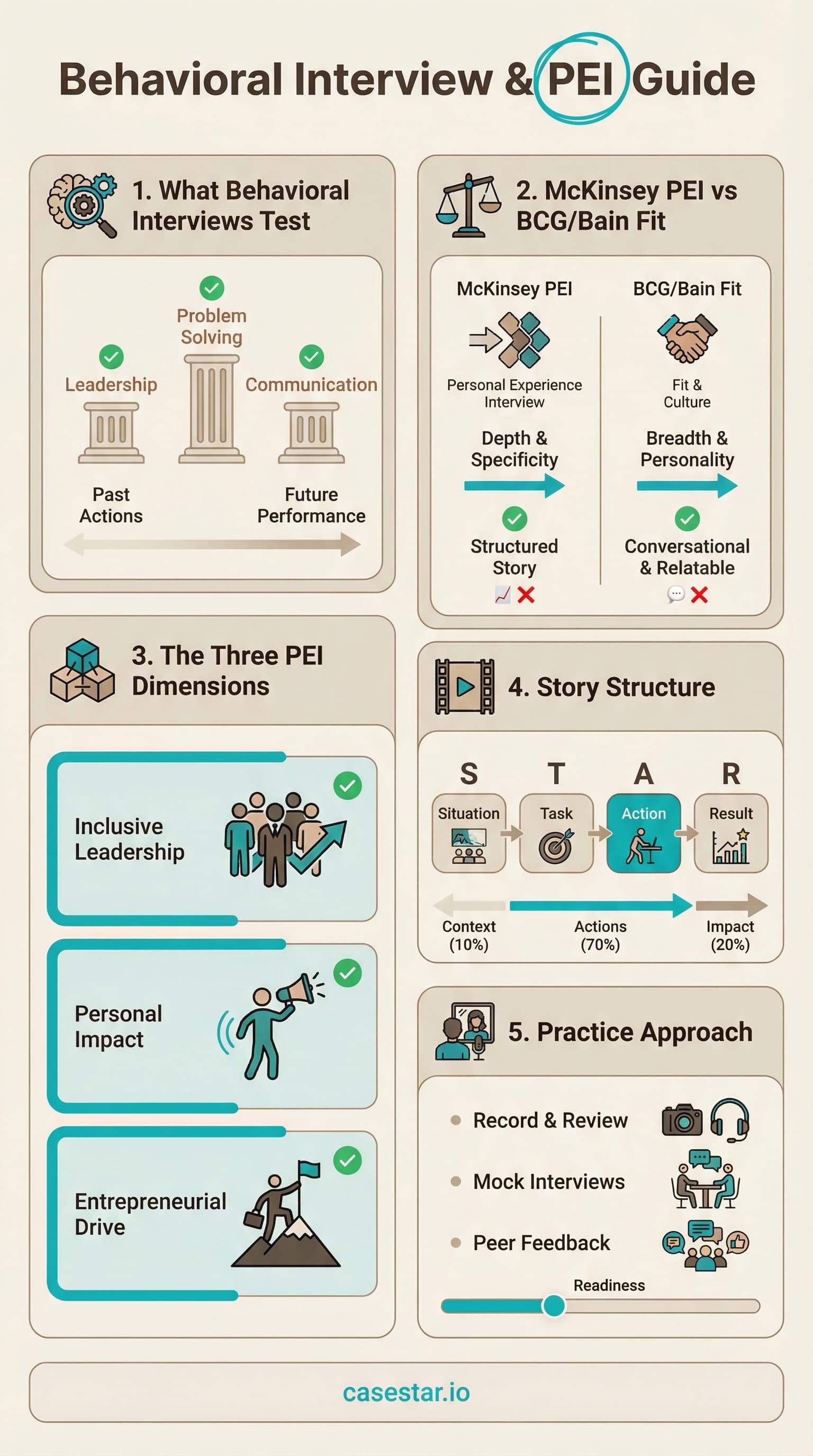
The PEI is a dedicated section of each McKinsey interview, lasting 15-20 minutes. Each interviewer picks one of four dimensions (Connection, Drive, Leadership, or Growth) and asks you to share a specific story. Then they spend 10-15 minutes asking probing follow-up questions.
The depth of questioning is what makes the PEI distinct. Expect questions like: "What exactly did you say to convince them?" "How did she respond to that?" "Why did you choose that approach instead of X?" "What would you do differently now?"
This depth makes fabrication nearly impossible. If your story is not real or your role was peripheral, the probing will expose it. Use genuine stories where you were the main driver.
BCG and Bain: Fit interviews
BCG and Bain weave behavioral questions throughout the interview rather than having a dedicated section. You might get 2-4 questions during a single interview, spending about 3-5 minutes on each. These are often called "fit" or "experience" questions.
The fit portion typically accounts for ~30% of your evaluation (varies by firm), less than McKinsey's PEI but still significant. BCG and Bain interviewers may ask about multiple stories in one interview, so you need broader coverage rather than extreme depth on single stories.
| Aspect | McKinsey PEI | BCG/Bain Fit |
|---|---|---|
| Format | Dedicated 15-20 min section | Woven throughout interview |
| Weight | ~50% of evaluation | ~30% of evaluation (varies by firm) |
| Stories per interview | One story, explored deeply | 2-4 stories, surface level |
| Follow-up depth | Extensive probing (10-15 min) | Light probing (1-2 follow-ups) |
| Dimensions | Four defined dimensions | Varies by interviewer |
| Prep needed | 4 deep stories with all details | 5-6 stories, moderate detail |
What are the 4 PEI dimensions?
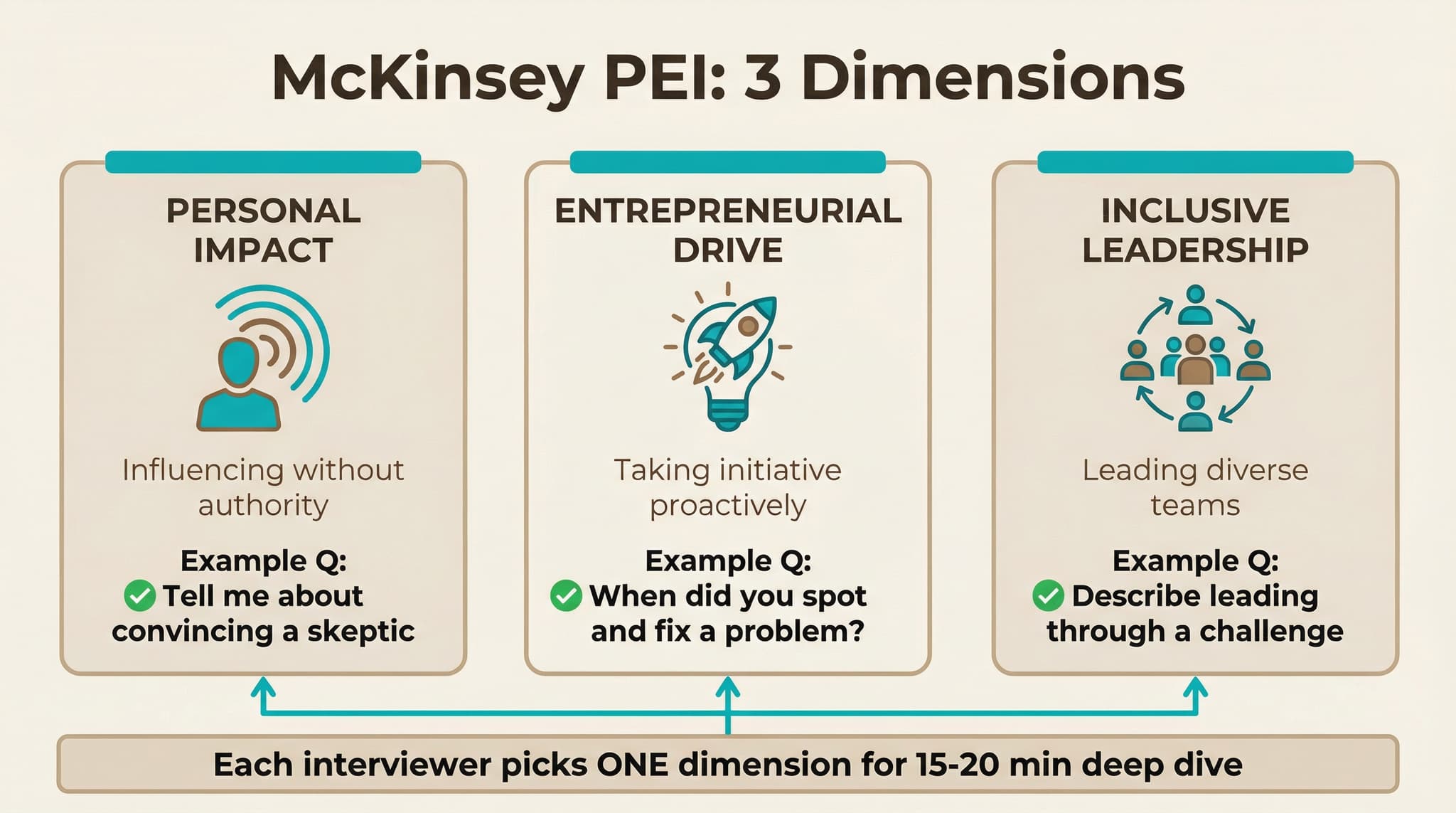
McKinsey evaluates four specific dimensions in the PEI. Each interviewer selects one dimension and asks for a story that demonstrates it. Prepare one strong story for each. McKinsey updated the PEI framework in mid-2025 — older prep materials may still reference the earlier three-dimension model (Personal Impact / Entrepreneurial Drive / Inclusive Leadership).
| Dimension | What it tests | Example questions |
|---|---|---|
| Connection | Listening, empathy, and building relationships. Understanding stakeholders deeply before trying to persuade them. | "Tell me about a time you built trust with someone whose perspective differed from yours." "Describe a situation where listening closely changed the outcome." |
| Drive | Achievement orientation, overcoming obstacles, and ambition. Pursuing a stretch goal and pushing through setbacks to deliver. | "Tell me about a time you set a stretch goal and overcame obstacles to reach it." "Describe when you persisted after a major setback." |
| Leadership | Influencing others, guiding teams, and challenging the status quo. Mobilizing people toward a shared outcome even when it requires pushing back against the established path. | "Tell me about a time you led others to challenge how something was being done." "Describe when you guided a team through a difficult situation." |
| Growth | Learning agility, self-awareness, and development orientation. Reflecting on feedback, identifying gaps, and deliberately developing yourself and others. | "Describe a time when feedback changed how you approached a problem." "Tell me about a time you intentionally developed a skill you didn't have." |
Note: Some stories can work for multiple dimensions. A story where you led a team through a challenging turnaround could demonstrate both Leadership and Drive. Know which angle to emphasize based on the question asked.
How should I structure my stories?
You have probably heard of the STAR method (Situation, Task, Action, Result). It provides useful scaffolding, but rigid STAR responses sound mechanical and rehearsed. The goal is structured storytelling, not filling in boxes.
A better approach
Think of your answer in three parts:
- Quick context (30 seconds): Give just enough background for the interviewer to understand the situation. What was happening, what was your role, what was at stake? Do not spend two minutes on setup.
- Your actions (1-2 minutes): This is the heart of your answer. What specifically did you do? What did you say? What decisions did you make? Use concrete details: "I scheduled a one-on-one with the VP and presented three options with tradeoffs" is better than "I communicated with stakeholders."
- Results and reflection (30 seconds): What happened? Quantify where possible. What did you learn? What would you do differently?
For McKinsey PEI, keep your initial answer to 2-3 minutes. The interviewer will spend 10-15 minutes asking follow-ups, so you do not need to include every detail upfront. For BCG/Bain, give a more complete answer (3-4 minutes) since they may only ask one or two follow-ups before moving on.
Making it natural
Avoid these common mistakes that make answers sound scripted:
- Starting with "The situation was…" followed by "The task was…"
- Using the same transition phrases every time
- Delivering the story identically word-for-word each time
- Rushing through as if reciting from memory
Instead, practice telling your stories multiple times but never exactly the same way. Know the key facts and details, but let the specific wording vary naturally. This creates the impression of genuine recollection rather than memorization.
What makes a behavioral story 'top tier'?
Strong behavioral stories share certain characteristics. Weak stories share different characteristics. Understanding both helps you select and refine your stories.
Strong story characteristics
- Specific details: Names, dates, numbers, exact dialogue. "I told Maria that her concerns about timeline were valid, and I proposed moving the deadline from March 15 to April 1."
- Clear personal role: What YOU did, not what the team did. "I created the analysis" vs "We analyzed the data."
- Genuine challenge: Real difficulty or conflict that you resolved. Easy wins do not demonstrate much.
- Quantifiable impact: "Revenue increased 23%" or "Reduced processing time from 5 days to 2 days."
- Honest reflection: What you learned, what you would do differently. Shows self-awareness.
Weak story characteristics
- Vague descriptions: "I communicated with stakeholders" or "I helped coordinate the project."
- Team-focused language: Constantly saying "we" without clarifying your individual contribution.
- Peripheral role: You observed or assisted but were not the main driver of the outcome.
- No real obstacle: Everything went smoothly. Good stories have tension.
- Generic lessons: "I learned the importance of communication" without specifics.
Testing your stories
For each story, ask yourself:
- Can I answer 10 detailed follow-up questions about this?
- Would I be comfortable if the interviewer called my former colleague to verify?
- Can I explain exactly what I said in key conversations?
- Can I quantify the outcome, even approximately?
- Is there a genuine challenge or conflict I had to navigate?
How many stories do I need?
The minimum depends on which firms you are targeting:
- McKinsey only: 4 stories minimum (one per PEI dimension)
- BCG or Bain only: 4-5 stories covering different themes
- All three firms: 5-6 stories for full coverage
Having extra stories helps in several scenarios:
- The interviewer asks for a second example ("Can you tell me about another time?")
- Your primary story does not quite fit their specific question
- You realize mid-answer that you need a different story
- You want variety across multiple interviews at the same firm
Recommended story types
Build a portfolio covering these themes:
- Relationship story: Built trust across a difference in perspective (maps to Connection)
- Stretch-goal story: Pursued an ambitious goal and overcame obstacles (maps to Drive)
- Team leadership story: Led a group or challenged the status quo (maps to Leadership)
- Learning story: Feedback or self-reflection changed how you worked (maps to Growth)
- Conflict story: Navigated interpersonal tension or disagreement
- Achievement story: Exceeded expectations or delivered exceptional results
Efficiency tip: Choose stories that work for multiple themes. A story about leading a team to turn around a failing project could work for leadership, failure recovery, and achievement depending on which angle you emphasize.
What are the common behavioral questions by firm?
Each firm has tendencies in what they ask. Knowing these helps you prepare the right stories.
McKinsey PEI Questions
McKinsey asks directly for one of four dimensions (updated mid-2025):
- "Tell me about a time you built trust with someone whose perspective differed from yours." (Connection)
- "Tell me about a time you set a stretch goal and overcame obstacles to reach it." (Drive)
- "Tell me about a time you led others to challenge how something was being done." (Leadership)
- "Describe a time when feedback changed how you approached a problem." (Growth)
BCG Fit Questions
BCG focuses on teamwork, ambiguity, and intellectual curiosity:
- "Tell me about a time you worked with a difficult team member."
- "Describe a situation where you had to make a decision with incomplete information."
- "Tell me about a time you had to change your approach."
- "What is something you are passionate about and why?"
Bain Experience Questions
Bain emphasizes results, collaboration, and culture fit:
- "Tell me about a time you exceeded expectations."
- "Describe when you helped a struggling team member."
- "What accomplishment are you most proud of?"
- "Tell me about a time you failed. What did you learn?"
Universal questions (all firms)
- "Why consulting? Why this firm?"
- "Walk me through your resume."
- "Tell me about yourself."
- "What questions do you have for me?"
How should I practice behavioral interviews?
Behavioral interview practice differs from case practice. You are not learning new frameworks. You are building fluency in telling your own stories and handling probing questions.
Phase 1: Story development (Week 1)
- Brainstorm 10-15 potential stories from work, school, and extracurriculars
- Select 5-6 that demonstrate different competencies and have strong details
- Write out each story with all the details: names, dates, numbers, exact actions
- For each story, prepare answers to common follow-up questions
- Identify which dimensions or themes each story best demonstrates
Phase 2: Solo practice (Week 2)
- Tell each story out loud, timing yourself (aim for 2-3 minutes initially)
- Record yourself and listen back. Note filler words, pacing, and clarity.
- Practice varying the wording each time while hitting the same key points
- Practice transitioning between stories when asked for another example
Phase 3: Partner practice (Week 3+)
- Have a partner ask behavioral questions and give your full answer
- Have them probe with follow-ups for 10-15 minutes (simulating the PEI)
- Practice staying calm when you do not immediately know the answer to a follow-up
- Get feedback on clarity, specificity, and whether your role was clear
Weekly behavioral practice schedule
- 2-3 times per week: Practice telling stories out loud (15 min each)
- 1-2 times per week: Full behavioral mock with partner (30 min)
- Weekly: Review and refine stories based on feedback
FAQ
What is the difference between McKinsey PEI and BCG/Bain fit?
McKinsey PEI is a dedicated 15-20 minute section worth ~50% of evaluation where one interviewer probes deeply into one story. BCG and Bain weave shorter fit questions throughout, covering multiple stories with less depth. PEI requires extreme preparation on 4 stories (one per dimension); fit interviews need broader coverage of 5-6 stories.
What are the McKinsey PEI dimensions?
McKinsey updated the PEI in mid-2025 to four dimensions: Connection (listening, empathy, relationships), Drive (achievement, overcoming obstacles), Leadership (influencing others, guiding teams, challenging status quo), and Growth (learning agility, self-awareness, development). Older prep materials may still reference the earlier three-dimension model (Personal Impact / Entrepreneurial Drive / Inclusive Leadership).
How many stories should I prepare?
Prepare 4-6 stories minimum. McKinsey needs 4 for PEI dimensions. BCG/Bain need broader coverage. Extra stories help when asked for second examples, when questions do not quite match your primary story, or for variety across multiple interviews.
What makes a strong behavioral story?
Specific details (names, dates, exact dialogue), clear personal role (not team accomplishments), genuine challenge or conflict, quantifiable results, and honest reflection on learnings. Weak stories are vague, team-focused, lack obstacles, or have generic lessons.
How should I structure my answers?
Give a 30-second context, spend 1-2 minutes on your specific actions, then 30 seconds on results and reflection. For McKinsey, keep initial answers to 2-3 minutes since follow-ups will explore details. For BCG/Bain, give more complete 3-4 minute answers. Avoid rigid STAR format that sounds rehearsed.
What behavioral questions do BCG and Bain ask?
BCG focuses on teamwork, handling ambiguity, and intellectual curiosity. Bain emphasizes results orientation, collaboration, and culture fit. Both ask about failures, conflicts, and achievements. Questions are less structured than McKinsey's specific dimensions.
Practice behavioral interviews with instant feedback
CaseStar offers voice-powered behavioral interview practice with real-time feedback on your stories and responses. Our specialized Behavioral Mode simulates the McKinsey PEI deep-dive and fit questions from BCG/Bain.
Start behavioral interview practiceSave this guide
Last updated: April 2026