Growth Strategy Cases: The Ansoff Matrix Framework
Updated April 2026·16 min read
Summary: Growth strategy cases ask how a company should grow its business. The Ansoff Matrix is your core framework - it maps growth options across two dimensions: products (existing vs new) and markets (existing vs new). Market penetration is lowest risk, diversification is highest risk. For each option, evaluate whether to grow organically (build) or inorganically (acquire or partner). Your recommendation should prioritize options based on strategic fit, feasibility, and risk-adjusted returns.
Contents
What growth strategy cases test
Growth strategy cases are among the most versatile case types in consulting interviews. The prompt typically sounds like: "Our client is a regional coffee chain with $200M in revenue. The CEO wants to double revenue in five years. What options should they consider?"
Unlike profitability cases where you are diagnosing a problem, growth cases require you to identify and evaluate opportunities. Unlike market entry cases where you focus on a single market, growth cases often require evaluating multiple options simultaneously.
Interviewers evaluate several skills in growth strategy cases:
- Structured thinking: Can you systematically map the universe of growth options?
- Strategic judgment: Can you prioritize options based on multiple criteria?
- Business acumen: Do you understand what drives growth in different contexts?
- Risk awareness: Can you identify trade-offs between growth and risk?
- Creativity: Can you identify non-obvious growth opportunities?
The Ansoff Matrix framework
The Ansoff Matrix (also called the Product-Market Growth Matrix) is the foundation for growth strategy analysis. Developed by Igor Ansoff in 1957, it remains the most practical framework for structuring growth options.
The matrix plots growth options along two dimensions:
- Products: Existing products vs. new products
- Markets: Existing markets vs. new markets
This creates four distinct growth quadrants, each with different risk profiles and execution requirements:
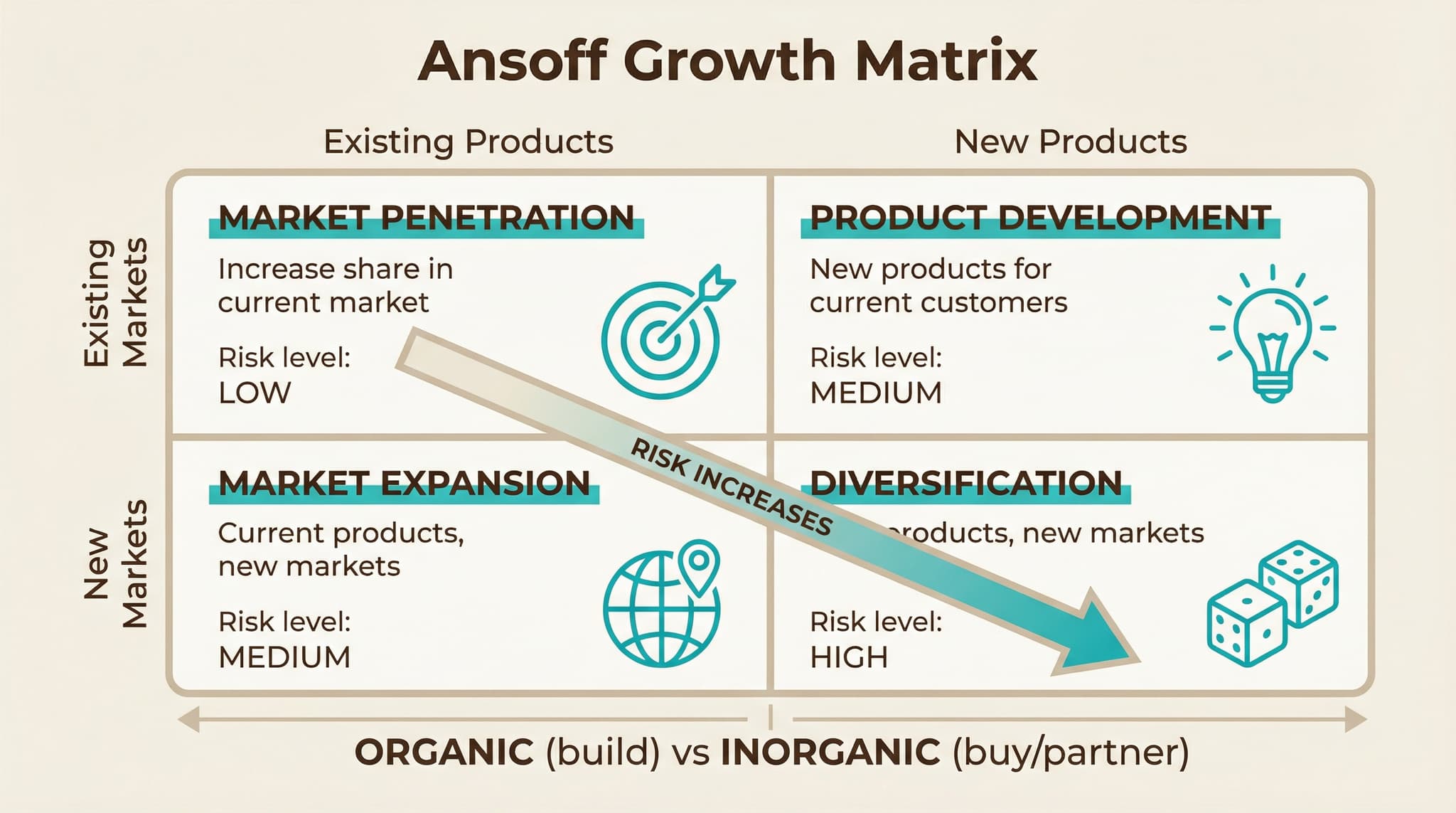
| Quadrant | Products | Markets | Risk Level |
|---|---|---|---|
| Market Penetration | Existing | Existing | Lowest |
| Product Development | New | Existing | Medium |
| Market Expansion | Existing | New | Medium |
| Diversification | New | New | Highest |
Key insight: Risk increases as you move away from what you know. Selling existing products to existing customers is low risk because you understand both sides. Selling new products to new markets is highest risk because you are learning both simultaneously.
Market penetration strategies
Market penetration means growing sales of existing products in existing markets. This is the lowest-risk growth strategy because you already understand your customers, your product works, and you have established operations.
Common market penetration tactics include:
Increase market share
Win customers from competitors through better pricing, marketing, distribution, or product improvements. Calculate the market share gap and identify which competitor segments are most vulnerable.
Increase usage frequency
Get existing customers to buy more often. Loyalty programs, subscription models, and complementary product bundles can drive repeat purchases. A coffee chain might introduce a rewards app to encourage daily visits.
Increase transaction size
Encourage customers to spend more per purchase through upselling, cross-selling, or premium tiers. A software company might offer enterprise features or a restaurant might add appetizers and desserts.
Reduce churn
Retain more customers longer. Customer success programs, improved service, and better onboarding reduce attrition. In subscription businesses, a 5% improvement in retention can dramatically impact lifetime value.
When to prioritize penetration: Choose market penetration when you have significant market share headroom, your current market is growing, and you have competitive advantages you have not fully exploited. Avoid it if the market is saturated or declining.
Product development strategies
Product development means creating new products or services for your existing customer base. You build on customer relationships and market knowledge you already have while developing new offerings.
Product development approaches include:
Line extensions
Variations of existing products - new flavors, sizes, or configurations. Lower risk because they build on proven concepts. Example: a snack company launching new flavors.
New categories
Entirely new product categories that address different customer needs. Higher risk but higher potential. Example: Amazon moving from books to electronics.
Service additions
Wrapping services around products to create new revenue streams. Example: equipment manufacturers adding maintenance contracts or software companies adding implementation services.
Platform evolution
Expanding platform capabilities to capture more customer spend. Example: a payments company adding lending products or a CRM adding marketing automation.
Key risk: Product development fails when companies assume their customers will buy anything they make. Always validate that the new product addresses a real customer need and that you have the capabilities to deliver it well.
Market expansion strategies
Market expansion means taking your existing products to new markets. This is a core focus of market entry cases, but in growth strategy cases you evaluate expansion alongside other options.
Market expansion can take several forms:
Geographic expansion
Enter new regions, countries, or territories. A regional retailer expanding nationally or a domestic company going international. Requires understanding local customer preferences, regulations, and competitive dynamics.
New customer segments
Target different customer types within the same geography. A B2B software company moving downmarket to small businesses or a luxury brand creating an accessible line. Requires adapting pricing, marketing, and sometimes the product.
New channels
Reach customers through new distribution channels. A retail brand launching e-commerce, a direct-to-consumer brand entering wholesale, or a physical retailer adding a marketplace. Requires channel capabilities and sometimes partner relationships.
When to prioritize expansion: Choose market expansion when your current market is limited or saturated, you have a differentiated product that translates to new markets, and you can adapt operations to serve new geographies or segments efficiently.
Diversification strategies
Diversification means entering new markets with new products. This is the highest-risk quadrant because you are simultaneously learning about new customers and developing new capabilities.
There are two types of diversification:
Related diversification
New products and markets that share some connection with your core business - similar customers, overlapping capabilities, or adjacent value chains. Example: a camera company entering the medical imaging market. Less risky because you can leverage some existing knowledge.
Unrelated diversification
Entering completely new businesses with no connection to current operations. Example: a steel company acquiring an insurance business. Highest risk and often value-destroying unless there are strong financial or portfolio benefits.
| Factor | Related Diversification | Unrelated Diversification |
|---|---|---|
| Synergy potential | High - shared capabilities | Low - minimal overlap |
| Risk level | High | Very high |
| Common rationale | Leverage core competencies | Portfolio balance, cash flow |
| Typical outcome | Mixed - depends on synergy realization | Often value-destroying |
Caution: In case interviews, diversification is rarely the recommended strategy. If the interviewer presents a diversification opportunity, carefully probe whether it is related (some synergy exists) or unrelated (pure portfolio play). Unrelated diversification usually fails to create shareholder value.
Organic vs inorganic growth
For each Ansoff quadrant, you can pursue growth organically (build internally) or inorganically (acquire or partner). This choice significantly impacts speed, cost, risk, and control.
| Dimension | Organic (Build) | Inorganic (M&A) | Partnership |
|---|---|---|---|
| Speed | Slow (years) | Fast (months) | Moderate |
| Cost | Lower upfront | High (premium) | Shared |
| Risk | Execution risk | Integration risk | Partner risk |
| Control | Full | Full (post-deal) | Shared |
| Capabilities | Build from scratch | Acquire ready-made | Access via partner |
Choose organic when…
- Speed is not critical
- You have existing capabilities to leverage
- Suitable targets are not available or overpriced
- Cultural fit and control are paramount
- The opportunity requires iterative learning
Choose M&A when…
- Speed to market is essential
- You need capabilities that are hard to build
- Good targets are available at reasonable valuations
- Market consolidation creates strategic advantage
- Competitors would otherwise acquire the target
Choose partnership when…
- You want to test before committing
- Local expertise is critical (international markets)
- Regulatory requirements favor local players
- You lack capital for acquisition
- The opportunity has high uncertainty
Prioritizing growth options
In most growth strategy cases, you will identify multiple potential growth options. The key to a strong recommendation is a systematic prioritization framework.
Evaluate each growth option against these criteria:
1. Strategic fit
Does this option align with the company's core competencies, brand, and long-term vision? Growth that leverages existing strengths is more likely to succeed than growth that requires building entirely new capabilities.
2. Market attractiveness
How large and growing is the opportunity? What are the margins? Apply market sizing techniques to quantify the revenue potential of each option.
3. Feasibility
Can we actually execute this option? Do we have the capital, talent, technology, and partnerships required? What capability gaps exist and can they be filled?
4. Risk assessment
What could go wrong? Consider execution risk, competitive response, regulatory changes, and technology shifts. Higher-risk options require higher potential returns to justify.
5. Time to value
How quickly will we see returns? Some options generate revenue immediately while others require years of investment. Consider the company's financial situation and shareholder expectations.
Prioritization matrix approach
Create a simple 2x2 matrix plotting options by attractiveness (vertical axis) and feasibility (horizontal axis). High-attractiveness, high-feasibility options go in the "do first" quadrant. Low-attractiveness, low-feasibility options are "don't pursue." The other quadrants require more analysis or may be future options.
Worked example approach
Prompt: "Our client is a regional coffee chain with 50 locations and $200M in revenue. The CEO wants to double revenue to $400M in five years. What growth options should they consider, and which would you prioritize?"
Step 1: Clarify
Ask about the client: Where are current stores located? What is the customer profile? What drives the differentiation - quality, convenience, experience? What is the financial situation (cash, debt capacity)? Are there any strategic constraints or preferences?
Step 2: Structure using Ansoff Matrix
"I would like to map the growth options using the Ansoff Matrix. First, Market Penetration - can we grow sales at existing stores or add stores in our current region? Second, Product Development - can we add new products like packaged coffee, food, or merchandise? Third, Market Expansion - can we enter new geographic markets? Fourth, Diversification - are there adjacent businesses we should consider? For each, I will also evaluate organic versus inorganic approaches."
Step 3: Analyze each quadrant
Market Penetration: Increase same-store sales through loyalty programs and extended hours ($20M potential). Add 30 new stores in current region ($60M potential). Total: $80M.
Product Development: Launch packaged retail coffee in grocery stores ($30M). Add expanded food menu ($20M). Total: $50M.
Market Expansion: Enter two adjacent metro areas with 25 stores each ($100M). Consider acquiring a smaller chain in a new region.
Diversification: Not recommended given the risk and available options in other quadrants.
Step 4: Prioritize and recommend
"I recommend a portfolio approach prioritizing three initiatives:
First, market penetration in the current region - this is lowest risk and can generate $80M through same-store improvements and new stores where we have brand recognition.
Second, geographic expansion to two adjacent metros - this adds $100M and leverages our proven model. I would suggest organic expansion for one market and evaluate acquiring a local chain in the other for faster entry.
Third, packaged retail coffee - this $30M opportunity leverages our brand and quality with relatively low capital requirements.
This portfolio totals $210M in incremental revenue, exceeding the $200M target with diversified risk across multiple initiatives."
FAQ
What is the Ansoff Matrix?
The Ansoff Matrix is a strategic framework that maps growth options along two dimensions: products (existing vs new) and markets (existing vs new). This creates four quadrants: Market Penetration, Product Development, Market Expansion, and Diversification, each with different risk levels.
What is the difference between organic and inorganic growth?
Organic growth means building capabilities internally through R&D, hiring, and gradual market expansion. It is slower but cheaper. Inorganic growth means acquiring companies or forming partnerships to gain capabilities quickly. It is faster but more expensive with integration risks.
Which growth strategy has the lowest risk?
Market penetration has the lowest risk because you are selling existing products to existing markets. You already understand the customer, the product works, and you have established operations. Diversification has the highest risk because both products and markets are new.
How does growth strategy differ from market entry?
Market entry focuses specifically on entering a new geographic or customer market. Growth strategy is broader - it considers all growth options including market penetration, product development, and diversification, not just expansion. Market entry is one quadrant of the Ansoff Matrix.
When should I recommend diversification?
Rarely. Diversification is highest risk and often value-destroying. Only recommend it when: (1) core markets are declining with no turnaround potential, (2) the diversification is related with clear synergies, (3) the company has excess capital and management bandwidth, and (4) other growth options are exhausted or limited.
Practice growth strategy cases
CaseStar offers interactive case practice with instant feedback on your strategic analysis, framework application, and recommendations.
Start practicingSave this guide
Last updated: April 2026