Oliver Wyman Case Interview Guide
Updated April 22, 2026·16 min read
Summary: Oliver Wyman uses candidate-led cases with a strong quantitative emphasis. Expect math-heavy cases with multiple calculation steps and market sizing questions. The firm has deep expertise in financial services, risk management, and aviation. Interviews typically span 2-3 rounds with behavioral questions focused on leadership and teamwork. Prepare by drilling mental math and practicing candidate-led case formats.
Official Resources:Oliver Wyman Careers & Interview Preparation
Contents
Oliver Wyman overview
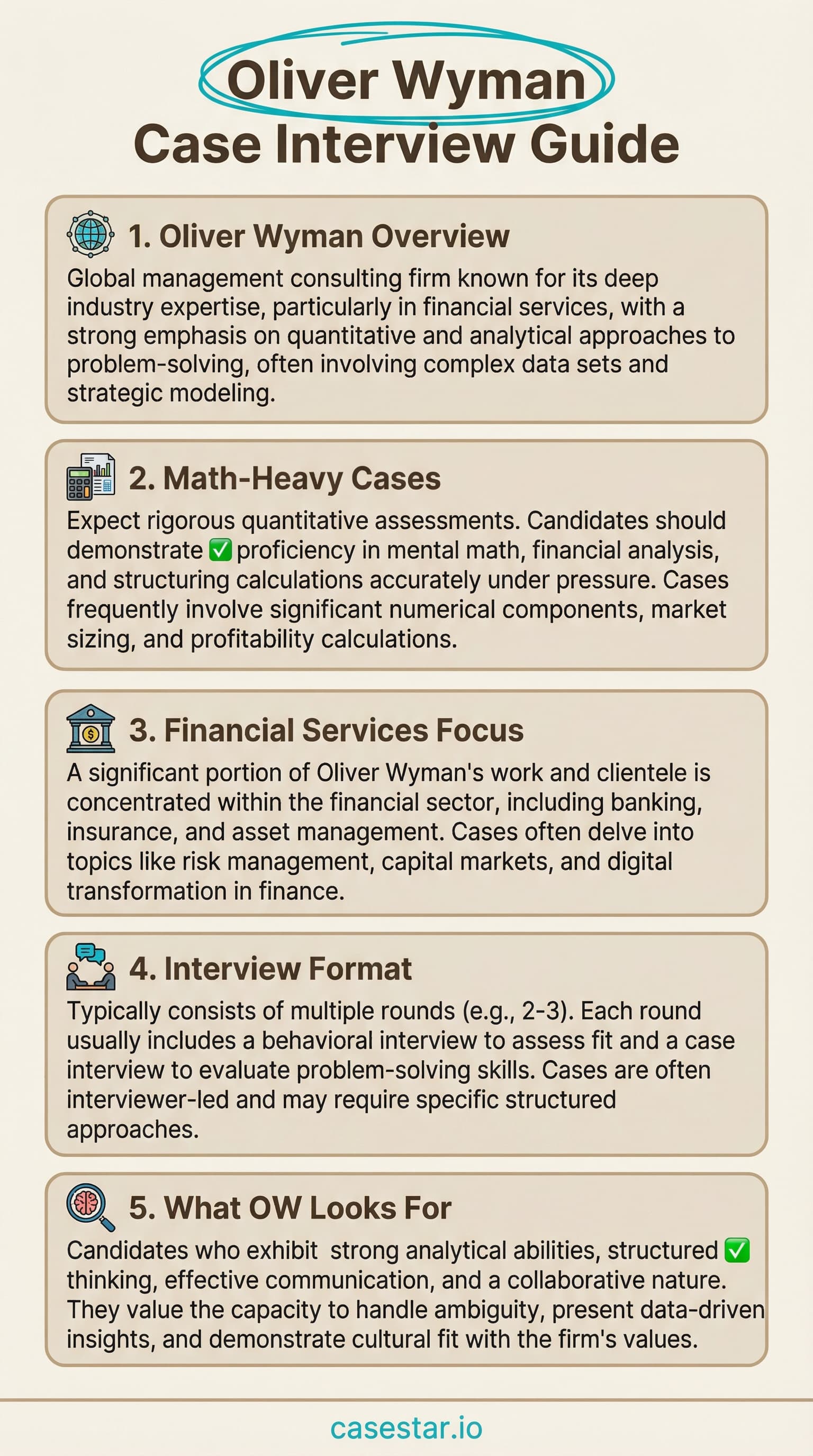
Oliver Wyman is a leading management consulting firm and part of Marsh McLennan, a global professional services company. The firm consistently ranks among the top strategy consultancies and is known for its analytical rigor and deep industry expertise, particularly in financial services and risk management.
With offices in over 30 countries, Oliver Wyman serves clients across banking, insurance, transportation, retail, and other sectors. The firm's heritage in financial services means many cases and projects involve quantitative analysis, risk modeling, and complex business problems that require strong numerical skills.
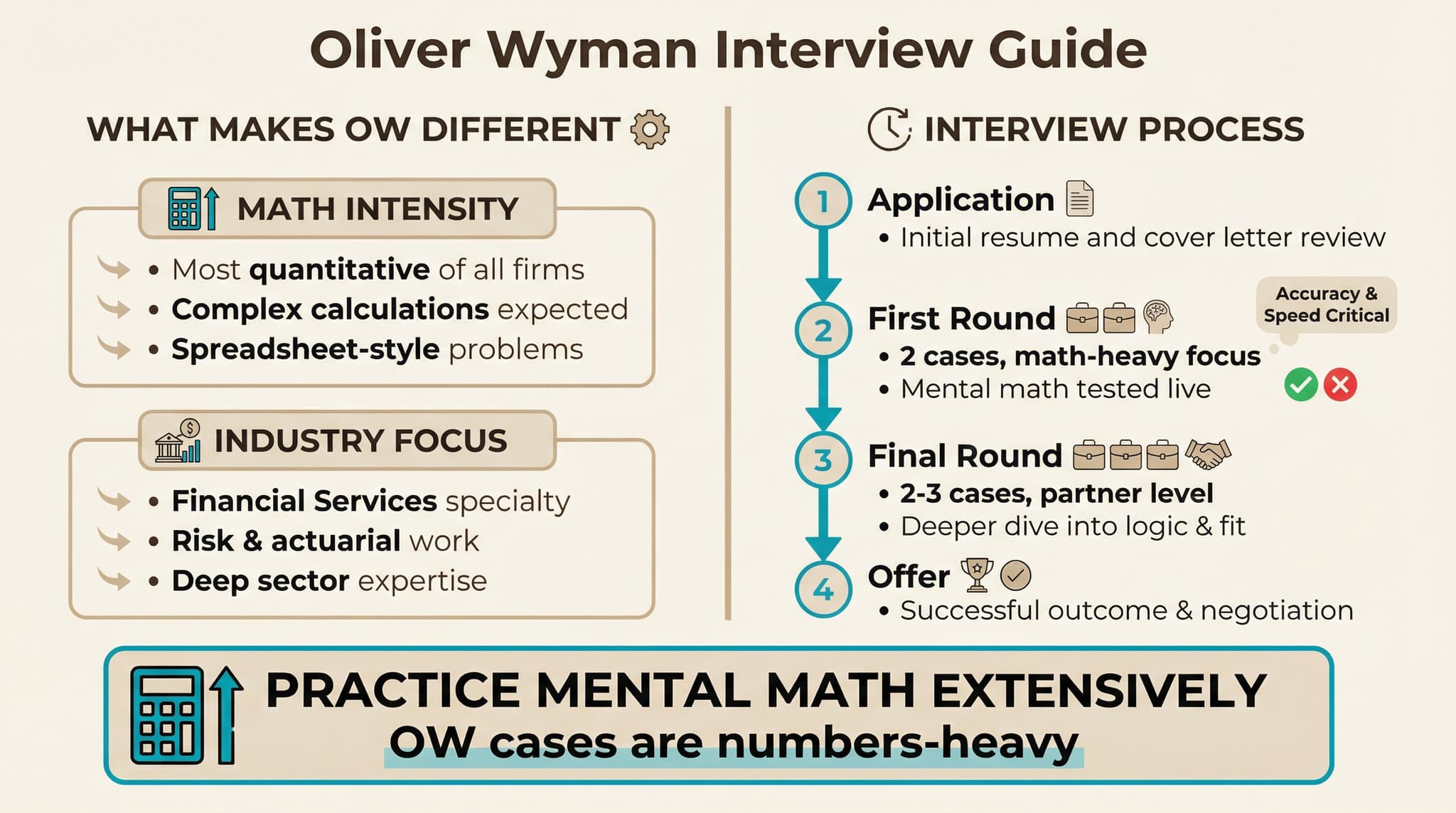
The interview process reflects this quantitative DNA. Candidates regularly report that Oliver Wyman cases are more math-intensive than those at other firms. If you are comfortable with numbers and enjoy analytical problem-solving, this environment may suit you well.
Key facts about Oliver Wyman
- Part of Marsh McLennan (NYSE: MMC)
- 7,000+ colleagues across 70+ cities in 30 countries
- Strong practices in financial services, risk, and aviation
- Known for quantitatively rigorous consulting work
- Competes with MBB for top strategy engagements
Interview format
Oliver Wyman's interview process typically involves 2-3 rounds, with the exact structure varying by office, role level, and hiring needs. The overall format combines case interviews with behavioral assessment.
Interview rounds
First round
Format: 2-3 interviews, each 25-35 minutes
Interviewers: Consultants and Engagement Managers
Each interview typically includes one case (25-35 minutes) and behavioral questions (10-15 minutes). First-round cases test fundamental analytical skills: structuring, quantitative analysis, and synthesis. Interviewers assess whether you can think logically and handle numbers comfortably.
Final round
Format: 2-4 interviews, each 25-35 minutes
Interviewers: Partners and Senior Partners
Final-round cases tend to be more complex, often drawing from actual client work. Partners evaluate business judgment, client readiness, and cultural fit alongside analytical performance. The behavioral component may carry more weight as senior leaders assess your potential for long-term success at the firm.
Online assessments
Some Oliver Wyman offices incorporate online assessments into their screening process. These may appear before the first interview round and can include:
- Numerical reasoning: Fast-paced, GMAT-like questions often including "brainteaser" math that tests intuitive number sense under extreme time pressure.
- Logical reasoning: Traditional matrix-based pattern recognition and syllogisms.
- Situational judgment: Assessing professional behavior and leadership in high-stakes environments.
Not all offices use these assessments, so check with your recruiter about what to expect. If required, treat them as a screening hurdle but do not over-invest time at the expense of case preparation.
Case types and quantitative focus
Oliver Wyman uses a candidate-led case format, similar to BCG and Bain. You receive a business problem, develop your own framework, and drive the analysis by requesting data and deciding which areas to explore. The interviewer follows your lead rather than directing you through a predetermined path.
The quantitative emphasis
Oliver Wyman cases are notably math-heavy. This reflects the firm's work in financial services and risk management, where quantitative analysis is central. Expect:
Multi-step calculations
Cases often require several calculation steps that build on each other. You might calculate market size, then segment growth rates, then revenue potential, then margin impact. Each step uses the previous result. Mistakes compound, so accuracy matters alongside speed.
Practice: Mental math drills
Percentage and ratio problems
Financial services cases frequently involve percentage calculations: profit margins, growth rates, market share changes, compound interest scenarios. You should be comfortable calculating percentages quickly and converting between percentages, decimals, and fractions.
Market sizing
Oliver Wyman cases may include standalone market sizing questions or market sizing as part of a larger case. These test your ability to structure an estimation problem, make reasonable assumptions, and execute calculations quickly.
Practice: Market sizing guide
Common case themes
Cases often reflect Oliver Wyman's industry focuses:
- Profitability: Revenue and cost analysis, particularly for financial institutions or insurers
- Market entry: Should a bank enter a new product market? Should an airline expand to new routes?
- Pricing: How should an insurer price a new product? What is the optimal pricing strategy for a retailer?
- Risk assessment: Evaluate risk scenarios, model potential outcomes, analyze trade-offs
- Operations improvement: Cost reduction, process efficiency, capacity optimization
Tip: When practicing cases, do the math out loud. Oliver Wyman interviewers want to hear your thought process, not just your final answer. Narrating your calculations demonstrates analytical confidence and makes it easier for them to give partial credit if you make arithmetic errors.
Industry focus areas
Oliver Wyman has built distinctive expertise in several industries. Understanding these can help you prepare relevant examples and demonstrate informed interest during interviews.
Financial services
This is Oliver Wyman's flagship practice. The firm advises banks, insurers, asset managers, and other financial institutions on strategy, operations, and risk. Topics include digital transformation, regulatory response, product innovation, and cost efficiency. Many partners have deep financial services backgrounds, and cases frequently involve banking or insurance scenarios.
Risk management
As part of Marsh McLennan, Oliver Wyman has natural synergies with risk and insurance practices. The firm helps clients identify, quantify, and mitigate risks across their businesses. This can include operational risk, credit risk, market risk, and strategic risk. Cases may involve scenario analysis and probability-weighted decision making.
Aviation and transportation
Oliver Wyman has a well-known aviation practice that advises airlines, airports, and aerospace companies. Projects range from route network strategy to fleet planning to operational efficiency. If you have interest in transportation, this is a distinguishing strength compared to other consulting firms.
Other sectors
Beyond these core areas, Oliver Wyman serves clients in healthcare, retail, telecommunications, energy, and public sector. The firm takes on general strategy work across industries, though financial services remains the center of gravity for many offices.
Why this matters for interviews: Cases may reflect these industry focuses. Familiarity with basic concepts in banking, insurance, or aviation can help you structure problems more quickly. You do not need expert knowledge, but understanding terms like "net interest margin," "loss ratio," or "load factor" demonstrates preparation and genuine interest.
Behavioral interviews
Oliver Wyman integrates behavioral questions into each interview rather than conducting separate behavioral-only sessions. Expect 10-15 minutes of behavioral questions per interview, typically at the beginning or end of the case discussion. Our behavioral practice mode is designed to help you prepare concise, impactful answers for this format.
What interviewers assess
Behavioral questions at Oliver Wyman tend to focus on several themes:
Leadership
"Tell me about a time you led a group to achieve something." The firm wants to see that you can take ownership and motivate others. Your example does not need to involve formal authority; leading a project, coordinating peers, or driving initiative all count.
Teamwork and collaboration
"Describe a challenging team situation you navigated." Consulting is collaborative work. Interviewers want evidence that you work well with others, handle disagreements constructively, and contribute positively to team dynamics.
Problem-solving under pressure
"Tell me about a time you faced an unexpected challenge." This tests resilience and adaptability. Good answers show how you assessed the situation, adjusted your approach, and delivered results despite obstacles.
Motivation and fit
"Why consulting? Why Oliver Wyman?" Interviewers want to understand your career reasoning. Generic answers about prestige fall flat. Better answers connect your interests and experiences to what Oliver Wyman specifically offers: industry focus, analytical depth, or particular practice areas.
Preparing your stories
Prepare 4-5 stories that you can adapt to different question types. Each story should include:
- Context: Brief background on the situation (15-20 seconds)
- Your specific actions: What you personally did, in detail (60-90 seconds)
- Results: Quantifiable outcomes when possible (15-20 seconds)
- Reflection: What you learned or would do differently
Practice telling each story in 2-3 minutes. The interviewer may ask follow-up questions, so know the details well enough to elaborate on any part.
Tip: Choose stories where you played a central role. "We launched a product" is weaker than "I identified the opportunity, built the business case, and led the launch team." Use "I" to describe your contributions while acknowledging the team context.
Learn more: Behavioral interview guide
How to prepare for Oliver Wyman
Oliver Wyman preparation should emphasize quantitative skills more heavily than preparation for other firms. Here is how to allocate your time.
Mental math (30% of preparation time)
Given the quantitative intensity of Oliver Wyman cases, mental math should be a daily practice:
- Percentage calculations: Practice finding 15% of $340 million, calculating percentage changes, and working with compound growth rates. Mental math drills help build speed.
- Large number arithmetic: Multiply and divide numbers in the millions and billions. Practice until you can handle 3.2 million x 45 without hesitation.
- Multi-step problems: Chain calculations together. Start with market size, apply penetration rate, multiply by average revenue, apply margin. Practice maintaining accuracy through 4-5 calculation steps.
- Narrate your work: Always explain your calculations out loud. This builds the habit for interviews.
Case practice (40% of preparation time)
- Practice candidate-led format: Drive the case yourself. After receiving the problem, develop your framework, decide what to explore, and request specific data from your practice partner.
- Emphasize quantitative cases: Seek out cases with heavy math components. Profitability cases, pricing cases, and market sizing exercises are good choices.
- Practice market sizing regularly: Aim for 2-3 market sizing problems per week. Market sizing guide covers the approach.
- Build custom frameworks: Generic frameworks often fail in Oliver Wyman cases. Learn to construct structures from first principles based on the specific problem. Framework guide explains how.
Behavioral preparation (20% of preparation time)
- Prepare 4-5 stories covering leadership, teamwork, challenge, and achievement themes
- Practice telling each story in 2-3 minutes with specific details
- Develop a genuine answer to "Why consulting?" and "Why Oliver Wyman?" that references specific aspects of the firm
- Research Oliver Wyman's recent work in industries that interest you
Industry knowledge (10% of preparation time)
- Read about financial services trends: digital banking, insurance innovation, fintech disruption
- Understand basic financial metrics: net interest margin, return on equity, loss ratio, combined ratio
- Follow business news to have current examples for case discussions
- Review Oliver Wyman's published insights to understand their perspective on key issues
Sample weekly schedule (4-6 weeks before interview)
| Activity | Frequency | Time per session |
|---|---|---|
| Mental math drills | Daily | 20-30 minutes |
| Market sizing practice | 3x per week | 15-20 minutes each |
| Full candidate-led cases | 3-4 per week | 45-60 minutes each |
| Behavioral story practice | 2-3x per week | 20-30 minutes |
| Business news and industry reading | Daily | 15 minutes |
Practice quantitative cases with instant feedback
CaseStar offers voice-powered case practice with instant feedback on structuring, mental math, and synthesis. Build the quantitative skills that Oliver Wyman values.
Start practicingFAQ
What is the Oliver Wyman interview format?
Oliver Wyman uses candidate-led cases with 2-3 interview rounds. Each round has multiple 25-35 minute interviews combining case discussions and behavioral questions. Cases are quantitatively intensive. Some offices also use online assessments for screening.
How quantitative are Oliver Wyman cases?
Oliver Wyman cases are known for being math-heavy. Expect multi-step calculations, percentage problems, and market sizing. The firm values candidates who handle numbers quickly and accurately while explaining their reasoning.
What industries does Oliver Wyman focus on?
Financial services (banking, insurance, asset management) is Oliver Wyman's flagship practice. The firm also has strong expertise in risk management, aviation, and healthcare. Understanding financial services concepts can help during interviews.
Does Oliver Wyman use online assessments?
Some offices use online assessments including numerical reasoning, logical reasoning, and situational judgment tests. The format varies by office and hiring cycle. Check with your recruiter about what to expect for your application.
How should I prepare specifically for Oliver Wyman?
Focus heavily on mental math (daily practice), market sizing, and multi-step calculations. Practice candidate-led cases. Research Oliver Wyman's industry practices and prepare behavioral stories demonstrating leadership and teamwork.
Ready to prepare for Oliver Wyman?
CaseStar offers interactive practice for quantitative cases, mental math, market sizing, and behavioral interviews.
Start practicing freeSave this guide
Last updated: April 22, 2026