Roland Berger Case Interview Guide: Format, Tips & Preparation
Updated April 2026·16 min read
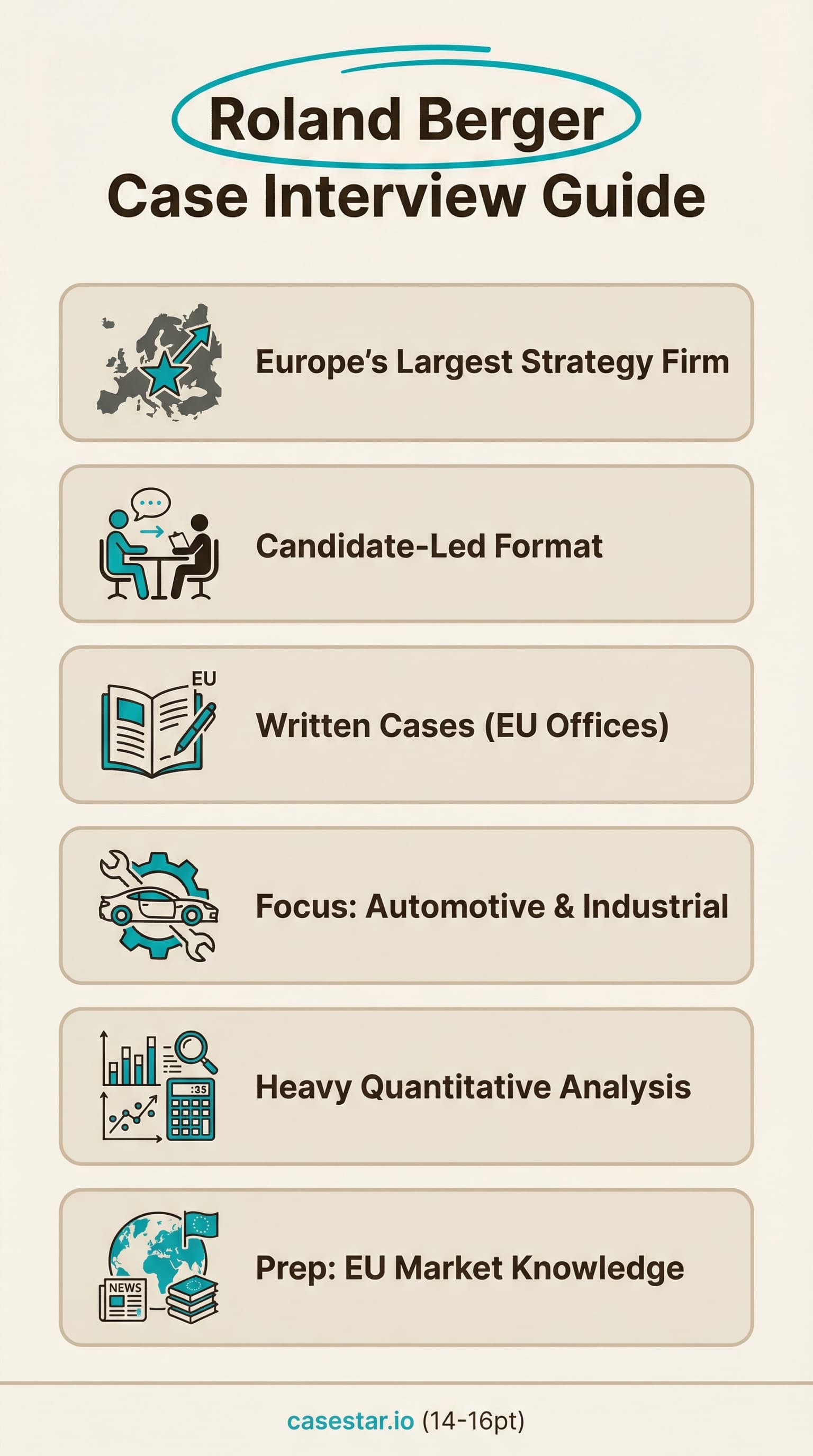
Summary: Roland Berger is Europe's largest strategy consulting firm, headquartered in Munich. Interviews use a candidate-led case format with strong emphasis on quantitative analysis. Expect 2-3 rounds with 2-3 interviews each, potentially including written case studies. Cases often feature European markets, automotive clients, and industrial operations. The firm values analytical rigor, entrepreneurial thinking, and practical problem-solving skills.
Official Resources:Roland Berger Careers & Interview Preparation
Contents
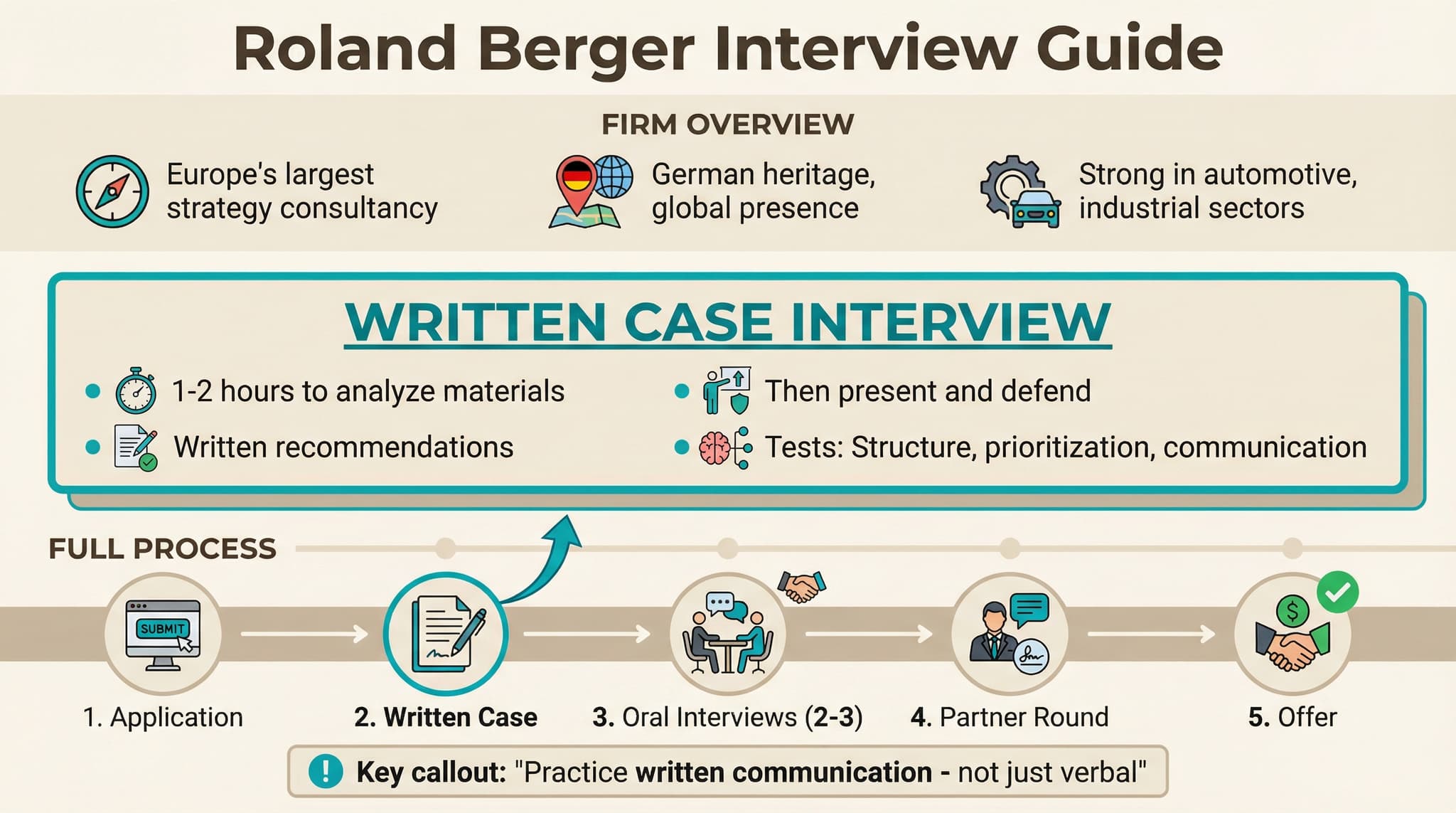
Roland Berger overview
Roland Berger occupies a distinct position in the strategy consulting landscape. Founded in Munich in 1967, it has grown to become one of the largest European-headquartered strategy firms with over 50 offices worldwide. While smaller than the MBB firms globally, Roland Berger commands significant market share in Germany, Austria, and other European markets.
The firm's heritage shapes its client base and expertise. Roland Berger has deep relationships with German industrial giants, automotive manufacturers, and engineering companies. This specialization translates directly into interview content: candidates should expect cases involving manufacturing operations, supply chain challenges, and European market dynamics more frequently than they might at US-headquartered firms.
Key characteristics of Roland Berger
- European focus: Strong presence in Germany, France, Italy, and other EU markets. Deep expertise in European regulatory environments and business cultures.
- Industry strength: Particularly known for automotive, industrial goods, transportation, and energy practices.
- Entrepreneurial culture: Partners operate with significant autonomy. The firm is known for a less hierarchical, more open consulting culture compared to some competitors.
- Restructuring expertise: Strong track record in operational improvement and corporate restructuring projects.
- Quantitative rigor: Cases and client work emphasize analytical depth and data-driven recommendations.
Understanding the firm's position helps you prepare more effectively. Roland Berger interviews test similar core skills as other strategy firms, but the context, industries, and specific case scenarios often reflect the firm's European and industrial heritage.
2025/2026 Focus: European Market Leadership
In recent cycles, Roland Berger has leaned heavily into its role as the premier European-heritage consultancy. Prepare to discuss "Green Leadership," digital transformation within the German Mittelstand (large SMEs), and navigating the macroeconomic shifts affecting the EU.
Interview format and structure
Roland Berger typically conducts 2-3 interview rounds, with the exact number varying by office and candidate type. Each round contains 2-3 interviews, meaning candidates can expect 4-9 total interviews before receiving an offer.
First Round
- 2-3 interviews, each 45-60 minutes
- Interviewers: Consultants, Project Managers, Principals
- Format: Case interview (25-35 minutes) + Behavioral questions (15-20 min)
- Focus: Core analytical skills, structured thinking, basic fit
Second Round
- 2-3 interviews, each 45-60 minutes
- Interviewers: Senior Principals and Partners
- Format: More complex cases, deeper behavioral exploration
- May include written case study in some offices
Final Round (some offices)
- 1-2 interviews with Senior Partners
- Focus: Strategic fit, career motivations, firm knowledge
- May be more conversational than previous rounds
The candidate-led approach
Roland Berger uses a candidate-led case format, similar to BCG and Bain. After receiving the case prompt, you develop your own framework, decide which areas to explore, and drive the analysis forward by requesting specific information.
This differs from McKinsey's interviewer-led format where the interviewer guides you through specific questions. In a Roland Berger case, silence after you finish analyzing one area means you should decide what to investigate next.
Interview timing: Roland Berger interviews often run slightly longer than MBB (up to 60 minutes vs 45). Use this time wisely. More time means higher expectations for analytical depth and synthesis quality.
Types of cases
Roland Berger cases reflect the firm's client base and expertise areas. While you might encounter any standard case type (market entry, profitability, M&A), certain themes appear more frequently.
Operations and efficiency
Cases involving cost reduction, process optimization, or operational improvement are common. You might analyze a manufacturing plant's efficiency, optimize a logistics network, or identify savings in a procurement process. Strong profitability analysis skills are essential.
Automotive and industrial
Given the firm's German heritage, automotive cases appear frequently. These might involve an OEM considering electric vehicle strategy, a supplier facing margin pressure, or a manufacturer evaluating production footprint decisions. Familiarity with automotive industry basics helps.
Restructuring
Roland Berger has a notable restructuring practice. Cases may involve distressed companies needing turnaround plans, business unit rationalization, or portfolio optimization. These cases test your ability to prioritize under constraints.
European market entry
Market entry cases often feature European expansion scenarios. A US company entering Germany, a French retailer considering Eastern Europe, or a Chinese manufacturer establishing European production. Understanding EU market dynamics and regulations provides useful context.
Quantitative emphasis
Roland Berger cases tend to be quantitatively demanding. Expect to work through detailed calculations, interpret complex data exhibits, and build financial models within the case. Mental math speed matters significantly.
- Breakeven analysis and sensitivity calculations
- Multi-step profitability waterfalls
- NPV and payback period estimations
- Market sizing with detailed segmentation
- Data interpretation from multiple exhibits
Practice your mental math and market sizing skills thoroughly. Being slow with calculations will hurt your performance more at Roland Berger than at some other firms.
Written case interviews
Many Roland Berger offices include written case studies as part of the interview process, particularly in European locations. This format tests your ability to work independently with complex materials under time pressure.
Written case format
- Materials: Information pack (15-20 slides) containing financials, market data, and qualitative reports.
- Time: Strict 10-15 minute reading/prep window followed by a 15-minute presentation or discussion.
- Format: You are often asked 3 high-level questions to answer using only the provided data pack.
- Delivery: Presenting your recommendation slide-by-slide to a Principal or Partner, focusing on hypothesis generation and critical thinking.
How to approach written cases
First 15 minutes: Survey and structure
Quickly skim all materials to understand what you have. Identify the core question, note which exhibits exist, and determine which data is most critical. Do not start deep analysis yet.
Middle 40-50 minutes: Analyze and synthesize
Work through the key exhibits relevant to answering the main question. Do not try to use every piece of data. Extract insights, perform calculations, and begin formulating your recommendation. Take notes that can structure your presentation.
Final 15-20 minutes: Structure presentation
Organize your findings into a clear narrative. Lead with your recommendation, support it with 2-3 key arguments, acknowledge risks or uncertainties, and outline next steps. Practice saying your opening out loud.
Preparation tip: Practice reading dense business materials under time pressure. Find old case competition materials or Harvard Business School case studies and practice extracting key insights in 30-45 minutes. The skill of quickly identifying what matters versus what is noise is critical.
Behavioral interviews
Roland Berger integrates behavioral questions into each interview rather than conducting separate behavioral rounds. Expect 15-20 minutes of behavioral discussion per interview, typically at the beginning or end of the case portion. You can prepare for these mixed-format interviews using our behavioral practice mode.
Common behavioral themes
- Leadership: Describe a time you led a team or project. Roland Berger values initiative and ownership.
- Entrepreneurial thinking: Tell me about a time you identified and pursued an opportunity independently.
- Analytical challenge: Describe a complex problem you solved. This connects your experience to case skills.
- Teamwork and conflict: How have you handled disagreements or difficult team dynamics?
- Why consulting, why Roland Berger: What attracts you to strategy consulting and to this firm specifically?
What Roland Berger looks for
Entrepreneurial mindset
The firm's partnership structure encourages independent thinking. Stories demonstrating initiative, creative problem-solving, or building something from scratch resonate well.
Practical results orientation
Roland Berger emphasizes implementation and tangible outcomes. When describing experiences, focus on what actually changed because of your work, not just the analysis you produced.
European or international context
If you have experience working across cultures, speaking multiple languages, or operating in European contexts, highlight these. The firm values candidates comfortable in international environments.
Prepare 4-5 stories covering different themes. Each should be 2-3 minutes long with clear situation, action, and result components. Practice telling them naturally rather than reciting memorized scripts.
How to prepare
Preparing for Roland Berger requires standard case interview skills plus specific attention to the firm's quantitative emphasis, written case format, and European business context.
Case interview preparation (70% of time)
1. Master candidate-led format
Practice driving cases yourself. After presenting your framework, decide what to explore next without waiting for prompts. Build comfort with requesting specific data and handling silence.
2. Strengthen quantitative skills
Roland Berger cases are analytically demanding. Dedicate daily time to mental math drills. Practice complex calculations, percentage changes, and multi-step problems until you can handle them quickly and accurately.
3. Prepare for written cases
If your office uses written cases, practice reading and synthesizing dense materials under time pressure. Work through business school cases or consulting case competitions, forcing yourself to develop recommendations within 60 minutes.
4. Build industry familiarity
Read about automotive industry trends, European manufacturing, and industrial operations. You do not need expert knowledge, but familiarity with basic concepts (OEM vs supplier dynamics, production economics, EU regulations) helps you engage with cases more quickly.
Behavioral preparation (20% of time)
- Prepare 4-5 stories covering leadership, teamwork, analytical challenge, initiative, and results.
- Practice telling each story in 2-3 minutes with clear STAR structure.
- Develop a genuine answer to "Why Roland Berger?" that references specific aspects of the firm: European presence, industry expertise, entrepreneurial culture.
- Research Roland Berger's recent publications and notable projects in areas that interest you.
Firm research (10% of time)
- Read Roland Berger's publications and insights on their website.
- Understand the firm's key practice areas and recent thought leadership.
- If possible, connect with current consultants to learn about their experience and the firm's culture.
- Know basic facts: founding year (1967), headquarters (Munich), number of offices, and key industry strengths.
Sample weekly schedule
| Activity | Frequency | Time |
|---|---|---|
| Mental math drills | Daily | 15-20 min |
| Structuring practice | Daily | 10-15 min |
| Full candidate-led cases | 3-4 per week | 45-60 min each |
| Written case practice | 1-2 per week | 90 min each |
| Behavioral story practice | 2-3 per week | 20 min each |
| Industry reading | 2-3 per week | 30 min each |
Practice with realistic cases
CaseStar offers interactive case practice with candidate-led format support. Build your quantitative skills, practice structuring, and get instant feedback on your approach.
Start practicingFAQ
What is the Roland Berger interview format?
Roland Berger uses candidate-led case interviews across 2-3 rounds with 2-3 interviews per round. Each interview lasts 45-60 minutes and combines a case discussion with behavioral questions. Some offices include written case studies.
How is Roland Berger different from MBB firms?
Roland Berger is Europe's largest strategy firm, headquartered in Munich. Cases often focus on European markets and emphasize automotive, industrial, and engineering sectors. The firm has a more entrepreneurial culture with less hierarchy than some competitors.
Does Roland Berger have written case interviews?
Yes, many offices include written case interviews. You receive 10-20 pages of materials, have 60-90 minutes to analyze, then present your findings and recommendations. Check with your recruiter about your specific office.
What industries should I prepare for?
Roland Berger has strong expertise in automotive, industrial goods, transportation, and energy. Cases frequently involve manufacturing, supply chain, and restructuring scenarios. European market knowledge is valuable.
How should I prepare specifically for Roland Berger?
Focus on candidate-led case practice with strong quantitative emphasis. Practice mental math daily. Prepare for written cases if your office uses them. Develop familiarity with automotive and industrial sectors and European business context.
Ready to prepare for Roland Berger?
CaseStar offers voice-powered practice for candidate-led cases, mental math, and structuring drills. Build the analytical skills Roland Berger values.
Start practicing freeSave this guide
Last updated: April 2026