Solo Case Practice: Preparing Without Partners
Updated April 2026·14 min read
"HELP—I have a case interview in 2 days and can't find a practice partner."
This panic post appears weekly in consulting forums. Time zones, schedules, or simply not knowing other candidates—finding practice partners is one of the biggest barriers to effective prep.
Here's the truth: most of your preparation can and should be done solo. Partner practice is valuable, but you can build 80% of the skills you need on your own—if you practice the right way.
Contents
What to practice solo vs. with partners
Not everything needs a partner. Here's how to split your time:
| Skill | Solo Practice | Partner Practice |
|---|---|---|
| Mental math | ✓ Primary method | Not needed |
| Structuring prompts | ✓ Primary method | Occasional feedback |
| Market sizing | ✓ Primary method | Occasional feedback |
| Chart interpretation | ✓ Primary method | Not needed |
| Case familiarity | ✓ Read-through cases | Full simulations |
| Full case practice | ○ Self-casing + AI | ✓ Best method |
| Communication skills | ○ Recording review | ✓ Real feedback |
| Handling pressure | ○ Timed + AI tools | ✓ Best simulation |
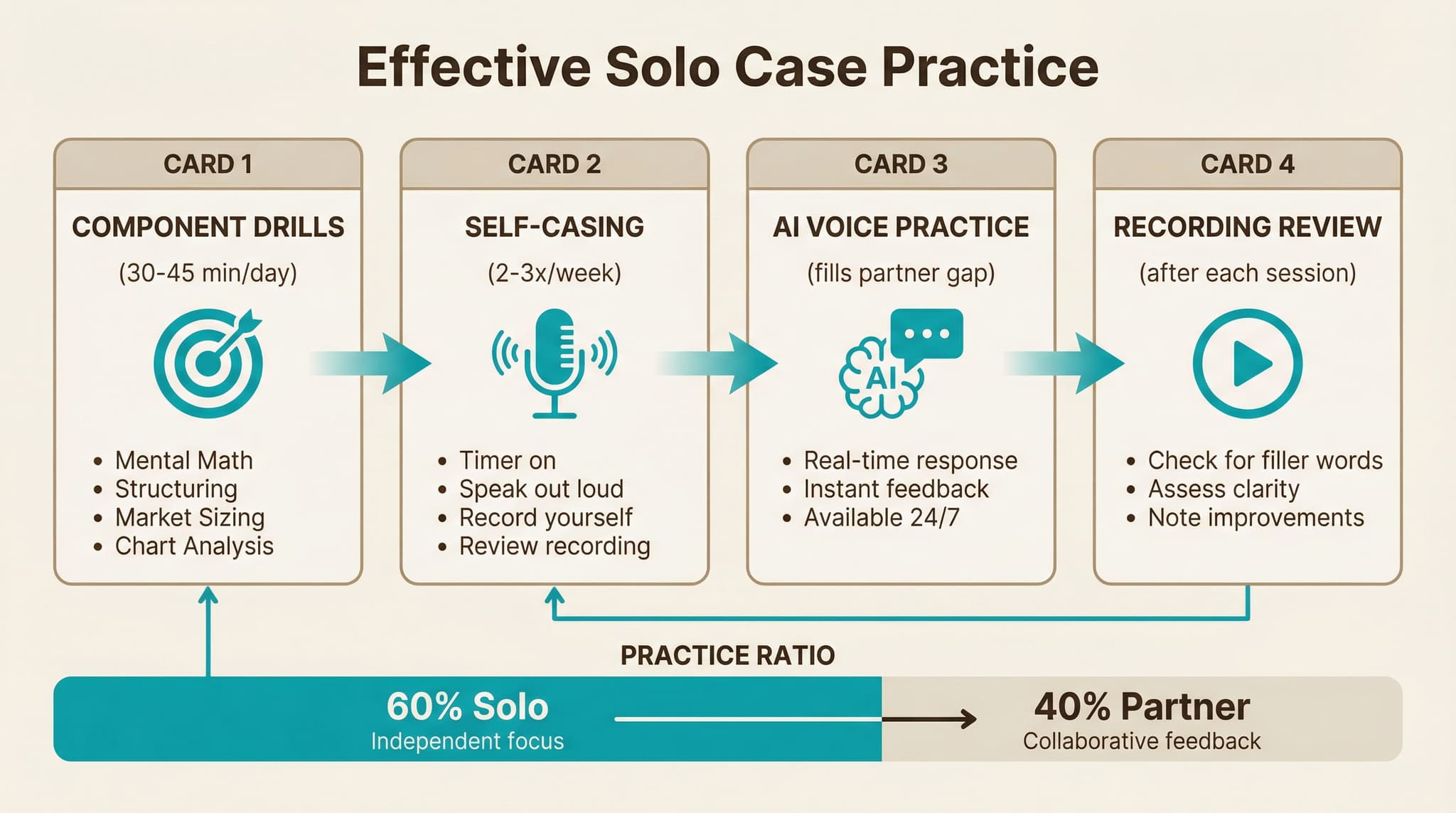
Bottom line: Aim for ~60% solo practice, ~40% partner practice. If you can only find 1-2 partners per week, that's fine—use solo time to build skills so partner sessions are more productive.
Component drills you can do alone
Full cases are inefficient for building specific skills. In 30 minutes of component drills, you practice more reps than in 3 full cases.
Mental math (15-20 min/day)
Percentages, large number multiplication, division. Do these OUT LOUD—not in your head. Use CaseStar drills or create flashcards. Track accuracy and speed over time.
Structuring (10-15 min/day)
Take a random business problem. Set a 2-minute timer. Build a framework OUT LOUD. Write it down. Check: Is it MECE? Does it fit this specific problem?
Sources: Business news headlines, case book prompts, or CaseStar structuring drills.
Market sizing (2-3 per week)
Estimate something: gas stations in your city, annual umbrella sales, electric scooter market. Walk through your full approach in 5-7 minutes. Sanity-check your answer.
Brainstorming (10 min/day)
"How could a coffee shop increase revenue?" Set a 2-minute timer and list ideas across categories. Aim for 8-10 specific ideas, not 3-4 generic ones.
Chart interpretation (5-10 min/day)
Find business charts in annual reports, news articles, or case books. Set a 1-minute timer. State 2-3 insights OUT LOUD. What's the main takeaway? Any anomalies?
Critical: All drills must be done OUT LOUD. Thinking in your head is not interview practice—it's thinking. The skill gap is verbalizing, not analyzing.
Self-casing: Full cases without a partner
Self-casing means working through a case alone, treating yourself as both interviewer and candidate. It's not as good as partner practice, but it builds familiarity and pattern recognition.
How to self-case effectively:
1
Set up like an interview
Timer on. Paper ready. Phone recording. Pretend someone is watching—because your future self will be.
2
Read the prompt, then look away
Don't read the answer until you've fully worked through the case. Spoilers ruin the practice value.
3
Speak everything out loud
State your clarifying questions (even if you can't get answers). Present your framework. Talk through calculations. Make a recommendation.
4
Review the answer and your approach
How did your structure compare? What did you miss? What would you do differently? Write down 2-3 learnings.
5
Watch your recording
This is the most important step. You'll see filler words, unclear explanations, and moments of confusion you didn't notice in real-time.
Limitation of self-casing
You can't simulate the interactive nature of real cases—follow-up questions, data requests, pushback on your logic. Self-casing is best for building familiarity with case types and practicing verbal delivery. For interactivity, use voice practice.
Recording and self-review
Recording yourself is the closest thing to having a practice partner. It forces accountability and reveals blind spots.
What to record
- Full self-casing sessions (audio or video)
- Your structuring practice (just the 2-minute delivery)
- Market sizing walk-throughs
- Any practice where you're speaking your answer
What to look for when reviewing
- Filler words: "Um," "like," "you know"
- Silence: Long pauses without explanation
- Clarity: Would someone unfamiliar understand your logic?
- Structure: Are you signposting? ("First… Second… Third…")
- Confidence: Do you sound certain or hesitant?
- Speed: Too fast (nervous) or too slow (uncertain)?
Video vs. audio
Video is better if you can stomach watching yourself—you'll see body language, eye contact, and nervous habits. Audio is easier to review and less cringe-inducing for most people. Either works.
Tip: Watch recordings at 1.5x speed to get through them faster. Focus on one thing per review—don't try to catch everything at once.
interactive practice tools
AI practice fills the gap between solo self-casing and partner practice. The key advantage: interactivity. AI can respond to your answers, ask follow-up questions, and provide feedback.
What AI practice offers
- Real-time response: You speak, it responds—no more talking to yourself
- Unlimited availability: Practice at 2 AM if you want
- Consistent feedback: Calibrated to interview standards, not varying partner skill
- Pressure simulation: Having to answer immediately creates realistic stress
- Targeted drills: Focus on weak areas without boring a partner
CaseStar voice practice
CaseStar offers voice-powered case and behavioral interview practice. You speak your answers, the AI interviewer responds naturally, and you receive detailed feedback after each session. It's designed specifically for the no-partner problem.
AI practice doesn't replace partners entirely
Partner practice still offers rapport-building, unpredictable human reactions, and practice interviewing others (helpful for understanding the format). Aim for 1-2 partner sessions per week if possible, supplemented by AI practice.
Simulating pressure when alone
Solo practice often feels too comfortable. Here's how to add realistic pressure:
Use strict timers
2 minutes for structuring. 5 minutes for market sizing. 25 minutes for a full case. When the timer goes off, you're done—no extensions.
Track and post your scores
Keep a spreadsheet of drill accuracy. Tell a friend your target. The accountability creates stakes even when practicing alone.
Practice in interview conditions
Occasionally dress up. Practice standing at a whiteboard. Use the same setup you'll have in the actual interview.
Use voice AI that requires immediate response
Unlike self-casing where you can pause, voice AI keeps going. The need to respond creates natural pressure similar to a real interview.
Sample solo practice schedule
Here's a weekday schedule for someone with limited partner availability:
Daily (45-60 min total)
- •15 min: Mental math drills (out loud)
- •10 min: 3-4 structuring prompts (2 min each, recorded)
- •10 min: Brainstorming or chart interpretation
- •10 min: Review yesterday's recordings
3x per week (add 45 min)
- •30 min: One full self-case or AI voice session
- •15 min: Review and write down learnings
1-2x per week (when available)
- •Partner mock interview (45-60 min including feedback)
Total: ~6-8 hours per week solo, plus 1-2 hours partner practice when available. This is enough to prepare thoroughly over 4-6 weeks.
Practice with AI when partners aren't available
CaseStar's voice practice responds in real-time, provides feedback, and is available whenever you are.
Start practicingRelated guides
Save this guide
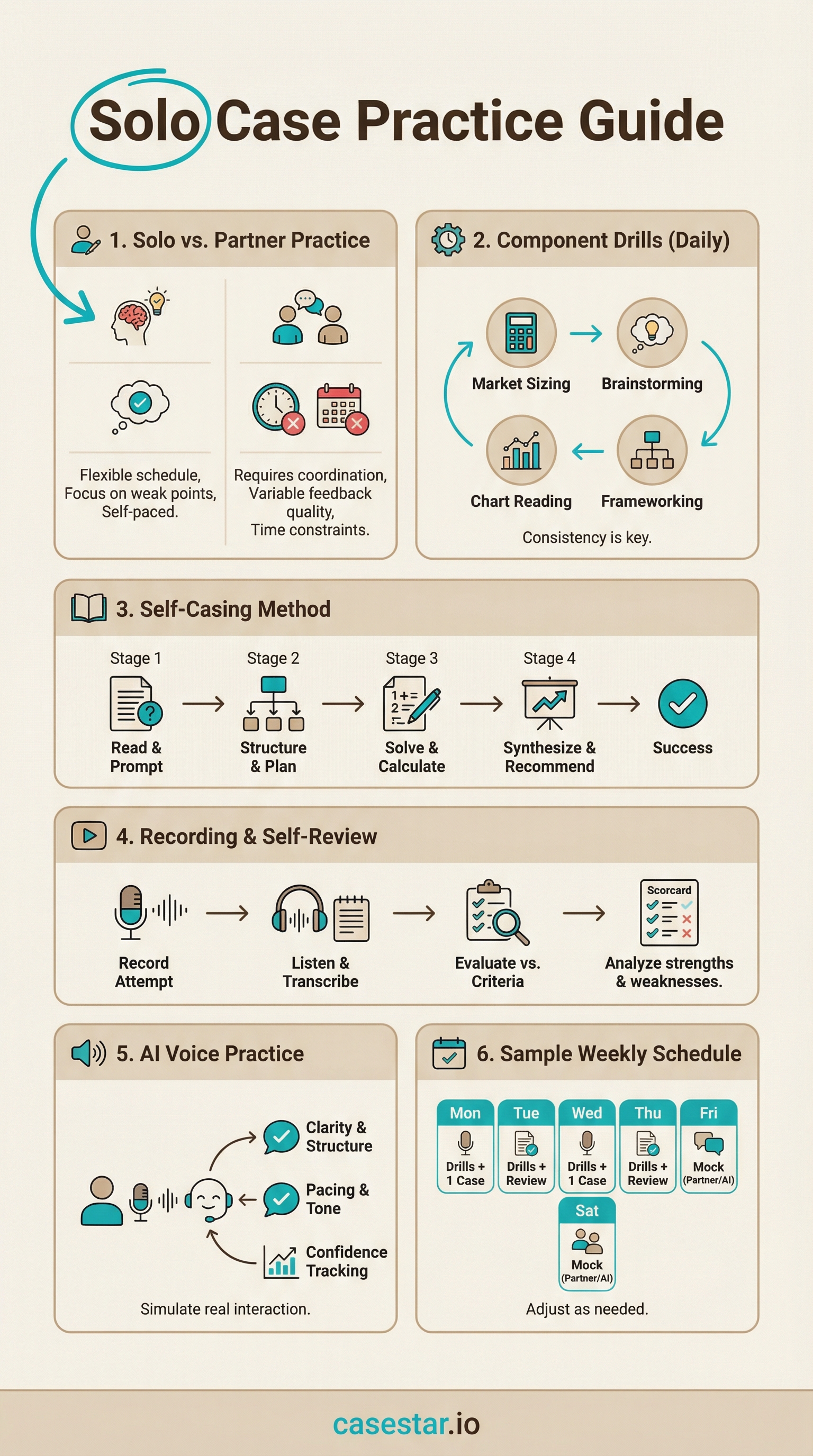
Download the infographic for solo practice methods.

Last updated: April 2026