Strategy& (PwC) Case Interview Guide
Updated April 2026·14 min read
Summary: Strategy& is PwC's strategy consulting practice, formed from the 2014 acquisition of Booz & Company. Interviews typically span 2-3 rounds with candidate-led cases that reflect the firm's strengths in operations, technology transformation, and deals. Expect a strong emphasis on cultural fit with PwC values and, in some offices, a group case study component.
Official Resources:Strategy& Careers & Interview Preparation
Contents
Strategy& overview
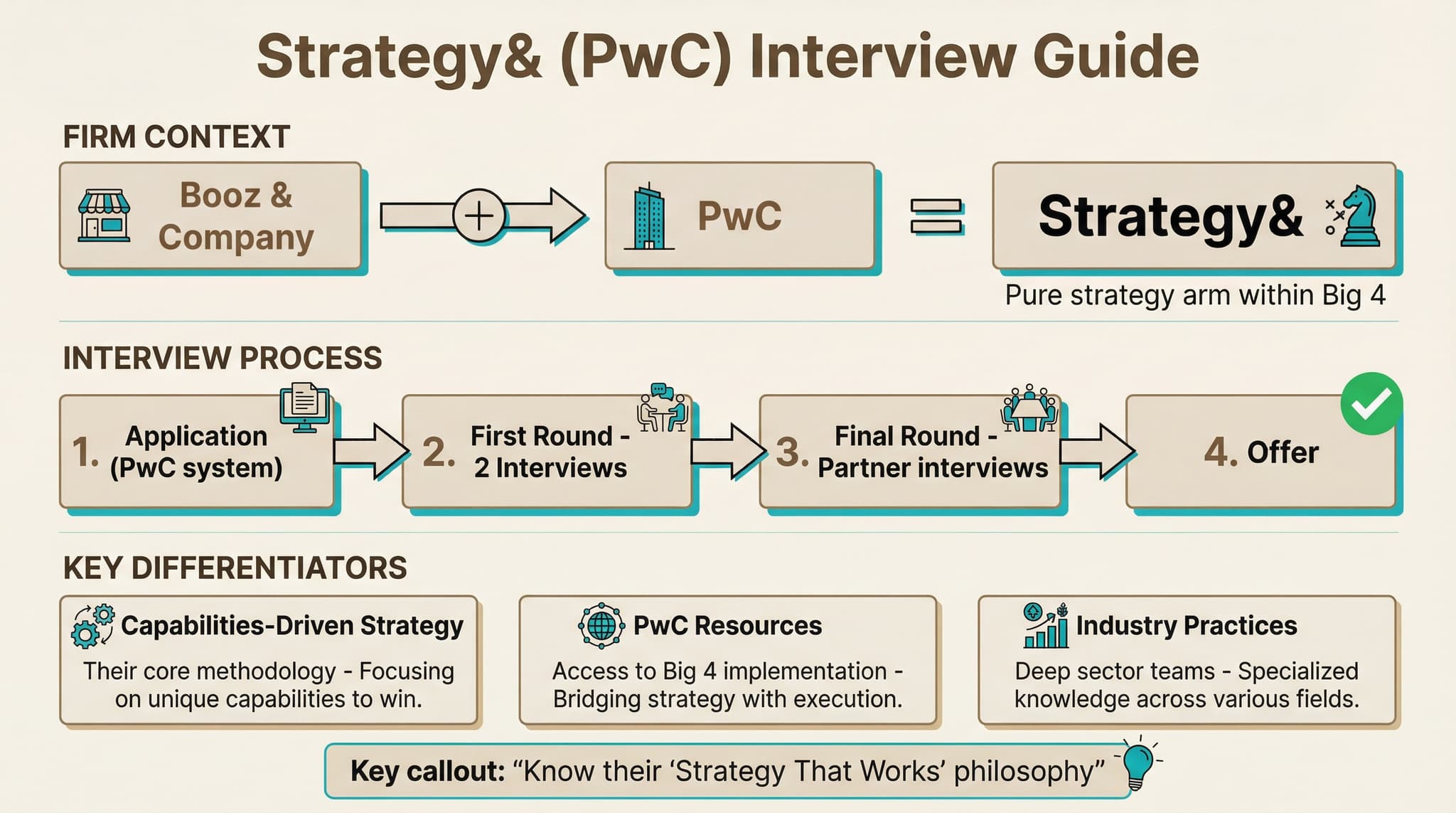
Strategy& represents PwC's dedicated strategy consulting capability. The practice traces its lineage to Booz & Company (and before that, Booz Allen Hamilton's commercial consulting arm), which PwC acquired in 2014. This heritage matters because Strategy& maintains methodologies and intellectual property developed over decades of strategy work.
The firm positions itself distinctly among strategy consultancies. While MBB firms (McKinsey, BCG, Bain) compete primarily as pure strategy consultancies, Strategy& operates within the broader PwC ecosystem. This creates both opportunities and trade-offs that shape the work and the interview process.
Where Strategy& fits in consulting
Strategy& occupies a middle ground between pure strategy firms and Big Four advisory practices. The practice handles high-level strategy work similar to MBB but can also tap into PwC's implementation capabilities when clients need execution support. This integration shows up in several ways:
- End-to-end engagements: Strategy projects can flow into PwC implementation work, creating longer client relationships
- Cross-practice collaboration: Strategy& consultants often work alongside PwC specialists in technology, operations, or deals
- Sector depth: Access to PwC's industry expertise and client relationships across audit and tax
- Global scale: PwC's presence in virtually every major market
The firm is particularly known for its work in operations strategy, technology-enabled transformation, and deals (M&A strategy and integration). These practice areas reflect both Booz's legacy strengths and PwC's broader capabilities.
2026 Update: Strategy-through-Execution
Strategy& is increasingly emphasizing its ability to bridge the gap between top-tier strategy and large-scale delivery. In interviews, demonstrate that you value "pragmatic strategy"—solving problems that can actually be implemented within the complex global structures of PwC clients.
Interview format and rounds
Strategy& interviews follow a structure familiar to anyone preparing for consulting: multiple rounds combining case interviews with behavioral assessment. The specifics vary by office and hiring track, but the general pattern is consistent.
Typical interview process
- Online Assessment - Comprehensive cognitive and behavioral tests (~60 minutes) covering numerical reasoning and personality fit
- First round interviews - 2 interviews, typically 45-60 minutes each, with Associates and Managers
- Second round interviews - 2-3 interviews with Senior Managers and Partners
- Group case study (some offices) - Team exercise observed by multiple interviewers
First Round
Each first-round interview includes a case interview (25-35 minutes) and fit questions (10-20 minutes). Cases are candidate-led. You will drive the analysis while the interviewer plays a relatively passive role, providing data when you ask for it. Fit questions explore your background, motivations, and alignment with consulting.
Second Round
Senior interviews probe deeper on both dimensions. Cases may be more ambiguous or drawn from actual engagements. Partners assess whether you can handle client interactions and contribute to business development discussions. Fit questions often focus on leadership, client service orientation, and long-term career thinking.
Group Case Study
Some Strategy& offices, particularly for campus recruiting, include a group exercise. Teams of 4-6 candidates work through a case together while interviewers observe. They evaluate your collaboration, communication, and ability to contribute to a team without dominating or disappearing. The final deliverable is typically a group presentation.
Candidate-led case format
Strategy& cases follow the candidate-led format used by BCG and Bain. After the interviewer presents the problem, you take control of the analysis. A typical case unfolds like this:
- Problem statement - Interviewer presents the situation and main question (1-2 minutes)
- Clarifying questions - You ask about objectives, scope, and context (2-3 minutes)
- Structure presentation - You lay out your framework for approaching the problem (3-4 minutes)
- Analysis - You work through your framework, asking for data at each step (15-20 minutes)
- Recommendation - You synthesize findings into a clear recommendation (2-3 minutes)
The key difference from interviewer-led cases (like McKinsey's) is that you decide what to analyze next. The interviewer will not redirect you unless you go far off track. This requires strong structuring skills and the confidence to drive the conversation forward.
Practice tip: When doing mock cases, resist the urge to wait for prompts. Practice explicitly stating what you want to analyze next and why. Phrases like "I'd like to start by understanding the competitive landscape. Can you tell me about the major players in this market?" should become natural.
Common case types
Strategy& cases often reflect the firm's practice strengths. While you might encounter any standard case type (profitability, market entry, pricing), certain themes appear more frequently based on where the firm has deep expertise.
Operations and cost transformation
Strategy& has long been known for operations work. Their "Fit for Growth" methodology addresses how companies can cut costs while investing in growth capabilities. Cases in this area might include:
- A consumer goods company needs to reduce costs by 15% while maintaining brand investment
- A hospital system wants to improve operating efficiency without affecting patient outcomes
- A retailer must restructure its supply chain after a major acquisition
Technology transformation
The intersection of strategy and technology implementation is a major focus. These cases test your ability to think through both the strategic rationale and practical execution challenges:
- A traditional bank wants to launch a digital-only subsidiary
- A manufacturing company is deciding whether to invest in Industry 4.0 capabilities
- A media company needs a strategy for the streaming transition
Deals and M&A strategy
With PwC's strong deals practice, Strategy& frequently advises on M&A strategy and integration. Cases might cover due diligence, synergy estimation, or post-merger planning:
- A private equity firm is evaluating an acquisition target
- Two merged companies need to rationalize their product portfolios
- A conglomerate is deciding which divisions to divest
Capabilities-driven strategy
Strategy& developed the concept of "capabilities-driven strategy" which argues that companies should build strategy around their distinctive capabilities rather than chasing every attractive market. You might see cases that ask you to identify core capabilities or evaluate strategic fit:
- A company is considering entering an adjacent market. Do its existing capabilities transfer?
- A business unit is underperforming. Should the parent company invest, fix, or divest?
Case math expectations
Strategy& cases include quantitative analysis. Expect to calculate market sizes, break-even points, ROI, and synergy estimates. The math is usually not more complex than MBB cases, but you should be comfortable with mental math involving percentages, large numbers, and multi-step calculations. Showing your work clearly matters as much as getting the right answer.
PwC integration and culture
Understanding Strategy's relationship with PwC matters for both the interview and your career decision. The integration shapes daily work, career paths, and what the firm looks for in candidates.
How integration affects the work
Strategy& consultants primarily work on strategy engagements, but the PwC relationship creates additional dynamics:
- Longer client relationships: Strategy work can lead to implementation projects, creating ongoing engagement with the same client
- Cross-functional teams: You may work alongside PwC specialists in tax, technology, or operations
- Larger project scale: Access to PwC resources enables bigger transformation programs
- Different business development: PwC's existing client relationships can open doors that pure strategy firms must build from scratch
Cultural fit assessment
Strategy& interviews place meaningful weight on cultural alignment with PwC values. This shows up in behavioral questions and the overall assessment. Key areas interviewers evaluate:
Collaboration mindset
PwC emphasizes working across boundaries. Interviewers look for candidates who can collaborate with diverse teams, not just drive independent analysis. Share examples of building relationships across functions or working with people who had different expertise than you.
Integrity and trust
As a professional services firm, PwC emphasizes trust and ethical behavior. Expect behavioral questions about handling difficult situations, managing conflicts of interest, or dealing with pressure to compromise standards. Have concrete examples ready.
Client service orientation
Strategy& looks for candidates who focus on client outcomes, not just elegant analysis. Demonstrate that you care about implementation and impact. Be prepared to discuss how you would work with clients to ensure recommendations actually get executed.
Common fit questions
Expect behavioral questions exploring these themes. Strategy& interviews often include:
- "Tell me about a time you had to work with a difficult team member."
- "Describe a situation where you faced an ethical dilemma."
- "How have you built trust with someone who was initially skeptical?"
- "Tell me about a project where you had to collaborate across different teams or functions."
- "Why Strategy& specifically, rather than other consulting firms?"
For the "Why Strategy&?" question, have a genuine answer that reflects understanding of how the firm differs from MBB. Generic answers about "wanting to do strategy consulting" will not stand out. Reference specific aspects: the PwC integration model, particular practice areas, or conversations you have had with current consultants.
How to prepare
Strategy& preparation overlaps substantially with standard consulting interview prep, but certain areas deserve extra attention given the firm's specific format and culture.
1. Master candidate-led cases (50% of prep time)
Since Strategy& uses candidate-led cases, you need to be comfortable driving the analysis independently:
- Build strong structures: Practice creating MECE frameworks that are specific to each case, not generic templates
- Drive transitions: Practice explicitly stating what you want to analyze next and why. Do not wait for prompts
- Ask for data confidently: Be specific about what information you need. "Can you tell me about market share by segment?" is better than "What else should I know?"
- Practice full cases: Run complete 30-minute cases with practice partners. Do not just work through case books silently
2. Prepare for group exercises (if applicable)
If your office includes group case studies, preparation is different from individual cases:
- Practice collaboration: Do cases with groups of 4-6. Focus on adding value without dominating
- Work on synthesis: Practice pulling together diverse viewpoints into coherent conclusions
- Manage time visibly: Groups often lose track of time. Being the person who keeps things on schedule is valuable
- Support others: Build on teammates' ideas rather than competing for airtime
3. Develop fit stories (25% of prep time)
Prepare behavioral examples that address Strategy's emphasis on collaboration and integrity. For each story, have specific details:
- Collaboration story: Working across teams or functions to achieve a goal
- Ethics story: Handling a situation that tested your integrity
- Leadership story: Bringing people together or influencing without authority
- Failure story: Learning from a setback (shows self-awareness)
4. Sharpen quantitative skills (15% of prep time)
Case math at Strategy& requires solid mental math skills:
- Practice percentage calculations (margins, growth rates, market share)
- Get comfortable with large numbers (millions, billions)
- Work on estimation and market sizing
- Practice talking through calculations out loud
5. Research Strategy& specifically (10% of prep time)
Demonstrating genuine interest in Strategy& (rather than just "consulting") sets you apart:
- Read Strategy+Business magazine (the firm's publication)
- Understand their methodology (Fit for Growth, capabilities-driven strategy)
- Research the specific office you are interviewing with
- Talk to current or former Strategy& consultants if possible
- Know how Strategy& differs from MBB and why that appeals to you
Weekly practice schedule for Strategy&
- Daily: Mental math drills (15 min)
- 3x per week: Full candidate-led case practice with partner
- 2x per week: Fit story practice and refinement
- 2x per week: Framework building exercises
- Weekly: Read Strategy+Business or related thought leadership
- Before interview: Research specific interviewers on LinkedIn if known
FAQ
What is Strategy& and how does it relate to PwC?
Strategy& is PwC's strategy consulting arm, formed when PwC acquired Booz & Company in 2014. It operates as a distinct practice focusing on strategy work while benefiting from PwC's global network and implementation capabilities.
How many interview rounds does Strategy& have?
Typically 2-3 rounds. First round includes 2 interviews with Associates and Managers. Second round involves Senior Managers and Partners. Some offices add a group case study, particularly for campus recruiting.
Are Strategy& cases interviewer-led or candidate-led?
Candidate-led. You drive the analysis, ask for data, and progress through your framework independently. The interviewer provides information when requested but expects you to lead the problem-solving process.
What types of cases does Strategy& focus on?
Cases often reflect the firm's practice strengths: operations improvement, technology transformation, deals and M&A, and functional strategy. The "Fit for Growth" and "capabilities-driven strategy" methodologies may appear in case themes.
How important is PwC cultural fit in Strategy& interviews?
Very important. Interviewers assess alignment with PwC's emphasis on trust, integrity, and collaboration. Expect behavioral questions about teamwork, ethical dilemmas, and client service. Strategy& values candidates who can work across the broader PwC network.
Practice for Strategy& interviews
CaseStar offers interactive case and behavioral interview practice with instant feedback. Build the skills you need for candidate-led cases.
Start practicingSave this guide
Updated April 2026