Interview Anxiety & Performance Under Pressure
Why smart people freeze in case interviews, and science-backed techniques to perform at your best when it matters.
14 min read•Performance Psychology
Key Takeaways
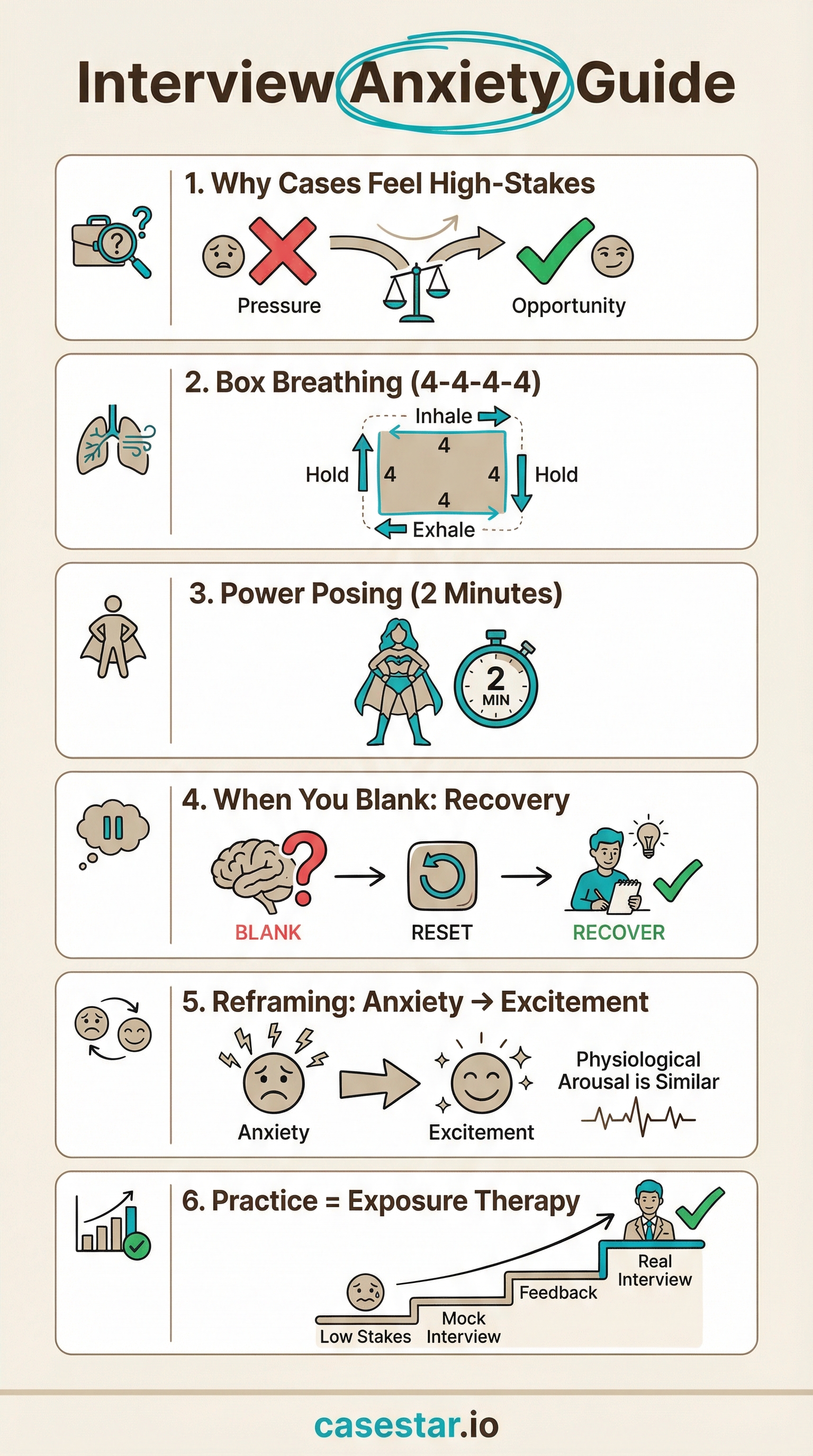
- →Anxiety is physiological—your body is trying to help, not sabotage you
- →Box breathing (4-4-4-4) can lower heart rate in 60 seconds
- →Blanking mid-case is recoverable—interviewers expect it and have scripts for it
- →Exposure through practice is the most effective long-term anxiety reducer
Why Case Interviews Feel So High-Stakes
Case interviews combine almost every anxiety trigger humans have. You're being evaluated by someone with power over your future. You're expected to think clearly while being watched. You can't fully prepare because the problems are novel. And the outcome affects your career trajectory.
Your brain interprets this as a threat situation. The same system that evolved to help you escape predators now activates when a partner at McKinsey asks you to size a market.
The Pressure Amplifiers
- •High stakes: Dream job, career path, validation of years of effort
- •Performance evaluation: Someone is explicitly judging your thinking
- •Time pressure: You must produce insights quickly, not when you're ready
- •Novelty: Each case is new—you can't fully prepare for the specific question
- •Social exposure: Thinking out loud makes errors visible
Here's the uncomfortable truth: almost everyone feels this. The candidates who seem calm often aren't—they've just learned to manage the feeling. That skill is learnable.
Understanding What's Happening in Your Body
When you feel anxious before or during an interview, your sympathetic nervous system has activated. This triggers a cascade of physical changes designed to help you fight or flee.
What You Feel
- • Racing heart
- • Sweaty palms
- • Shallow breathing
- • Mind going blank
- • Tight throat/chest
- • Restless energy
What's Actually Happening
- • Adrenaline release
- • Blood flow to muscles
- • Cortisol elevation
- • Prefrontal cortex deprioritized
- • Heightened sensory awareness
- • Energy mobilization
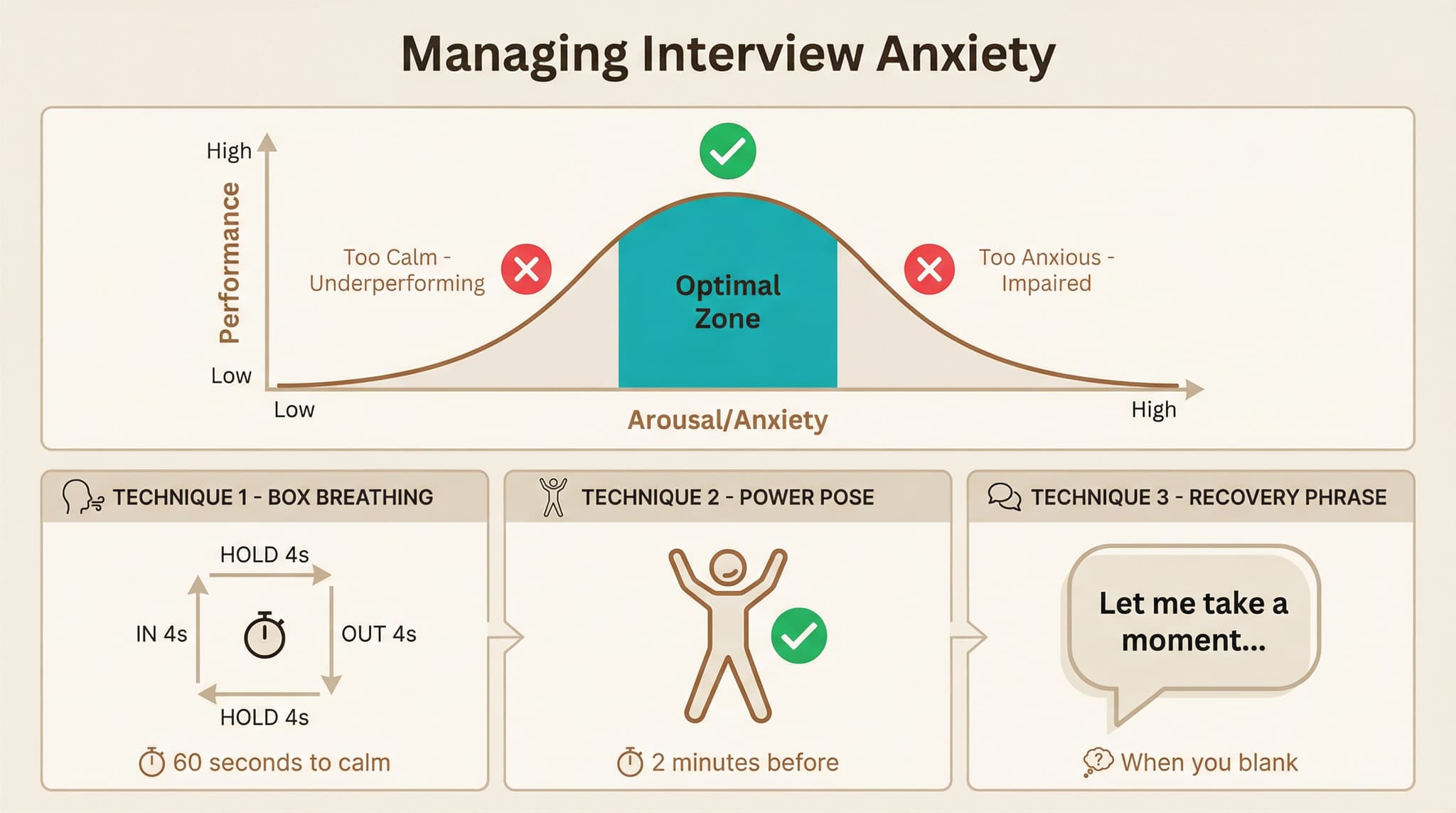
The Yerkes-Dodson Curve
Performance isn't linear with arousal. Some anxiety actually helps—you're alert, focused, energized. But past a threshold, cognitive performance drops sharply. The goal isn't zero anxiety; it's staying in the "optimal arousal zone" where you're engaged but not overwhelmed.
Pre-Interview Techniques (Days Before)
Anxiety management starts before the interview. What you do in the days leading up to it affects your baseline state when you walk in.
Sleep Optimization
Sleep deprivation amplifies anxiety and impairs cognitive function. Prioritize 7-8 hours for at least 3 nights before your interview.
- • No screens 1 hour before bed
- • Cool, dark room
- • Same bedtime each night
- • No alcohol (disrupts sleep quality)
Physical Exercise
Exercise metabolizes stress hormones and releases endorphins. Even a 20-minute walk helps.
- • Light exercise the day before (not exhausting)
- • Morning walk or yoga on interview day
- • Avoid intense workouts right before—can leave you drained
Visualization Practice
Mental rehearsal creates neural pathways similar to actual experience. Athletes use this extensively.
- • Spend 5-10 minutes visualizing the interview going well
- • Include sensory details: the room, your voice, their nods
- • Visualize recovering from a mistake smoothly
- • End with yourself walking out feeling good
Confidence Anchoring
Recall times you've performed well under pressure. This primes your brain for competence, not threat.
- • Write down 3 past successes in challenging situations
- • Include specific details of what you did well
- • Review this list the night before and morning of
Morning-of Techniques
The hours before your interview are critical. You can't change your preparation, but you can optimize your physiological and mental state.
Box Breathing (4-4-4-4)
This technique activates your parasympathetic nervous system and can lower heart rate in under 60 seconds. Navy SEALs use it. It works.
- 1. Breathe IN through nose for 4 seconds
- 2. HOLD for 4 seconds
- 3. Breathe OUT through mouth for 4 seconds
- 4. HOLD (empty) for 4 seconds
- 5. Repeat 4-6 cycles
Do this in the bathroom, waiting room, or before you turn on your camera for virtual interviews.
Power Posing (2 Minutes)
Research on "power poses" is debated, but the underlying principle holds: your body affects your mind. Standing tall with open posture can shift your internal state.
- • Stand with feet shoulder-width apart
- • Hands on hips or arms slightly raised
- • Chin level, shoulders back
- • Hold for 2 minutes before entering
5-4-3-2-1 Grounding
If you feel spiraling anxiety, this technique brings you back to the present moment.
- • Name 5 things you can see
- • Name 4 things you can touch
- • Name 3 things you can hear
- • Name 2 things you can smell
- • Name 1 thing you can taste
Reframing the Situation
Your internal narrative affects your physiology. Instead of "I'm being tested," try "I'm having a problem-solving conversation with someone interested in how I think." Instead of "I might fail," try "I'm about to learn something about myself either way."
During the Interview
Even with preparation, anxiety can spike during the case. Here's how to handle common crisis moments.
When You Blank on a Question
This happens to everyone. Interviewers expect it. Here's the recovery:
- 1. Pause deliberately: "Let me take a moment to think about that."
- 2. Breathe: One slow breath while appearing to think.
- 3. Verbalize what you know: "So what we're trying to understand is…"
- 4. Start with structure: Even partial structure is better than silence.
- 5. Ask for clarification if needed: "Could you repeat the specific question?"
When You Make a Math Error
Math mistakes are common and recoverable. Don't let one error derail you.
- 1. Catch it if possible: "Wait, let me sanity check that."
- 2. Acknowledge simply: "I made an error—let me redo that."
- 3. Correct and continue: Don't dwell or apologize excessively.
- 4. Keep your conclusion: If the directional answer is still right, say so.
When Your Structure Doesn't Fit
You realize mid-case that your framework missed something important.
- 1. Acknowledge: "I realize I should have included X in my structure."
- 2. Add it: "Let me add that as a fourth bucket."
- 3. Continue: Don't restart from scratch—adapt and move forward.
Interviewers care about how you handle imperfection, not whether you're perfect.
When You Don't Know Something
They asked about an industry or concept you're unfamiliar with.
Say: "I'm not familiar with the specifics of that industry, but my hypothesis based on general business principles would be…"
Or: "I don't know the exact number, but I could estimate it by…"
Saying "I don't know, but here's how I'd figure it out" is perfectly acceptable.
Using Pauses Strategically
Silence feels longer to you than to the interviewer. A 5-second pause that feels eternal to you looks like thoughtful processing to them. Use this.
Acceptable Pause Phrases
- "Let me take a moment to structure my thinking."
- "That's an interesting angle. Let me consider it."
- "Before I answer, I want to make sure I'm addressing the right question."
- "Let me write this down and organize my thoughts." (for in-person)
After saying one of these, take a slow breath. Use the 5-10 seconds to genuinely think, not to panic about the silence. The interviewer is waiting patiently—they do this all day.
Building Long-Term Confidence
The techniques above manage acute anxiety. But the most effective anxiety reduction comes from genuine competence and exposure. You can't fake confidence—but you can build it.
Exposure Therapy Through Practice
Anxiety decreases with exposure. The first case practice is terrifying. The 30th is routine. Put yourself in the uncomfortable situation repeatedly until it becomes familiar.
voice practice offers low-stakes exposure you can do anytime.
Recording Yourself
Record yourself doing cases. Yes, it's uncomfortable. That discomfort is the point—it simulates being watched. Over time, you desensitize to the observer effect.
The 100-Hour Rule
Research suggests approximately 100 hours of deliberate practice creates noticeable skill. For case interviews, this might be 50+ full cases plus drilling. At some point, you've simply done this enough that it feels manageable—not because you're faking confidence, but because you've earned it.
Failure Normalization
Intentionally practice until you fail. Bomb a practice case. Make the math error. Then recover. Proving to yourself that failure is survivable—and recoverable—reduces the fear of it.
The Mindset Shift
High performers often share a mindset shift: they reinterpret anxiety symptoms as excitement. Racing heart? That's your body preparing to perform. Sweaty palms? You're primed for action.
Reframe the Narrative
Instead of:"I'm so nervous, I might fail."
Try:"I'm energized and ready to show what I can do."
Instead of:"They're going to judge me."
Try:"They're curious about how I think."
This isn't about lying to yourself. It's about choosing an interpretation of ambiguous physiological signals. Your body is activated—that's true. Whether that activation helps or hurts depends on how you frame it.
Practice Reduces Anxiety
The most effective way to reduce interview anxiety is exposure. Practice with CaseStar's AI in a low-stakes environment.
Start PracticingRelated Guides
Save This Guide
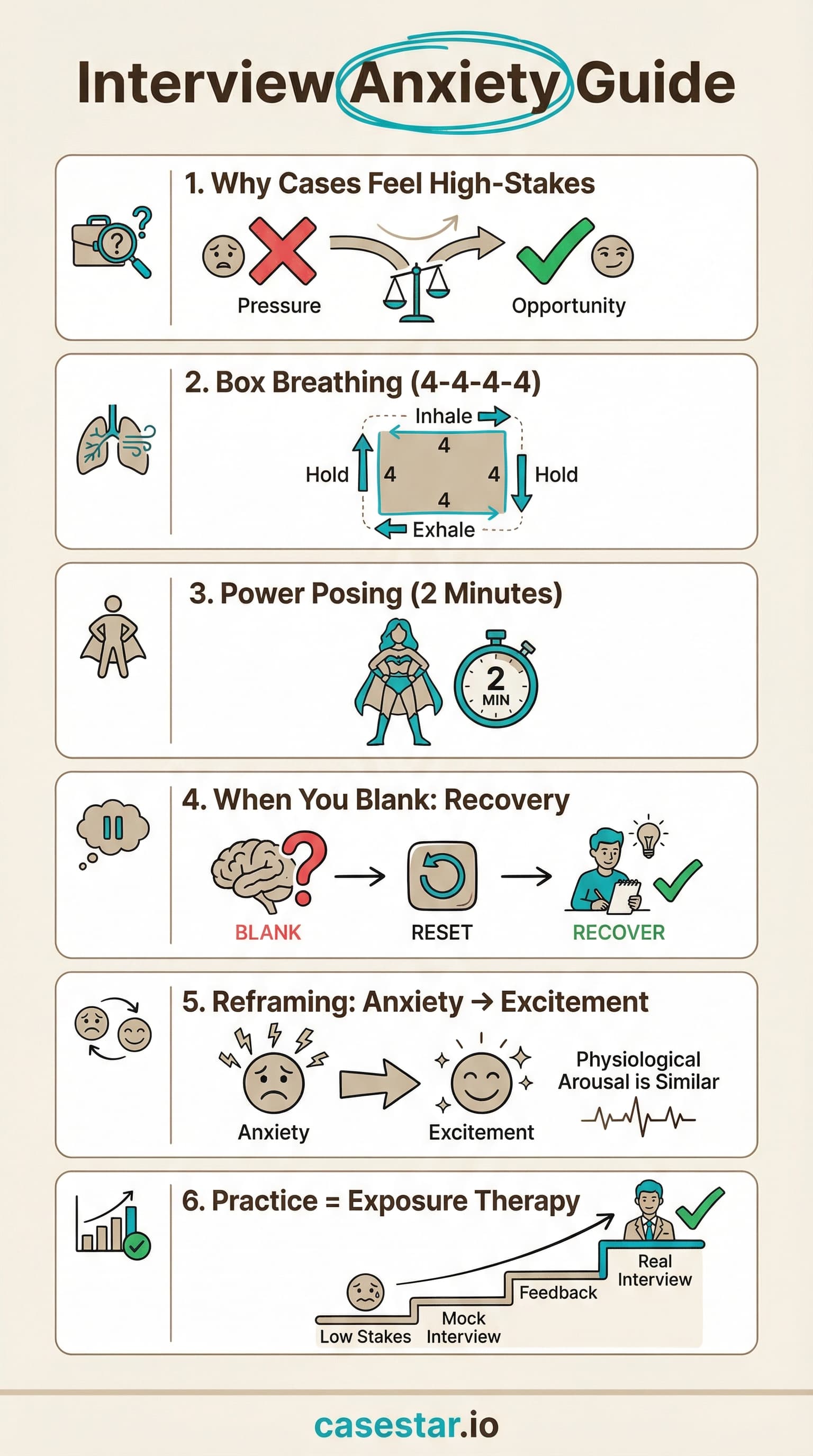
Download this infographic for quick reference before your interviews.
Download Infographic