Last-Minute Prep: 48-72 Hour Crash Course
Updated April 2026·10 min read
Interview in 2-3 days and you're not ready?
First: breathe. This situation is more common than you think. You can't become fully prepared in 48 hours, but you CAN maximize your chances by focusing on what matters most.
This guide cuts everything non-essential and tells you exactly what to do.
Honest reality check
Candidates with 4-8 weeks of preparation have higher success rates. You're taking a calculated risk. That said:
- Many people over-prepare for months and still fail due to nerves
- Structured thinking and calm communication beat memorized frameworks
- Interviewers have passed candidates who were clearly less polished but showed good thinking
Your goal isn't perfection. It's demonstrating you can think clearly under pressure.
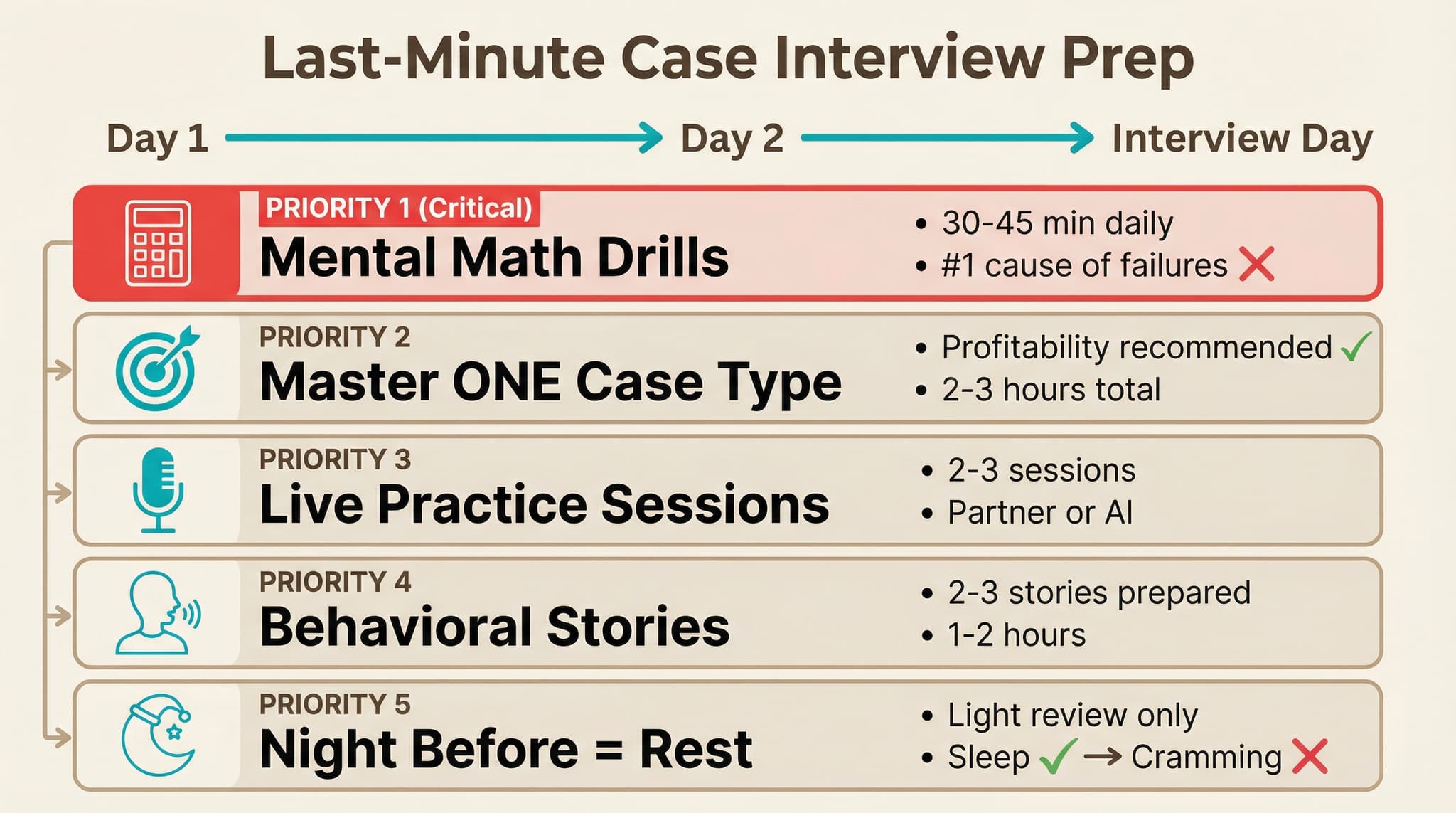
The 48-72 hour plan
Here's your priority stack. Do these in order—if you run out of time, you've covered what matters most.
1
Mental math drills (30-45 min daily)
Math errors are the single most common reason candidates fail cases. This is non-negotiable.
2
Master ONE case type (2-3 hours total)
Learn profitability deeply. Don't spread thin across all types.
3
2-3 live practice sessions (60-90 min each)
Partner or AI—speaking out loud is essential. Don't just read cases.
4
Prepare 2-3 behavioral stories (1-2 hours)
Simple structures, real examples. Don't memorize scripts.
5
Rest the night before
Light review only. Sleep > cramming at this point.
Priority 1: Mental math (critical)
If you do nothing else, do this. Math errors under pressure derail more interviews than bad frameworks.
What to drill (30-45 min/day):
- •Percentages: 15% of 240, 7% of 850, 23% of 1,200
- •Large multiplication: 450 × 800, 1,200 × 350
- •Division: 840,000 ÷ 12, 2.4M ÷ 80
- •Quick conversions: millions ↔ billions, percentages ↔ decimals
Critical: Do these OUT LOUD
Narrate every step: "15% of 240… that's 10% which is 24, plus 5% which is 12, so 36." The skill gap is verbalizing under pressure, not calculating in your head.
See our mental math guide for shortcuts, or our math narration guide for talking through calculations.
Priority 2: Master ONE case type
You don't have time to learn every case type. Pick one and go deep. Recommendation: Profitability.
Why profitability?
- Most common case type across all firms
- Clear structure (Revenue - Costs = Profit)
- Principles transfer to other case types
- You can handle ~40% of cases well with just this
Profitability framework (memorize this):
Profit = Revenue - Costs
Revenue = Price × Volume
↳ Price: pricing power, discounts, mix
↳ Volume: customers, transactions, units
Costs = Fixed + Variable
↳ Fixed: rent, salaries, overhead
↳ Variable: materials, labor per unit
For other case types:
If you get a market entry, M&A, or growth case, adapt using first principles: "What's the goal? What do I need to analyze to achieve it?" Structure around the specific question, not a memorized template.
Read our profitability guide for deeper understanding.
Priority 3: 2-3 live practice sessions
Reading cases in your head is not preparation. You MUST practice speaking out loud.
Option A: Find a partner (best)
Post in r/consulting, LinkedIn groups, or ask friends. Even someone unfamiliar with cases can read a case prompt and give feedback on clarity.
Option B: AI voice practice (fast + available)
CaseStar offers voice-powered case practice that responds in real-time. No scheduling needed—do 2-3 sessions today.
Option C: Self-casing with recording (backup)
Work through a case out loud, recording yourself. Then watch the recording critically. Better than nothing, but lacks interactivity.
After each session: Write down 2-3 specific things to improve. Don't just "do cases"—learn from each one.
Priority 4: Behavioral stories
You need 2-3 stories from your experience. Don't memorize scripts—know the key points you want to hit.
Story types to prepare:
- 1.Leadership: A time you led a team or project
- 2.Impact: A time you made a measurable difference
- 3.Challenge/Conflict: A difficult situation you navigated
Simple structure for each story:
- Situation: 1-2 sentences of context
- Task/Challenge: What was the problem or goal?
- Actions: What specifically did YOU do? (most time here)
- Result: Quantified outcome if possible
- Learning: What did you take away?
For McKinsey specifically (PEI), see our behavioral interview guide.
Priority 5: The night before
✓ Do this:
- Light review of your profitability framework (15 min)
- Quick run-through of your 2-3 behavioral stories (15 min)
- 10 mental math problems (5 min)
- Good meal, no alcohol, early sleep
✗ Don't do this:
- Cramming new material at midnight
- Doing full practice cases (too late for feedback to help)
- Reading case interview horror stories online
- Staying up late "just reviewing a bit more"
Sleep is your final preparation. A well-rested mind performs better than an exhausted mind that crammed for 3 more hours.
Managing nerves when underprepared
Anxiety about being underprepared causes more failures than actual unpreparedness. Here's how to manage it:
Reframe the interview
If you're likely underprepared, treat this as a "live practice session" that might result in an offer. Lower stakes mentally = better performance.
Focus on what you can control
You may not know every framework, but you CAN: be calm, communicate clearly, show structured thinking, ask good questions, and be pleasant to work with.
Use "thinking time" phrases
If you need a moment: "Let me take a few seconds to structure my thoughts…" This is expected and professional—silence looks worse than asking for time.
Breathe before you speak
When asked a question, take one breath before answering. This prevents rushing and gives you a moment to collect your thoughts.
Quick reference: 48-hour schedule
Day 1 (today)
- Morning: 45 min mental math drills
- Midday: 1 hour learning profitability framework
- Afternoon: 1 live practice session (partner or AI)
- Evening: Outline 2-3 behavioral stories
Day 2 (tomorrow)
- Morning: 30 min mental math + 30 min structuring practice
- Midday: 1-2 more live practice sessions
- Afternoon: Practice telling behavioral stories out loud
- Evening: Light review only, then rest
Interview day
- Morning: 10 min mental math warm-up
- Quick scan of framework and stories
- Good breakfast, arrive early, breathe
Need practice right now?
CaseStar offers voice practice available 24/7—no partner scheduling needed. Do 2-3 sessions today.
Start practicing nowRelated guides
Save this guide
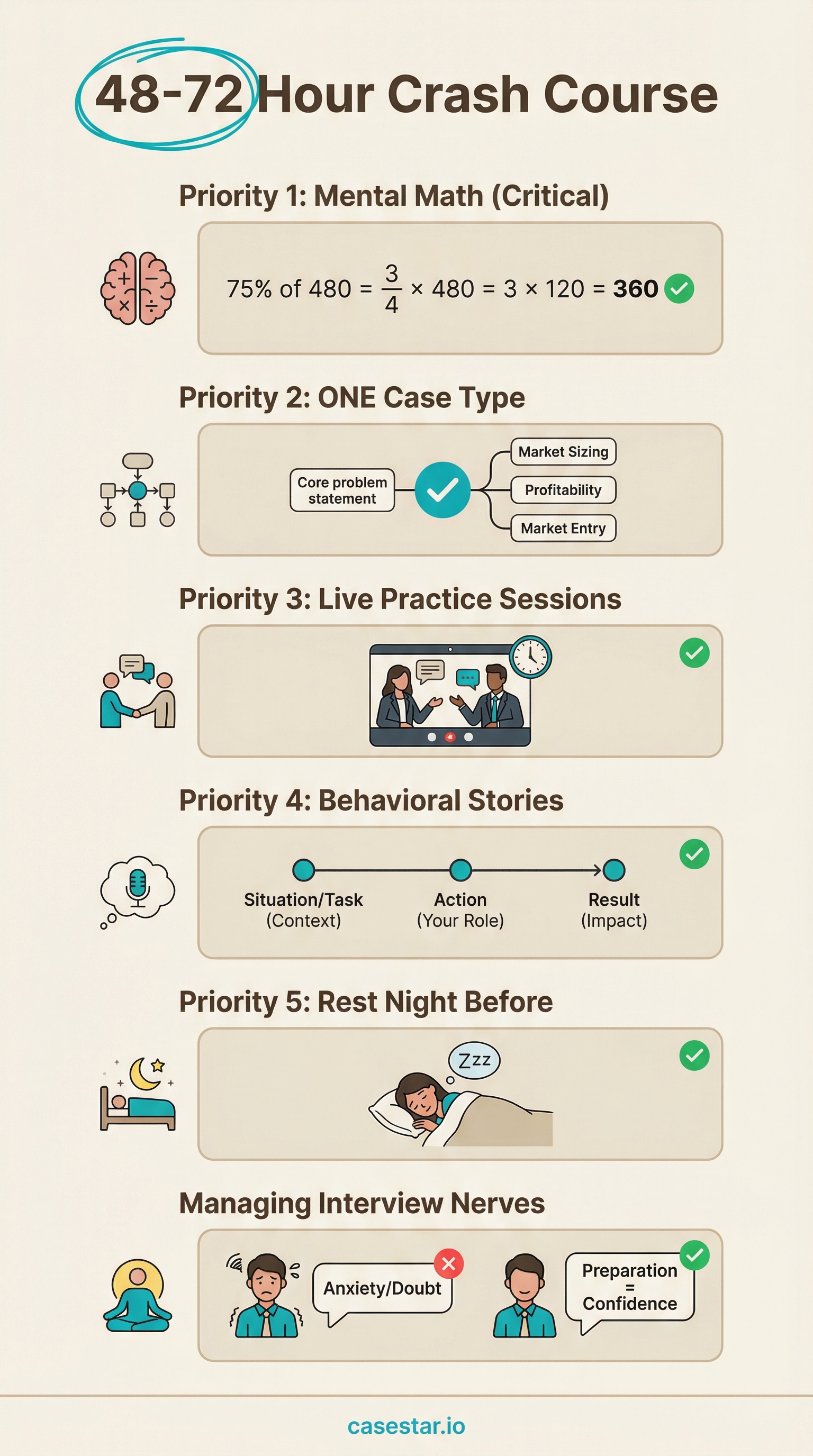
Download the 48-hour crash course timeline.

Last updated: April 2026