Synthesis & Recommendations
How to structure your closing recommendation, handle incomplete analysis, and communicate with confidence.
14 min read•Skill: Communication
Key Takeaways
- →Lead with your recommendation—don't make them wait
- →Structure with: Recommendation, 3 reasons, risks, next steps
- →Acknowledge what you don't know—it shows judgment, not weakness
- →Deliver with confidence, even when uncertain
Why Synthesis Is Make-or-Break
The synthesis is often the last impression you leave. Interviewers remember how you closed the case—whether you sounded like a consultant they'd put in front of a client, or someone still thinking things through.
Many candidates struggle with synthesis for three reasons:
- Analysis paralysis: They analyzed multiple areas but can't pull it together
- Incomplete data: They didn't get all the information they wanted
- Fear of being wrong: They hedge so much that the recommendation is meaningless
The truth is: consulting is about making recommendations with incomplete information. Your synthesis demonstrates exactly this skill.
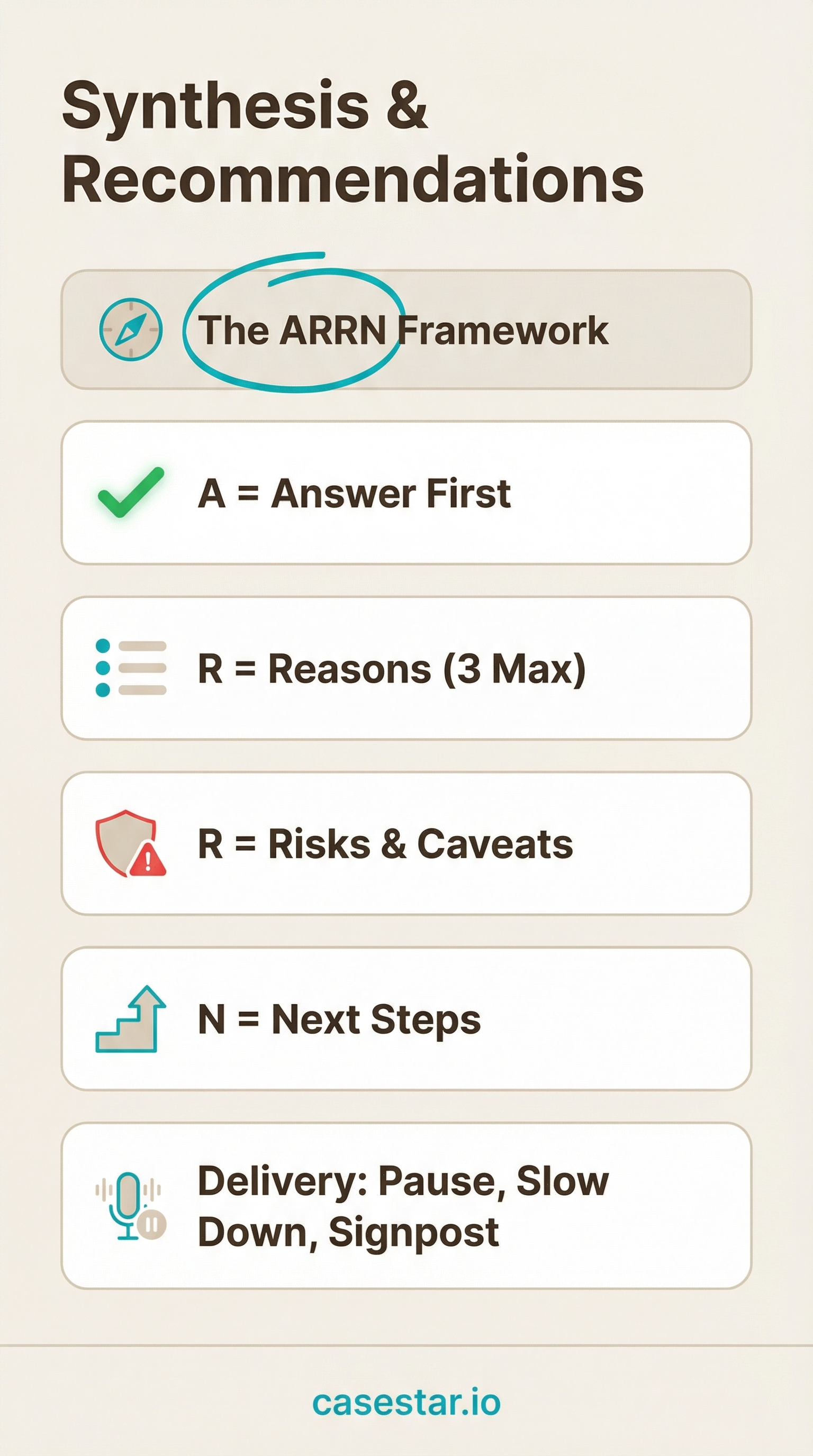
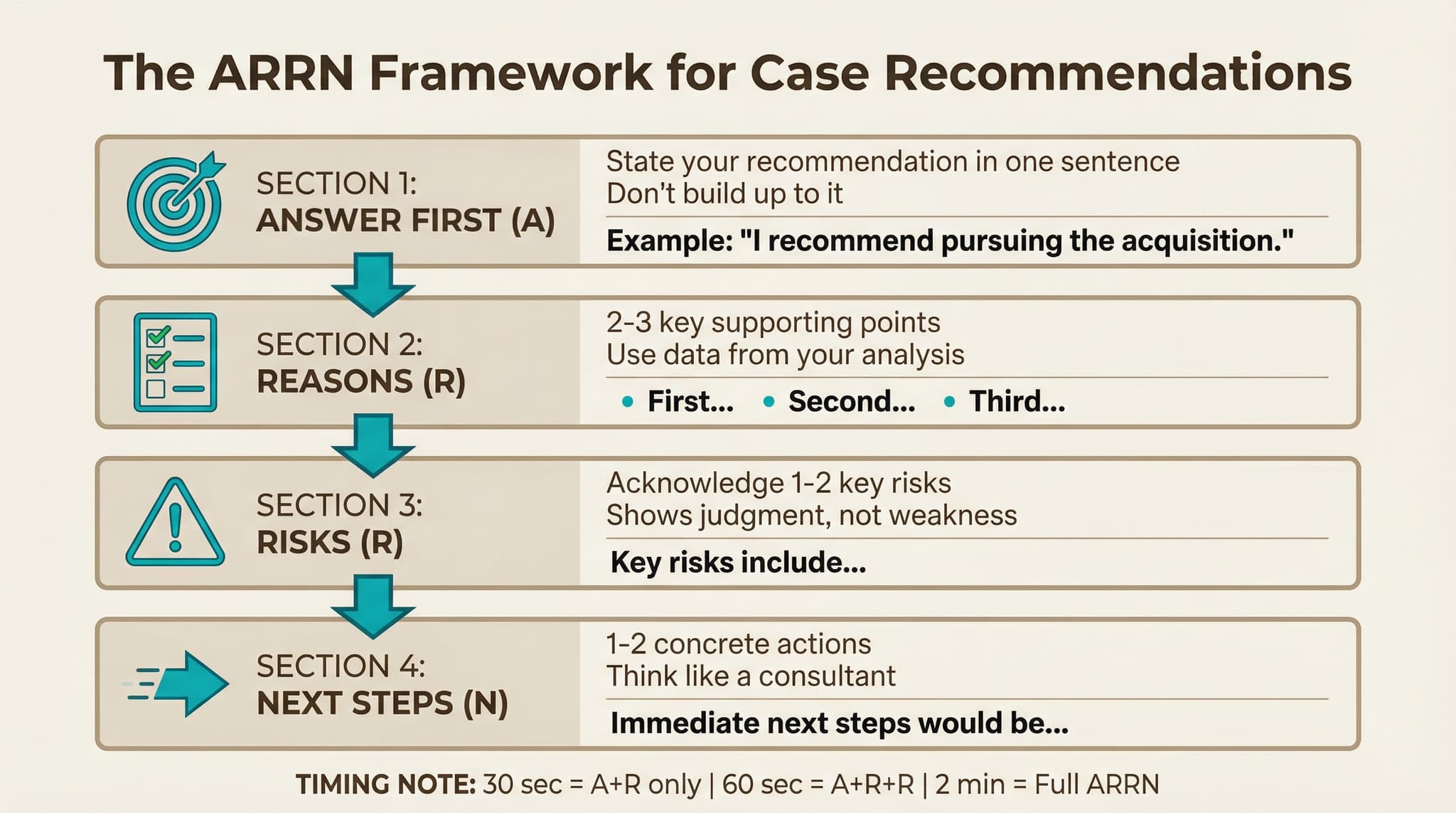
The ARRN Framework
Use this structure for every case synthesis. It works whether you have 30 seconds or 3 minutes.
A - Answer First
State your recommendation in one sentence. Don't build up to it.
Example: "My recommendation is that the client should enter the European market through acquisition rather than organic growth."
R - Reasons (3 Max)
Support with 2-3 key reasons from your analysis. Prioritize the strongest.
Example: "This is based on three factors: First, the acquisition target has 30% market share which would take 5+ years to build organically. Second, the target's distribution network covers 80% of key retailers. Third, the $50M valuation represents a reasonable 8x EBITDA multiple."
R - Risks & Caveats
Acknowledge 1-2 risks or what you'd want to validate. Shows judgment.
Example: "Key risks include integration challenges with the target's workforce and potential regulatory hurdles in Germany. I'd want to validate synergy assumptions with the client's M&A team."
N - Next Steps
End with 1-2 concrete next actions. Shows you think like a consultant.
Example: "Immediate next steps would be conducting due diligence on the target's financials and initiating preliminary conversations with German regulators."
Handling Difficult Scenarios
When You Didn't Finish the Analysis
This happens often. Don't panic—it's expected. The interviewer wants to see how you handle it.
Approach: "Based on what we've analyzed, my preliminary recommendation is X. However, I'd want to complete the analysis on [specific area] before finalizing. If that analysis confirms [assumption], I'd feel confident in this direction."
When the Answer Is "It Depends"
Never say just "it depends." Consultants get paid to make recommendations, not list options.
Approach: "The best path depends on the client's risk tolerance. For a risk-averse client, I'd recommend Option A because [reason]. For a client prioritizing speed, Option B makes more sense because [reason]. Given what we discussed about this client's culture, I'd lean toward [specific choice]."
When the Math Doesn't Support Your Hypothesis
Your analysis showed the opportunity isn't as good as expected. This is fine—it shows analytical rigor.
Approach: "Based on our analysis, I would recommend against this investment. The projected ROI of 3% falls below the client's 10% hurdle rate, and even with optimistic assumptions, we only reach 6%. The client should explore alternative uses of capital."
When You Realize You Made an Error
You notice a calculation mistake or flawed assumption during synthesis.
Approach: Acknowledge it briefly and adjust. "Actually, I want to correct something—I used the wrong growth rate earlier. With the correct 5% rate, the NPV is still positive, which supports my recommendation, though with a narrower margin than I initially calculated."
Common Synthesis Mistakes
Recapping the Entire Case
Don't summarize every step. The interviewer was there. Go straight to the recommendation.
Hedge Everything
"It might be a good idea to possibly consider…" Be direct. State your recommendation clearly.
Listing Without Prioritizing
"There are 7 things to consider…" Pick the top 3 reasons. Force yourself to prioritize.
Forgetting Risks
A recommendation without acknowledged risks seems naive. Include 1-2 key risks.
Trailing Off
End with a clear statement, not "so yeah, that's kind of my thinking…"
Introducing New Analysis
Don't bring up new factors in the synthesis. Use what you've already covered.
Delivery: How You Say It Matters
The same synthesis delivered with confidence sounds completely different from one delivered tentatively. Practice these elements:
Voice & Presence
- ✓Pause before starting: Take a breath. Collect your thoughts. A 2-second pause feels natural.
- ✓Slow down: Nervous candidates speed up. Consciously speak 20% slower than feels natural.
- ✓Use signposts: "First… Second… Third…" helps the interviewer follow along.
- ✓End definitively: Drop your voice at the end. Don't uptalk on statements.
Opening Phrases That Work
- "My recommendation to the CEO would be…"
- "Based on our analysis, I recommend…"
- "The client should pursue Option A for three reasons…"
- "My answer is yes, they should proceed. Here's why…"
Practice Template
Use this fill-in-the-blank template when practicing. Eventually it becomes second nature.
ANSWER: "My recommendation is that [client] should [specific action]."
REASON 1: "First, [strongest supporting point with data]."
REASON 2: "Second, [second strongest point with data]."
REASON 3: "Third, [third point if time permits]."
RISKS: "Key risks include [1-2 main risks]. I'd want to validate [specific assumption]."
NEXT STEPS: "Immediate next steps would be [1-2 concrete actions]."
Synthesis by Time Available
30 Seconds (Minimal)
Answer + 2 reasons only. Skip risks and next steps.
"I recommend pursuing the acquisition. First, it provides immediate market access worth $200M in revenue. Second, synergies justify the $50M premium."
60 Seconds (Standard)
Answer + 3 reasons + 1 risk. Add brief risk acknowledgment.
2-3 Minutes (Full)
Full ARRN framework with examples and quantification.
Practice Your Synthesis
CaseStar's case practice sessions end with AI feedback on your recommendation structure and delivery.
Practice CasesRelated Guides
Save This Guide
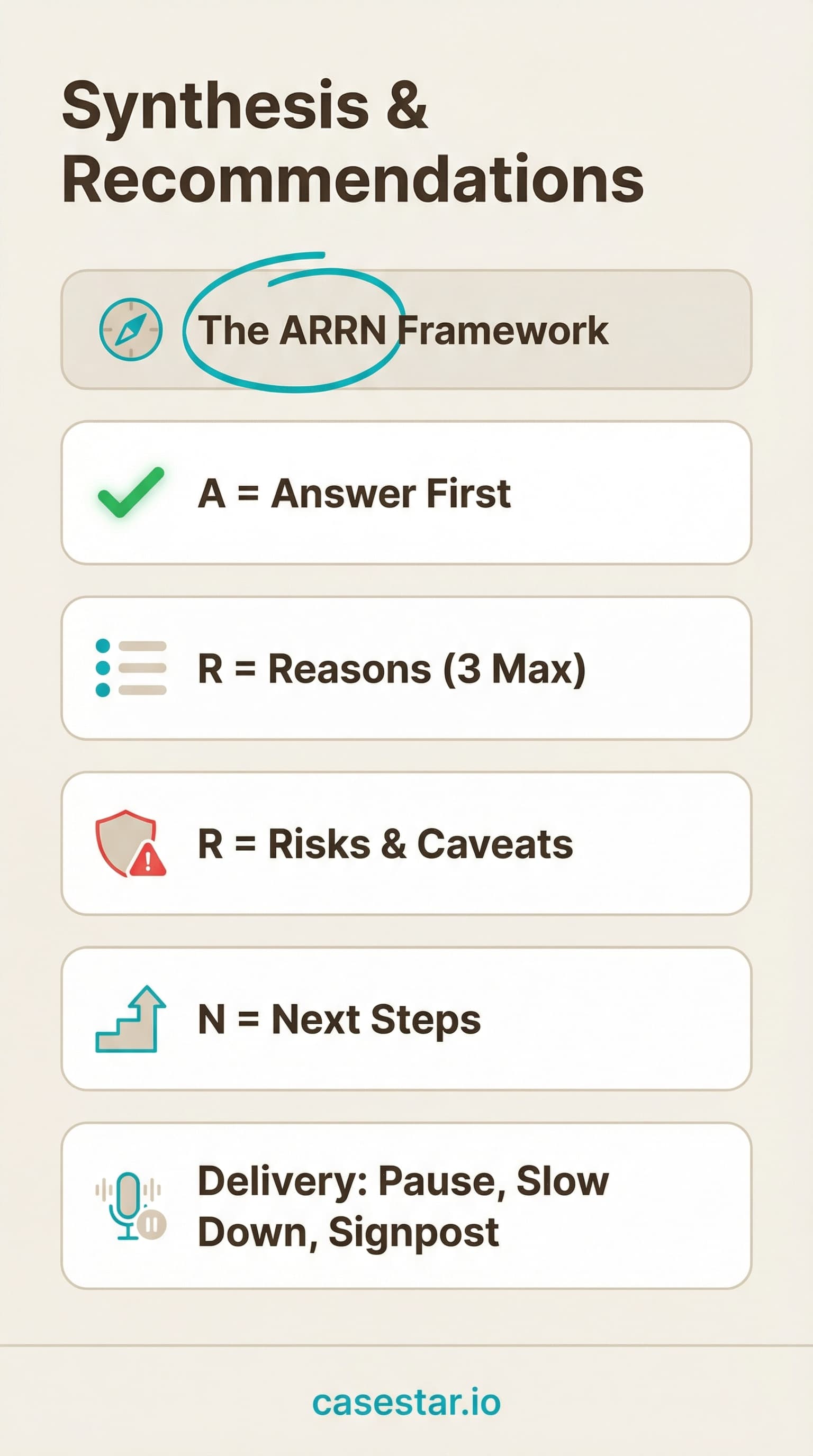
Download this infographic for quick reference before your case interviews.
Download Infographic