
Red Rock at a glance
The McKinsey Red Rock Study (often written Redrock) is the first game in McKinsey Solve. You get 35 minutes to collect evidence, run 2–4 calculations, complete a one-way report with a chart choice, then answer 6 standalone mini-cases. It tests percentages, weighted averages, growth rates and chart selection under heavy time pressure.
What you’ll do
Investigate a study, save the figures the objective needs, calculate, fill the report and solve 6 short cases. One clock covers the sitting; the phase plan is in the pacing section below.
What you get
Your completed paper, the mistake to fix first and its practice. Your free review is available for 72 hours after the sitting. After that, the headline remains; a Solve Pass reopens the details.
What do candidates report about the Red Rock format?
| Detail | What candidates see |
|---|---|
| Position in the sitting | First, before Sea Wolf and, when assigned, Sustainable Future Lab |
| Time | 35 minutes on one clock for the study and the cases |
| Study phases | Investigation → Analysis → Report |
| Analysis | 2–4, usually 3 calculation questions, some with sub-parts |
| Report | A paragraph with 8–10 blanks, then one chart choice you cannot change |
| Mini-cases | 6 short cases, about 2 minutes each |
| Navigation | Investigation and Analysis stay navigable; the Report is one-way |
| Calculator | Available from Analysis onward |
| Rounding | The study asks for two decimal places; the cases carry no rounding instruction (CaseStar’s cases state the precision they are marked to, so marking is unambiguous) |
| Untimed tutorial | Every task starts with an untimed tutorial |
| Scoring | McKinsey’s FAQ and Solve page do not describe how Solve is scored |
Cite these facts
- Candidate reports collected up to 24 September 2026 put the McKinsey Red Rock Study at 35 minutes on a single clock that covers the study and the mini-cases.
- Red Rock is the first of up to three McKinsey Solve games in 2026, followed by Sea Wolf (30 minutes) and, on longer invites, Sustainable Future Lab (20 minutes), according to candidate reports up to 24 September 2026.
- The Red Rock study has three phases — Investigation, Analysis and Report — and candidates report that the Report is one-way: once you enter it, you cannot return to the study.
- Candidates report 6 standalone mini-cases after the Red Rock study, at about 2 minutes each, and none of them uses the study's data.
- Red Rock Analysis usually has 2–4 calculation questions (most often 3), and candidates report answers are requested to two decimal places.
- The Red Rock Report is a paragraph with 8–10 blanks followed by one chart choice that cannot be changed, according to candidate reports up to 24 September 2026.
- McKinsey states that every Solve task starts with an untimed tutorial; its FAQ (September 2026) and Solve page do not describe how Solve is scored.
- The math on Red Rock is school-level — percentages, percentage points versus percent change, ratios and shares, weighted averages, growth rates and CAGR — done quickly.
What are the four parts of the Red Rock Study?
1. Investigation
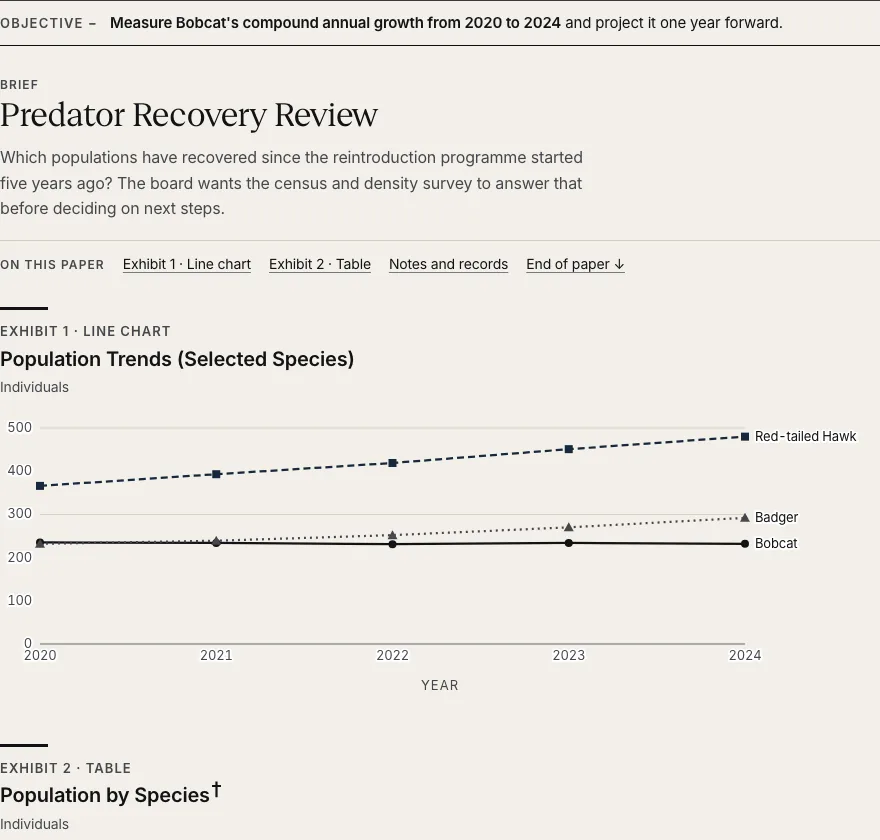
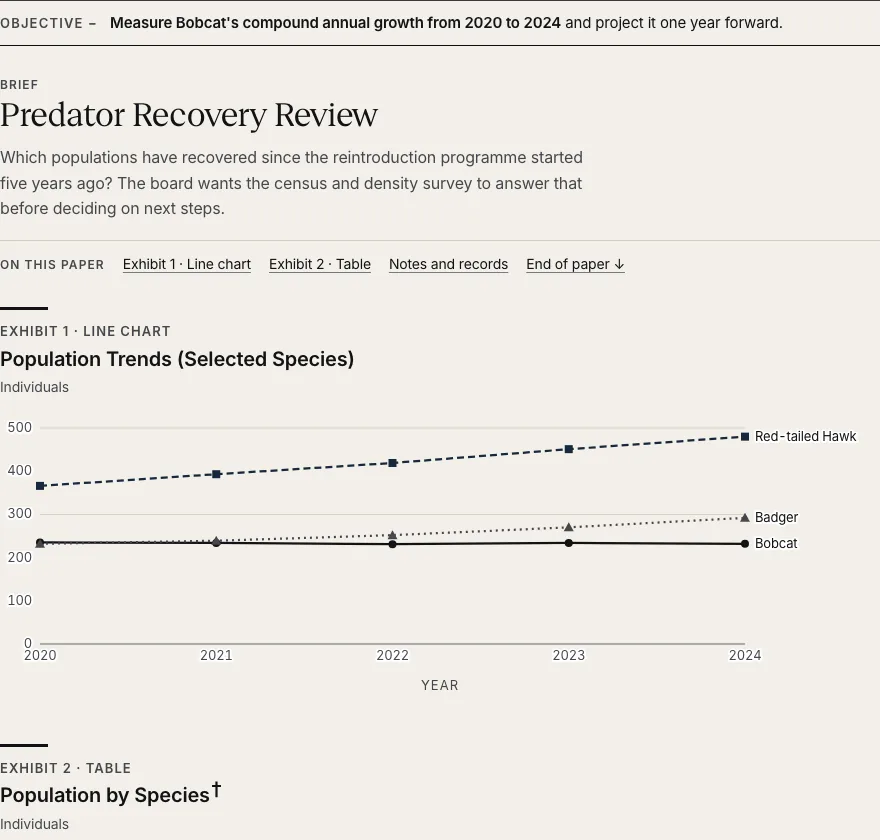
You land on a research brief: a short narrative, two or three tables or charts, and an objective such as estimating next year’s population or finding the most efficient region. Not everything on the page is relevant. Your job is to save the facts the objective needs into the research journal. There is no calculator yet, so this phase is about judgement, not arithmetic.
2. Analysis
2–4, usually 3 calculation questions, sometimes with sub-parts that build on each other. The calculator unlocks here. You can still move back to the source material, but every minute spent re-reading exhibits is a minute taken from the report and the cases. Answers you submit feed the report, so an early error cascades.
3. Report
A pre-written paragraph with 8–10 blanks, filled from dropdowns and the values you calculated. Then one chart choice that cannot be undone, followed by entering that chart’s values. Once you enter the report there is no way back to the study.
4. The mini-cases
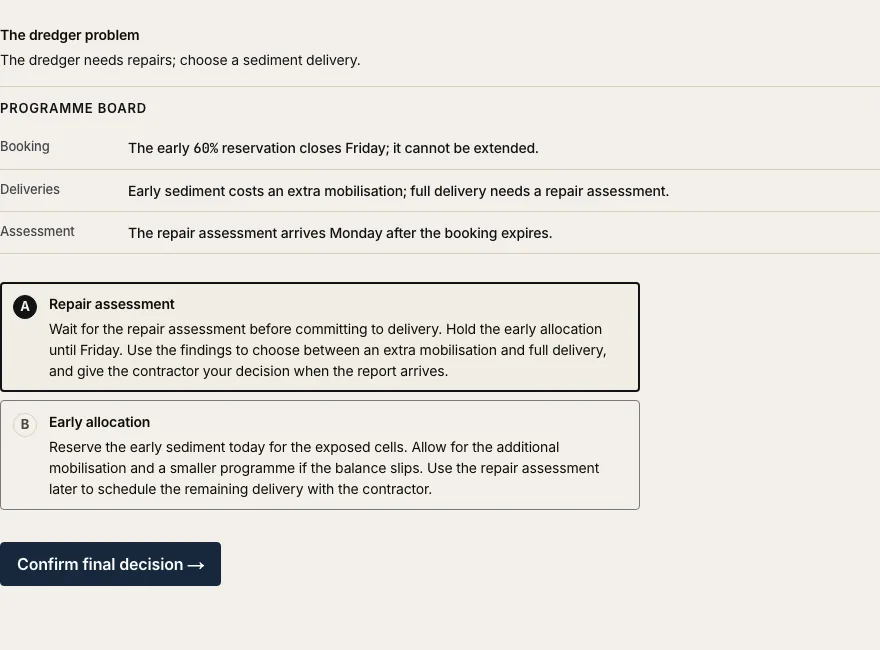
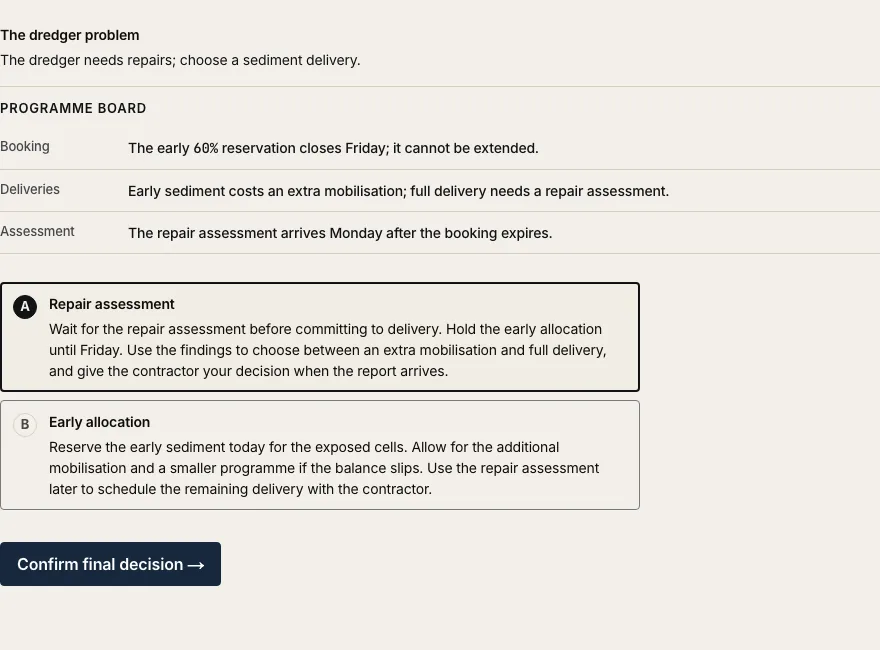
6 standalone cases follow, each with its own short text or exhibit. They share a theme with the study but not its data. The question formats candidates report are picking the right equation; true, false or cannot say against an exhibit; choosing the chart type that fits a message; mean, median, mode and range; and compound probability, so speed matters more than elegance. We publish six original Red Rock mini-case examples with worked answers.
What math is on the Red Rock Study?
Red Rock never needs advanced math. It needs percentages, percentage points versus percent change, ratios and shares, weighted averages, growth rates and CAGR, done accurately under time pressure. The full list, with drills, is in our Red Rock math guide.
Example 1: percentage points or percent?
River otters made up 12.5% of a reserve’s recorded mammals in 2022 and 15.0% in 2024. The report blank reads: “The otter share rose by ___ percentage points.”
Show the working
15.0 − 12.5 = 2.5 percentage points. The relative change is 2.5 ÷ 12.5 = 20%, which is the right answer to a different question. Read the unit in the blank before you calculate.
Example 2: a weighted average density
Three zones hold deer at 40, 25 and 10 animals per km². The zones cover 50, 120 and 30 km². What is the reserve-wide density?
Show the working
Animals: 40 × 50 + 25 × 120 + 10 × 30 = 2,000 + 3,000 + 300 = 5,300. Area: 200 km². Density: 5,300 ÷ 200 = 26.5 per km². The simple average of the three densities, 25.0, ignores that the middle zone is more than twice as large as the others.
How should you pace the Red Rock Study?
One clock covers the study and the cases, so nothing stops you spending twenty minutes on Analysis. This split is the plan CaseStar’s sittings and reviews hold you to; adjust it after your first full run.
| Phase | Minutes | Leave with | What to aim for |
|---|---|---|---|
| Investigation | 5 | 30:00 left | Read the objective first, then save only the facts it needs, with their units and periods. |
| Analysis | 9 | 21:00 left | Split the Analysis budget across this paper’s questions. Keep unrounded values until the final step. |
| Report | 9 | 12:00 left | Fill the paragraph from your journal, then choose the chart that answers the objective. |
| 6 mini-cases | 12 | the clock ends | About two minutes each. Guess and move on rather than lose the last cases. |
How is Red Rock scored?
Candidates and prep vendors describe a product score (whether your answers are correct) and a process score (how you worked). These are reported descriptions, not a published McKinsey scoring formula.
Ask the recruiting inbox named in your invite for your raw score and decile; CaseStar practice scores are not on that scale and do not predict a result. How to ask, and the pairs candidates report, are in how the McKinsey Solve score and decile work.
What are the common Red Rock mistakes?
Report had the lowest answer accuracy, so the list starts there (CaseStar practice data, not McKinsey results; n=94 graded sittings, 11 June to 2 September 2026). Tables and the CSV: where candidates lose marks in Red Rock.
- Percent versus percentage points. A share that moves from 12% to 15% has risen by 3 percentage points, or 25%. Read which one the blank asks for.Report
- Running out of time for the cases. Candidates regularly report never reaching cases 5 and 6. The cases are quick marks; protect about 12 minutes for them.Cases
- The wrong period. Exhibits often run over several years. Collecting 2023 when the question asks about 2024 gives a clean calculation of the wrong thing.Analysis
- The wrong denominator. Growth divides by the starting value; a share divides by the total. Write the formula with labels before you touch the calculator.Analysis
- Rounding too early. The study asks for two decimal places. Rounding an intermediate answer carries the error into every question that depends on it.Analysis
- Saving everything. A journal full of noise costs time in Analysis and makes the report harder to fill. Save what the objective needs.Investigation
Is there a free Red Rock practice test?
Free: an 8-minute sample with no sign-up, and one full 35-minute sitting with an email. The free full sitting is saved to your account, and its debrief shows your score, your main error pattern, where the time went, and the full review for 72 hours.
Solve Pass: the complete 35-minute study and 6 mini-cases, fresh-number papers or seeded memory checks, and a question-by-question debrief, as often as you like. It costs €69 once and covers unlimited Red Rock sittings plus Sea Wolf, Sustainable Future Lab and the full Solve mock. No expiry · yours to keep. Your Solve Pass stays active for as long as CaseStar offers the Solve simulators. No subscription.
How does Red Rock compare with Sea Wolf and Sustainable Future Lab?
| Order | Game | Time | What it asks of you |
|---|---|---|---|
| 1 | Red Rock Study | 35 min | Investigation, analysis and a report, then six short cases |
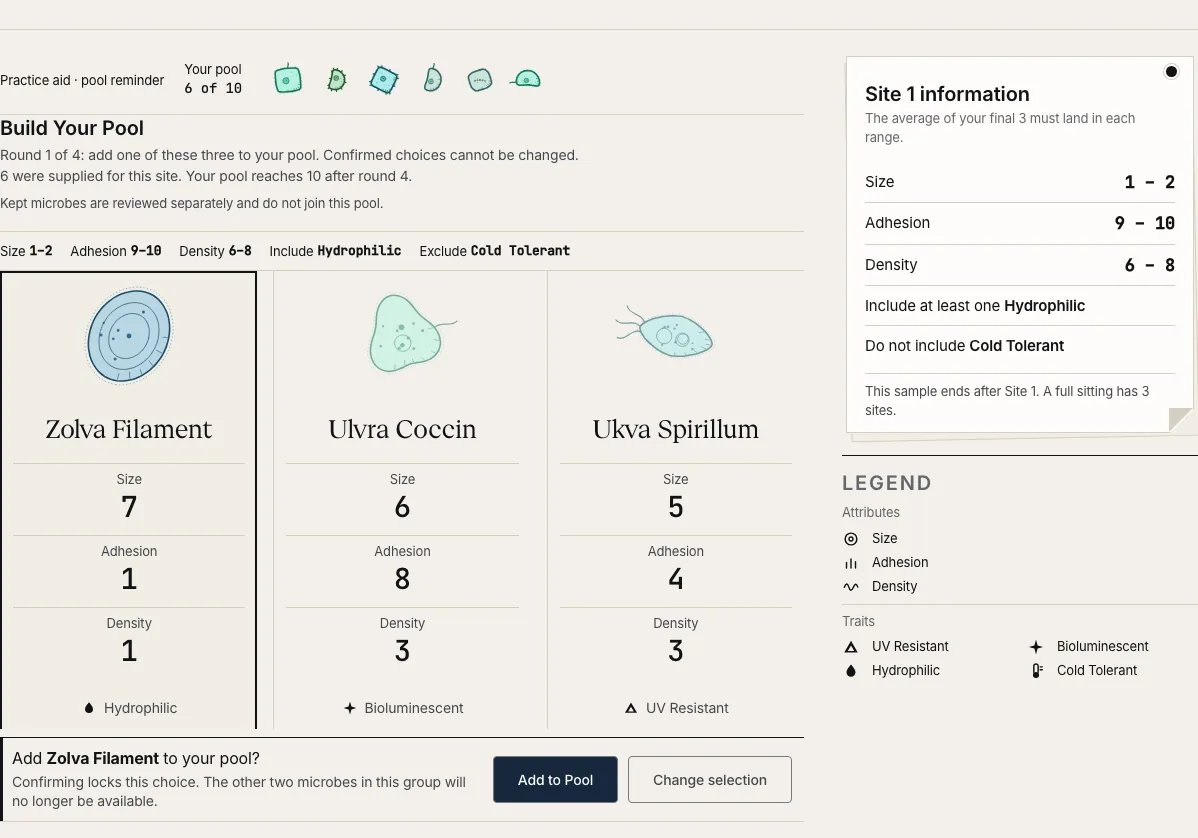
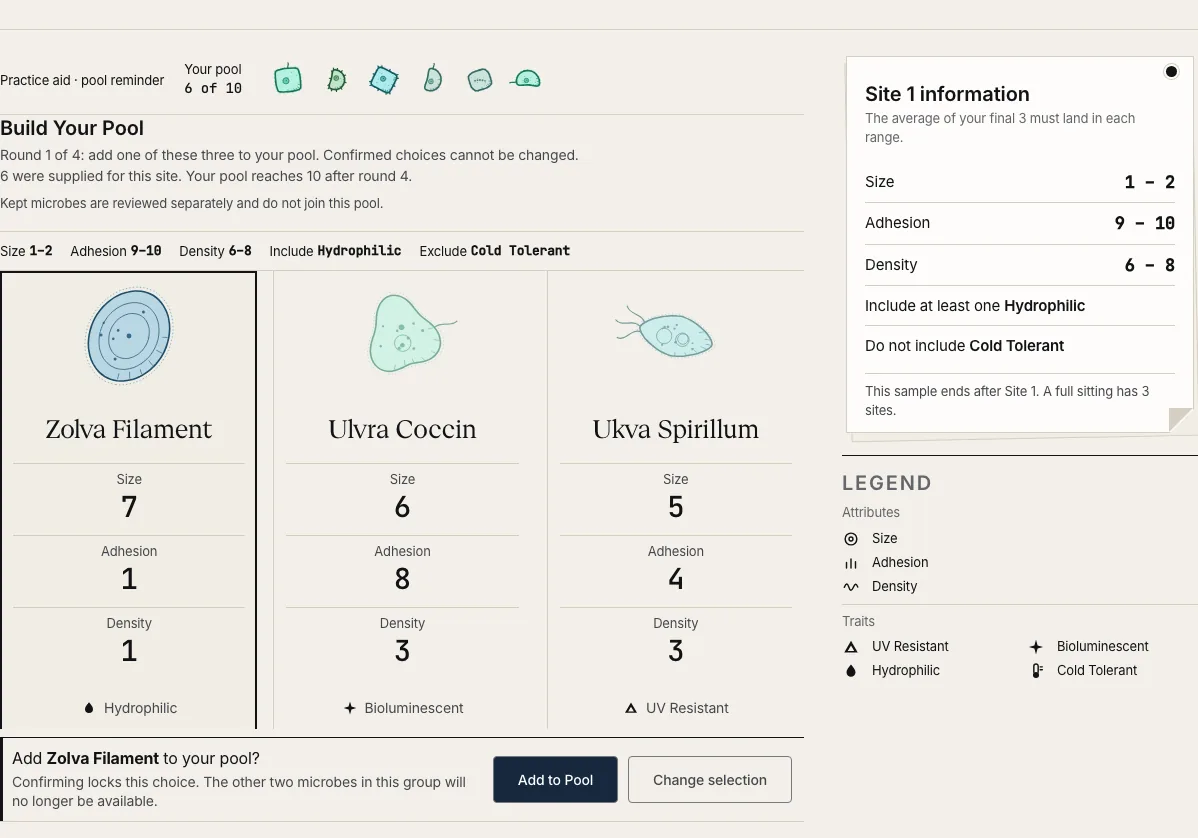
| 2 | Sea Wolf | 30 min | Three contaminated ocean sites, one microbe treatment each, one clock |
| 3 | Sustainable Future Lab | 20 min | A priority ranking, then twelve single-choice decisions |
Red Rock rewards careful reading and arithmetic; Sea Wolf rewards systematic filtering against constraints. If one is your weaker game, read Red Rock vs Sea Wolf: where to spend your prep time.
Red Rock questions and answers
How long is the whole McKinsey Solve assessment?
Candidates report invites of 65, 85 or about 95 minutes, plus about 20 minutes for instructions and the technical check. Red Rock is the first game.
What can I practise in the 8-minute sample?
The 8-minute sample is the opening eight minutes of a Red Rock study, with no sign-up: collect evidence, run two calculations, fill a short report and answer one mini-case, then see each answer worked through. It is not a full assessment.
Can I use a calculator in Red Rock?
A calculator is built in from Analysis onward and is not available while you collect evidence in Investigation. It keeps full precision, and its % key turns 15 into 0.15. Candidates call it accurate but slow, so estimate first and use it to confirm.
What if the real test lags or a button does not respond?
Contact Solve support when the technical issue happens, during the assessment: use live chat or email gbil-support@mckinsey.com. McKinsey’s FAQ says a reset exception is unavailable if you did not contact support during the assessment. Support may offer extra time or reset the link depending on the issue.
Can I retake Red Rock if it goes badly?
Candidates report a 12-month lock before you can sit Solve again (McKinsey does not publish this), so there is no quick second attempt at the real one. Rehearse first, and check your invitation and recruiter for your own situation.
Can I use CaseStar or other tools during the real Solve assessment?
No. Practise beforehand, then close CaseStar and every other preparation tool. McKinsey’s published integrity rules prohibit outside assistance and tools, pre-prepared notes, and recording or screenshots during Solve, except for accommodations McKinsey has approved.
Sources and limits
Historical CaseStar practice data (11 June to 2 September 2026), not McKinsey results and not a percentile for the upgraded engine. Source tables and methodology.
- McKinsey: Solve assessment overview and integrity rules
- McKinsey: Solve FAQ
- Candidate debriefs on PrepLounge and Reddit, January–September 2026, summarised in our 2026 change log
CaseStar (casestar.io) builds timed McKinsey Solve simulators, including Red Rock, for consulting candidates. Independent practice by CaseStar. Not affiliated with or endorsed by McKinsey & Company. Read the complete McKinsey Red Rock Study guide or the McKinsey Solve guide.