BCG Casey vs CaseStar: Understanding Assessment vs Practice
Updated April 2026·12 min read
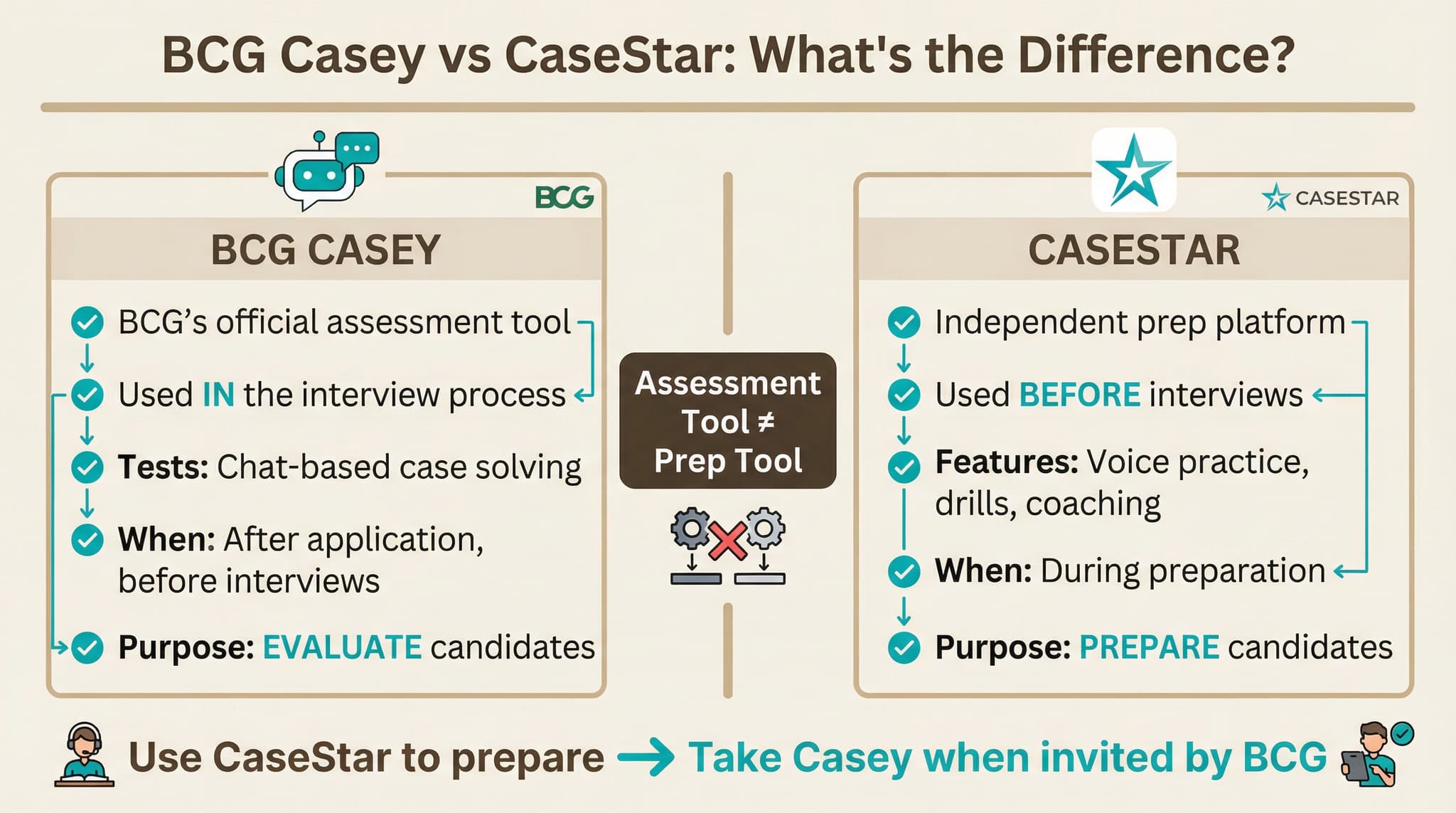
The key distinction: BCG Casey is an official assessment tool used in BCG's hiring process. CaseStar is a practice platform for building case interview skills. They serve completely different purposes: Casey evaluates you for BCG, while CaseStar prepares you for Casey and live interviews. This guide explains how each works and how to use them together effectively.
Contents
What is BCG Casey?
BCG Casey is Boston Consulting Group's proprietary online assessment tool. It functions as a chatbot-style case interview and is used as a screening mechanism in BCG's hiring process. When you apply to BCG, you may be invited to complete the Casey assessment before being considered for live interviews.
Casey presents a business scenario through a text-based chat interface. A virtual interviewer named "Casey" gives you a case prompt and then asks a series of questions about how you would approach the problem. Your responses directly influence whether you advance in BCG's hiring process.
How Casey works
- Format: Text-based chatbot interface where you type responses
- Duration: Approximately 25-30 minutes, timed overall
- Content: One complete business case with data exhibits
- Question types: Multiple choice, numerical input, and short written responses
- Stakes: This is an actual assessment that affects your candidacy
- Feedback: None provided; you receive a pass/fail outcome only
What Casey tests
Casey evaluates the same skills tested in live case interviews, adapted for a digital format:
Problem structuring
Can you identify the relevant factors to analyze and prioritize your approach? Casey tests this through questions asking which areas you would explore first.
Quantitative reasoning
Can you perform calculations accurately and quickly without a calculator? Casey includes numerical questions requiring mental math.
Data interpretation
Can you read charts, tables, and exhibits to extract meaningful insights? Casey presents data visualizations and asks questions about what they show.
Synthesis and recommendation
Can you combine your analysis into a coherent recommendation? Casey typically ends with questions asking what you would advise the client.
Important: BCG provides one official practice version of Casey. Complete it before your real assessment to familiarize yourself with the interface and question format. However, the practice version is limited; you cannot repeat it multiple times to build skills.
What is CaseStar?
CaseStar is an interactive practice platform designed to help candidates prepare for consulting interviews. Unlike BCG Casey, which is an assessment tool, CaseStar is a training environment where you can build and refine your case interview skills without any impact on your job applications.
The platform uses voice-based practice to simulate realistic interview conversations. You speak your responses aloud and receive an interactive dialogue, similar to practicing with a human partner but available on demand.
How CaseStar works
- Format: Voice-based conversation with practice interviewer
- Duration: Practice sessions of your choosing, no time pressure
- Content: Multiple case types across various industries and problem formats
- Interview styles: Both candidate-led (BCG/Bain style) and interviewer-led (McKinsey style)
- Stakes: Zero; this is practice only
- Feedback: Detailed performance analysis after every session
What CaseStar offers
Case interview practice
Full case simulations where you work through business problems from prompt to recommendation. Practice structuring, hypothesis formation, and synthesis.
Behavioral interview practice
Prepare for fit questions and personal experience interviews. Practice telling your stories and handling follow-up questions.
Mental math drills
Targeted practice for the calculation skills needed in Casey and live interviews. Build speed and accuracy with percentages, multiplication, and market sizing math.
Adaptive difficulty
The system adjusts based on your performance, providing appropriate challenge levels as your skills develop.
Graded feedback
Receive scores and specific feedback on structure, math accuracy, communication clarity, and synthesis quality after each session.
Key differences at a glance
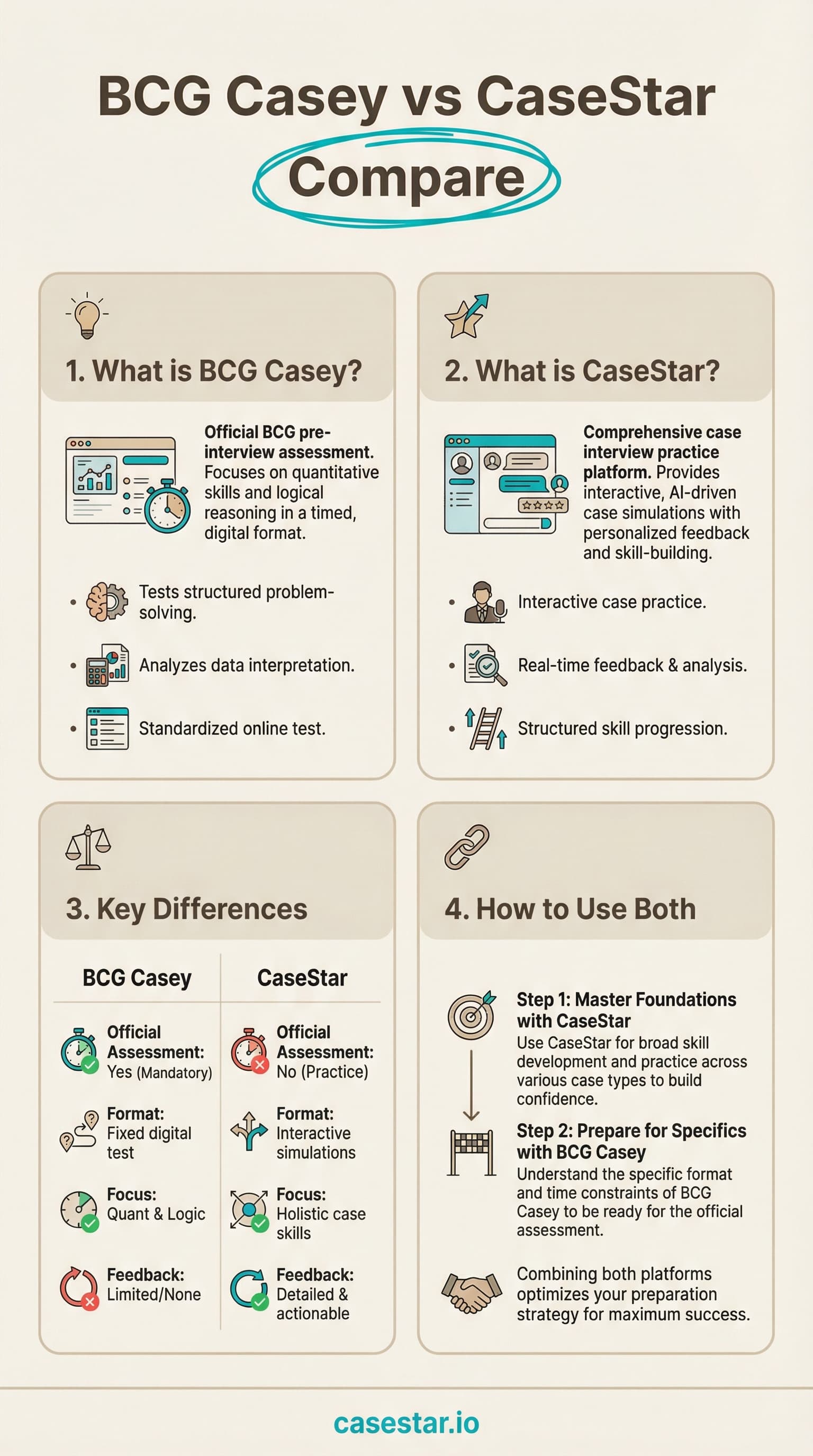
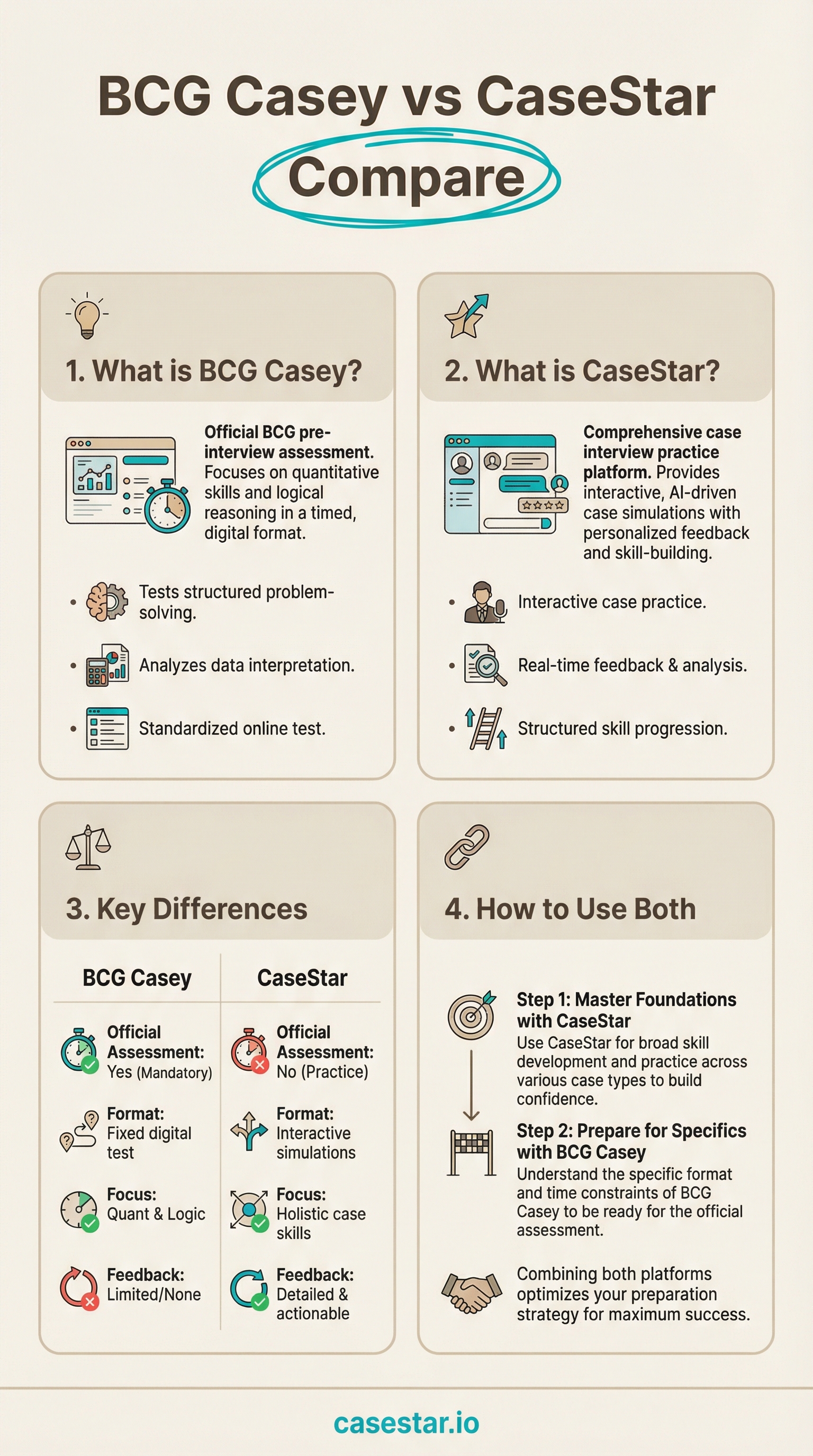
The fundamental difference is purpose: Casey assesses you for BCG, while CaseStar prepares you for interviews. This distinction affects every aspect of how the tools work.
| Aspect | BCG Casey | CaseStar |
|---|---|---|
| Purpose | Official BCG hiring assessment | Practice and skill development |
| Provider | BCG (proprietary) | Independent platform |
| Format | Text-based chatbot | Voice-based conversation |
| Stakes | Directly affects candidacy | No impact on applications |
| Attempts | One real attempt per application cycle | Unlimited practice sessions |
| Feedback | None (pass/fail only) | Detailed performance analysis |
| Content scope | One case scenario | Multiple cases, drills, and formats |
| Interview types | Case only | Case + behavioral + mental math |
| Firm coverage | BCG only | All firms (MBB, Big 4, boutiques) |
| Availability | By invitation from BCG | Available 24/7 |
| Time limit | 25-30 minutes, strictly timed | Flexible, practice at your pace |
Think of it this way: Casey is the exam. CaseStar is the study tool. You would not try to learn material during the actual test; you prepare beforehand. Similarly, use CaseStar to build skills, then apply those skills when you take Casey.
How Casey and CaseStar work together
Casey and CaseStar serve complementary roles in your preparation journey. Understanding how they fit together helps you use each tool effectively.
The relationship explained
BCG Casey tests specific skills: structuring, quantitative reasoning, data interpretation, and synthesis. These are the same skills you need for live case interviews. CaseStar helps you develop these skills through repeated practice and targeted feedback.
While Casey uses a text-based format and CaseStar uses voice, the underlying analytical abilities transfer. A candidate who can structure a problem well verbally can also do it in writing. Strong mental math works the same way regardless of input method.
Skills that transfer from CaseStar to Casey
Problem structuring
CaseStar case practice builds your ability to break down business problems into logical components. When Casey asks which areas you would explore, you will have a mental framework for approaching these questions systematically.
Mental math speed
CaseStar's mental math drills directly prepare you for Casey's numerical questions. Building speed with percentages, multiplication, and division helps you answer calculation questions within time limits.
Data interpretation
Case practice exposes you to charts, tables, and graphs similar to those in Casey. You learn to quickly identify key data points and draw meaningful conclusions from visual information.
Synthesis ability
CaseStar sessions end with recommendation practice, building your ability to combine evidence into a clear conclusion. This prepares you for Casey's final questions asking for your recommendation.
What CaseStar prepares you for beyond Casey
Casey is one component of BCG's hiring process. If you pass Casey, you advance to live interviews where you will face actual case discussions with consultants. CaseStar's voice-based format directly simulates these live conversations.
Additionally, CaseStar covers behavioral interview preparation, which Casey does not test but live BCG rounds heavily weight. You can practice these skills in our dedicated behavioral practice mode. The platform also prepares you for other firms using different formats, giving you broader coverage.
Preparation strategy
Here is how to use both tools effectively as part of your BCG interview preparation.
Phase 1: Build foundational skills (2-4 weeks before Casey)
- Start daily mental math drills on CaseStar (15-20 minutes)
- Complete 2-3 full case practice sessions per week to build structuring habits
- Focus on the candidate-led format that BCG uses
- Review CaseStar feedback after each session to identify weak areas
- Read through the BCG guide to understand their overall process
Phase 2: Simulate Casey conditions (1 week before)
- Time your CaseStar sessions to build speed (aim for 25-30 minute cases)
- Practice writing concise answers rather than only speaking; Casey requires typed responses
- Focus on data interpretation speed; practice extracting insights from exhibits quickly
- Complete BCG's official practice Casey to familiarize yourself with the interface
- Continue mental math drills to maintain calculation speed
Phase 3: Take Casey
- Choose a time when you are well-rested and can focus without interruption
- Use a reliable computer with stable internet connection
- Read each question carefully before answering; accuracy matters more than speed
- Use scratch paper for calculations; do not try to do everything in your head
- Manage your time across all questions; do not spend too long on any single item
Phase 4: Continue preparation for live interviews
- If you pass Casey, shift to CaseStar's voice-based practice for live interview simulation
- Add behavioral interview practice since BCG live interviews include fit questions
- Practice longer, more complex cases that mirror final round interviews
- Focus on communication clarity and recommendation delivery
Remember: Passing Casey gets you to interviews, but it does not get you the job. The skills you build with CaseStar serve double duty: they help you pass Casey and they prepare you for the live interviews that follow.
FAQ
What is BCG Casey?
BCG Casey is Boston Consulting Group's proprietary online assessment tool used in their hiring process. It presents a business case through a text-based chatbot interface and evaluates candidates on problem structuring, quantitative reasoning, data interpretation, and synthesis. The assessment typically lasts 25-30 minutes and directly affects your candidacy.
Can I practice on BCG Casey before the real test?
BCG provides one official practice version of Casey that you can complete before your actual assessment. However, this practice version is limited and you can only use it once. For more extensive skill-building, candidates use practice platforms like CaseStar to develop structuring, mental math, and data interpretation abilities.
How is CaseStar different from BCG Casey?
CaseStar is a practice platform while Casey is an assessment. CaseStar offers unlimited voice-based case practice with detailed feedback after every session. Casey is a one-time text-based assessment that evaluates you without providing feedback. They serve different purposes: CaseStar builds skills, Casey tests them.
Should I use CaseStar to prepare for BCG Casey?
Yes, CaseStar helps you build the core skills Casey tests. Practice mental math drills for calculation speed, case simulations for structuring ability, and data-heavy cases for interpretation skills. While the formats differ (voice vs. text), the analytical abilities transfer directly.
Does Casey give you feedback on your performance?
No. BCG Casey provides no feedback on individual answers or overall performance. You receive only a pass/fail outcome as part of your application status. This is why practice platforms with feedback capabilities are valuable for preparation.
What skills does BCG Casey test?
Casey evaluates four main areas: (1) Problem structuring, identifying relevant factors and prioritizing analysis; (2) Quantitative reasoning, performing calculations without a calculator; (3) Data interpretation, reading charts and extracting insights; (4) Synthesis, forming recommendations based on evidence. These mirror live case interview skills.
Prepare for BCG Casey and live interviews
CaseStar helps you build the skills Casey tests: structuring, mental math, data interpretation, and synthesis. Practice unlimited cases with immediate feedback.
Start practicingRelated guides
BCG Interview Guide
Complete overview of BCG's interview process, format, and preparation tips.
Mental Math Guide
Techniques for fast calculations in case interviews and Casey assessments.
Case Frameworks
How to build custom frameworks for structuring business problems.
Case Interview Basics
Fundamental concepts and approach for consulting case interviews.
Save this guide
Updated April 2026