EY-Parthenon Case Interview Guide: Format, Tips & Preparation
Updated April 2026·15 min read
Summary: EY-Parthenon is EY's strategy consulting arm, formed from the acquisition of The Parthenon Group in 2014. Interviews use a candidate-led case format with 2-3 rounds. Final rounds often include group case interviews. The firm has strong private equity, transaction advisory, and education sector expertise. Cases frequently emphasize commercial viability, market attractiveness, and investment logic.
Official Resources:EY-Parthenon Careers
Contents
EY-Parthenon overview
EY-Parthenon occupies an unusual position among strategy firms. Created when EY acquired The Parthenon Group in 2014, it combines boutique strategy consulting heritage with the global reach and resources of a Big Four firm. With over 9,000 strategy professionals across 40+ countries, EY-Parthenon has grown to become one of the largest strategy consulting practices globally.
The Parthenon heritage shows in the firm's culture and client focus. Before the acquisition, The Parthenon Group was known for rigorous analytical work, particularly in private equity and education sectors. These strengths remain central to EY-Parthenon's identity, even as it has expanded into corporate strategy, restructuring, and transaction advisory.
Key characteristics of EY-Parthenon
- Private equity focus: Strong relationships with PE firms for commercial due diligence, value creation, and exit strategy work. Many cases involve investment decision frameworks.
- Transaction advisory: Integration with EY's transaction practice means frequent work on M&A strategy, commercial assessments, and deal support.
- Education expertise: Unique strength in education sector strategy, from K-12 to higher education and EdTech.
- Big Four resources: Access to EY's global network, data capabilities, and cross-functional teams that pure-play strategy boutiques cannot match.
- Quantitative rigor: Cases emphasize analytical depth, particularly around ROI, CAGR, and investment return calculations.
Strategy vs. Advisory Tracks
EY has multiple consulting tracks. EY-Parthenon is specifically the strategy arm. If you're interested in pure strategy work, ensure you're applying to EY-Parthenon roles rather than general EY Advisory positions. The interview process and case styles differ between tracks.
Interview format and structure
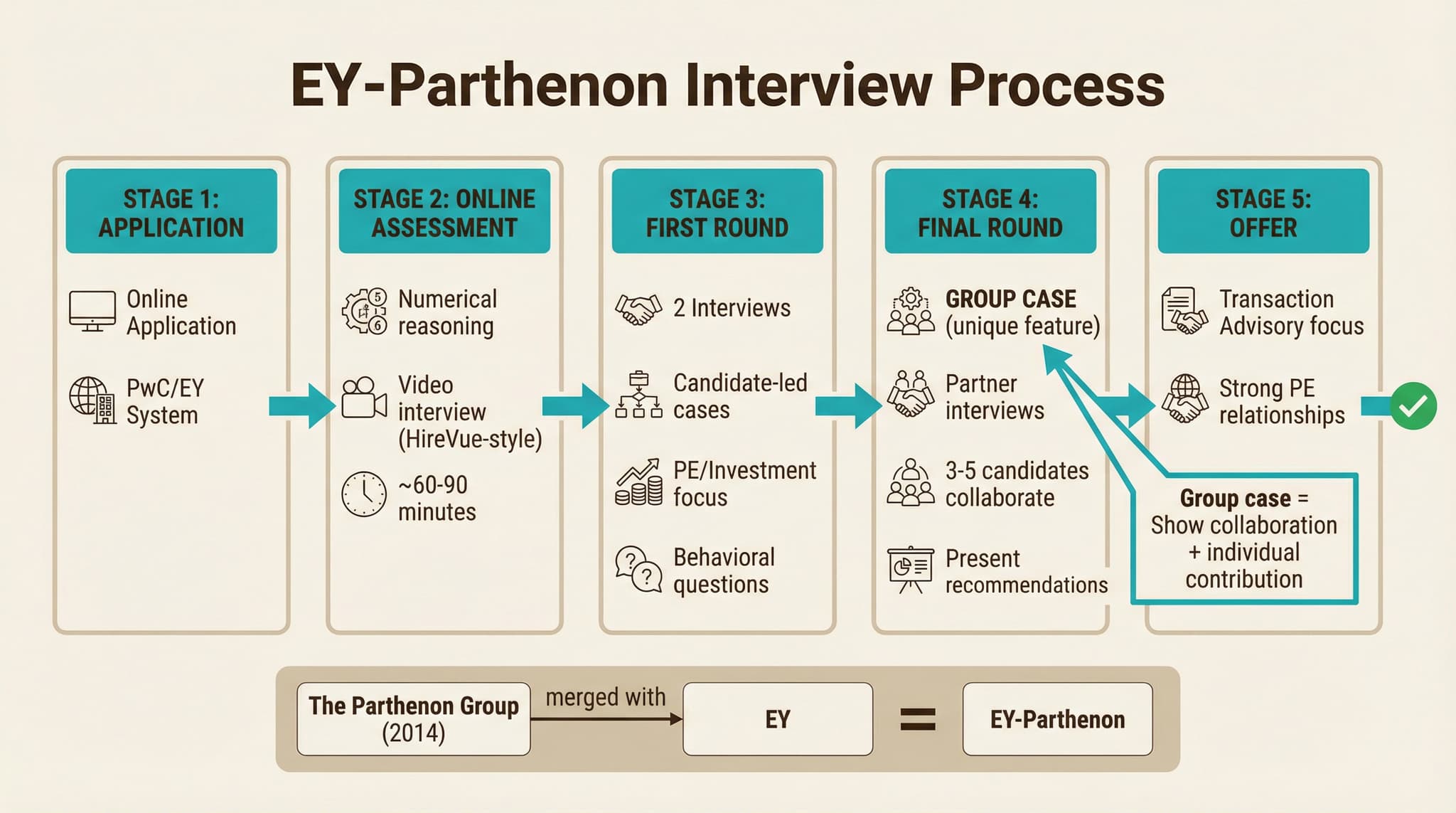
EY-Parthenon typically conducts 2-3 interview rounds. The entire process can take 2-12 weeks depending on the role, location, and hiring timeline. Each round includes multiple interviews combining case and behavioral elements.
First Round
- 2 interviews, each 45-60 minutes
- Interviewers: Consultants and Managers
- Format: Behavioral/fit (15-20 min) + Case interview (25-35 minutes)
- Focus: Core analytical skills, structured thinking, motivation
- May be conducted virtually via video call
Second/Final Round
- 2-3 interviews with Directors and Partners
- More complex, multi-layered cases
- Often includes group case interview
- Deeper behavioral exploration with Partner
- May be conducted in-person at EY office
The candidate-led approach
EY-Parthenon uses a candidate-led case format, similar to BCG and Bain. After receiving the case prompt, you develop your own framework, decide which areas to explore, and drive the analysis forward. The interviewer provides data when you ask for it but does not guide you through the case structure.
This differs from McKinsey's interviewer-led format where the interviewer directs you through specific questions. In an EY-Parthenon case, you need to actively decide what information you need and where to focus your analysis.
Interview difficulty: Glassdoor users rate EY-Parthenon interviews at 3.31/5 difficulty, with 77% reporting positive experiences. Consultant and MBA Summer Consultant roles are rated as the most challenging.
Online assessments
For entry-level and campus hiring (often called "Career Starter" positions), EY-Parthenon typically includes online assessments before interview rounds. The specific format varies by position and region.
Common assessment types
Numerical reasoning test
Tests your ability to interpret data, charts, and tables under time pressure. Questions involve percentages, ratios, growth rates, and basic business calculations. Similar to SHL or Cubiks numerical tests.
Video interview (HireVue-style)
You record video responses to behavioral and situational questions. Questions appear on screen and you have limited time to prepare and record your answer. Both content and presentation are evaluated.
Written responses
Some positions include written components where you type responses to scenario-based questions. These test your ability to structure thoughts and communicate clearly in writing.
Ranking/prioritization exercises
You may be asked to rank options or prioritize actions in hypothetical business scenarios. These assess judgment and decision-making approach.
Preparation tip
Practice numerical reasoning tests before the assessment. Free practice tests are available online. For timed response or interview prompts, practice speaking clearly and concisely. Use the STAR format (Situation, Task, Action, Result) to structure your responses.
Types of cases
EY-Parthenon cases reflect the firm's strengths in private equity, transaction advisory, and strategic decision-making. Cases often have a commercial viability or investment angle.
Private equity / Commercial due diligence
Cases involving PE investment decisions are common. You might evaluate whether a target company is worth acquiring, assess market attractiveness for an investment thesis, or analyze a portfolio company's growth potential. The PE lens means focus on returns, exit multiples, and value creation levers.
Market attractiveness
Cases frequently involve evaluating market size, growth rates, competitive dynamics, and margin potential. These feed into investment decisions or market entry recommendations. Strong market sizing skills are essential.
Profitability and ROI
Cases often require calculating and interpreting financial metrics. Expect to work through CAGR calculations, break-even analysis, ROI projections, and margin analysis. Fast, accurate mental math is crucial.
Education sector
Given the firm's heritage, education cases appear regularly. These might involve K-12 school systems, higher education institutions, EdTech companies, or education policy questions. Understanding basic education industry dynamics can help.
Growth strategy
Corporate growth strategy cases are common, often with a quantitative bent. You might evaluate organic vs. inorganic growth options, new product launches, or geographic expansion with clear financial targets and payback periods.
Quantitative emphasis
EY-Parthenon cases tend to be quantitatively demanding. Interviewers expect you to execute financial and market sizing math confidently. Key calculations to master:
- CAGR (Compound Annual Growth Rate)
- Break-even analysis and payback periods
- ROI and investment return calculations
- Market share and penetration analysis
- Revenue and profitability waterfalls
Practice until these calculations feel automatic. Being slow or making errors in quantitative work will significantly hurt your performance.
Group case interviews
EY-Parthenon uses group case interviews in final rounds to assess how you collaborate, communicate, and contribute in team settings. This format is less common at other strategy firms and requires specific preparation.
Group case format
- Team size: 3-5 candidates working together
- Duration: Approximately 60 minutes total
- Materials: Handout with exhibits, charts, and background information
- Output: 10-15 minute group presentation
- Observation: Interviewers watch silently, taking notes
What interviewers evaluate
Quality of contribution
Are your insights valuable? Do you advance the analysis? Interviewers look for candidates who add substantive ideas rather than just agreeing with others or making superficial points.
Collaboration style
Do you listen to others? Build on their ideas? Help quieter team members contribute? The goal is to demonstrate that you can work effectively in consulting teams, not dominate the discussion.
Process management
Does the team use time effectively? Do you help structure the approach? Someone needs to keep track of time and ensure the team covers all key areas before preparing the presentation.
Communication clarity
Can you explain your thinking clearly? Do you help synthesize different viewpoints? Good communicators help the team reach consensus and structure a coherent recommendation.
Tips for group cases
- Speak early: Make a meaningful contribution in the first 5-10 minutes to establish your presence.
- Do not dominate: Making 25-30% of contributions is ideal. Talking more than others does not help your evaluation.
- Build on others: Explicitly reference and extend others' ideas: "Building on what Sarah said…"
- Manage time: Offer to track time or suggest when to move to next steps, but do so collaboratively.
- Be flexible: If the group disagrees with your idea, accept it gracefully and support the team's direction.
Behavioral interviews
EY-Parthenon integrates behavioral questions into each interview, typically 15-20 minutes at the beginning or end of the case portion. Partner interviews in final rounds tend to be more heavily weighted toward behavioral discussion.
Common behavioral themes
- Leadership: Tell me about a time you led a team or project. How did you handle challenges or conflicts?
- Teamwork: Describe working on a team with different perspectives. How did you contribute to the group?
- Problem-solving: Walk me through a complex problem you solved. What was your approach?
- Initiative: When have you gone beyond what was expected? What drove you to take that initiative?
- Failure and learning: Tell me about a time something did not go as planned. What did you learn?
- Why consulting, why EY-Parthenon: What attracts you to strategy consulting and this firm specifically?
What EY-Parthenon looks for
Analytical mindset
Stories that demonstrate rigorous, data-driven thinking resonate well. Show how you approached problems systematically and used evidence to guide decisions.
Impact orientation
EY-Parthenon emphasizes measurable results. When describing experiences, quantify your impact wherever possible: revenue generated, costs saved, efficiency improved, people influenced.
Team effectiveness
Given the group case format, the firm values candidates who can work well with others. Stories showing collaboration, conflict resolution, and bringing out the best in team members are valuable.
Prepare 4-5 stories covering different themes. Each should be 2-3 minutes long with clear situation, action, and result components. Practice with our behavioral practice mode to refine your delivery.
How to prepare
Preparing for EY-Parthenon requires standard case skills plus attention to the firm's PE orientation, group case format, and quantitative emphasis.
Case interview preparation (70% of time)
1. Master candidate-led format
Practice driving cases yourself. After presenting your framework, decide what to explore next without waiting for prompts. Build comfort with requesting specific data and structuring your analysis independently.
2. Strengthen quantitative skills
EY-Parthenon cases are analytically demanding. Dedicate daily time to mental math drills. Practice CAGR, ROI, break-even, and market share calculations until they feel automatic.
3. Practice PE-style thinking
Many EY-Parthenon cases involve investment logic. Practice evaluating decisions through a PE lens: What's the market opportunity? Is the company a good target? What's the path to value creation? What's the exit thesis?
4. Prepare for group cases
If possible, practice group cases with other candidates. Focus on contributing quality insights while supporting team dynamics. Being a good collaborator matters as much as analytical ability.
Behavioral and firm preparation (30% of time)
- Prepare 4-5 stories covering leadership, teamwork, problem-solving, initiative, and failure/learning.
- Practice telling each story in 2-3 minutes with clear STAR structure.
- Develop a genuine answer to "Why EY-Parthenon?" Reference specific aspects: PE focus, education expertise, Big Four resources, transaction advisory strength.
- Research EY-Parthenon's recent publications, thought leadership, and notable deals.
- Practice numerical reasoning tests if applying to entry-level positions.
EY-Parthenon vs. other firms
| Aspect | EY-Parthenon | MBB |
|---|---|---|
| Case format | Candidate-led | McKinsey interviewer-led; BCG/Bain candidate-led |
| Group cases | Common in finals | Rare |
| PE focus | Strong (Parthenon heritage) | Present but not core |
| Online assessments | Yes (entry-level) | McKinsey Solve; BCG Casey; Bain SOVA |
| Interview rounds | 2-3 rounds | 2-3 rounds |
Practice with realistic cases
CaseStar offers interactive case practice with candidate-led format support. Build your quantitative skills, practice structuring, and get instant feedback on your approach.
Start practicingFAQ
What is the EY-Parthenon interview format?
EY-Parthenon uses candidate-led case interviews across 2-3 rounds. Each interview combines a case discussion (25-35 minutes) with behavioral questions (15-20 min). Final rounds often include group case interviews with 3-5 other candidates.
How is EY-Parthenon different from MBB firms?
EY-Parthenon is EY's strategy arm, formed from The Parthenon Group. It has strong PE and transaction advisory expertise. Cases often have investment logic focus. Group case interviews are common in finals, which is unusual for strategy firms.
Does EY-Parthenon have group case interviews?
Yes. You work with 3-5 other candidates to analyze a case and present recommendations within about 60 minutes. Interviewers observe how you collaborate, contribute, and communicate in a team setting.
What online assessments does EY-Parthenon use?
Entry-level positions may include numerical reasoning tests and video interviews (HireVue-style). You answer questions via video, rank options, and provide written responses. The specific format varies by position.
What types of cases should I expect?
EY-Parthenon cases often involve PE scenarios, commercial due diligence, market attractiveness, and ROI-based decisions. Strong quantitative skills are essential, including CAGR, break-even, and profitability analysis. Education sector cases are also common.
Ready to prepare for EY-Parthenon?
CaseStar offers voice-powered practice for candidate-led cases, mental math, and structuring drills. Build the analytical skills EY-Parthenon values.
Start practicing freeSave this guide
Last updated: April 2026