How CaseStar Works
From "I have an interview in 6 weeks" to "I got the offer"—here's the path.
Updated April 2026·8 min read
The problem: Consulting interviews are unlike anything you've done before. You need to practice specific skills—structuring, mental math, synthesis—but most people practice wrong, get bad feedback, or run out of practice partners.
What CaseStar does: Gives you a personal coach that understands where you are, creates a plan for where you need to be, and provides unlimited practice with instant, accurate feedback—available whenever you have 10 minutes or 2 hours.
What you'll learn
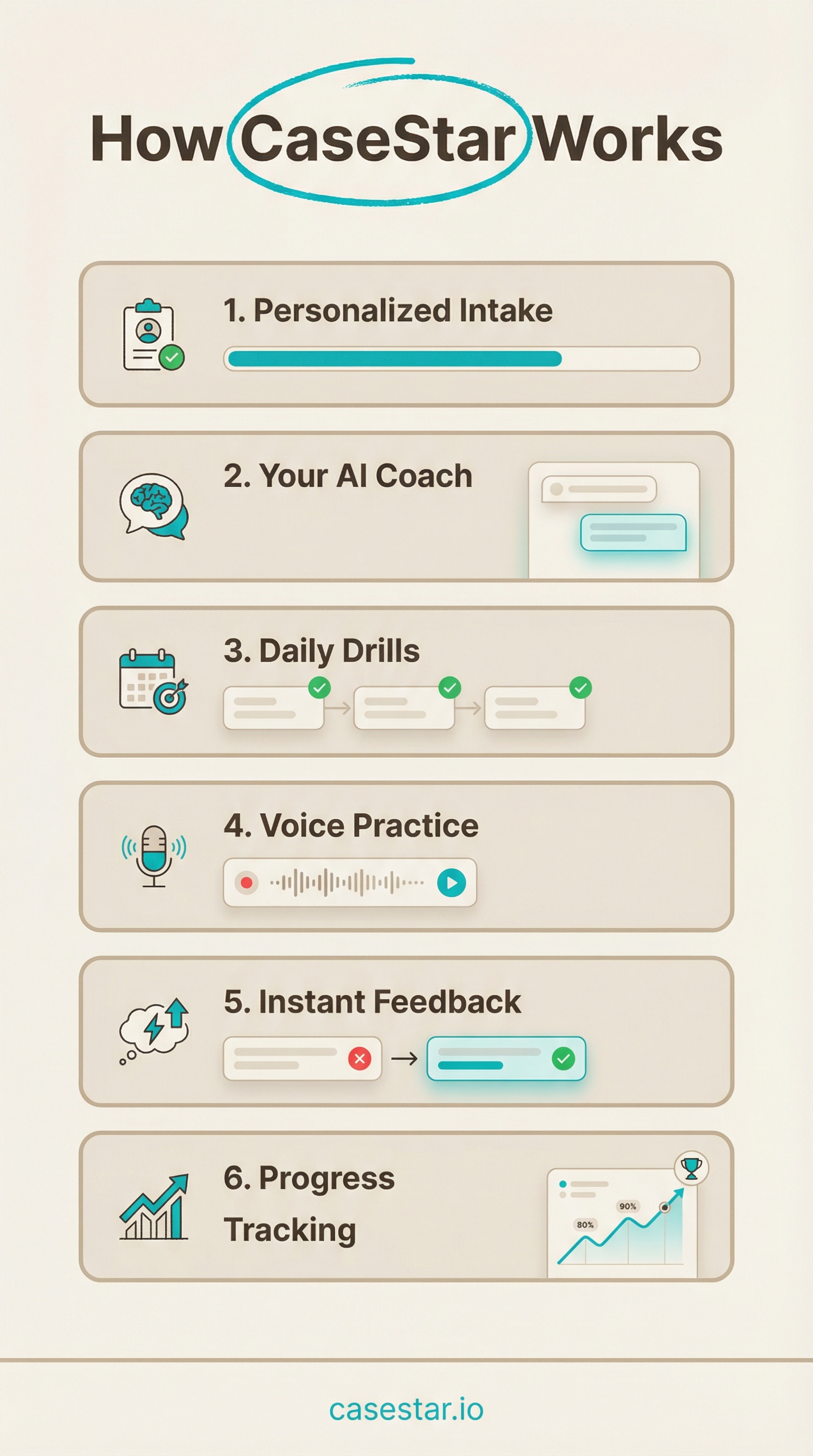
- 1. The intake: Understanding your starting point
- 2. Your coach: Personalized guidance that adapts
- 3. Daily drills: Building core skills fast
- 4. Voice practice: Realistic case simulation
- 5. Behavioral prep: Story library and PEI practice
- 6. Feedback: What actually makes you improve
- 7. Progress tracking: Seeing your growth
- 8. Plan adjustment: Your coach learns with you
- FAQ
1. The intake: Understanding your starting point
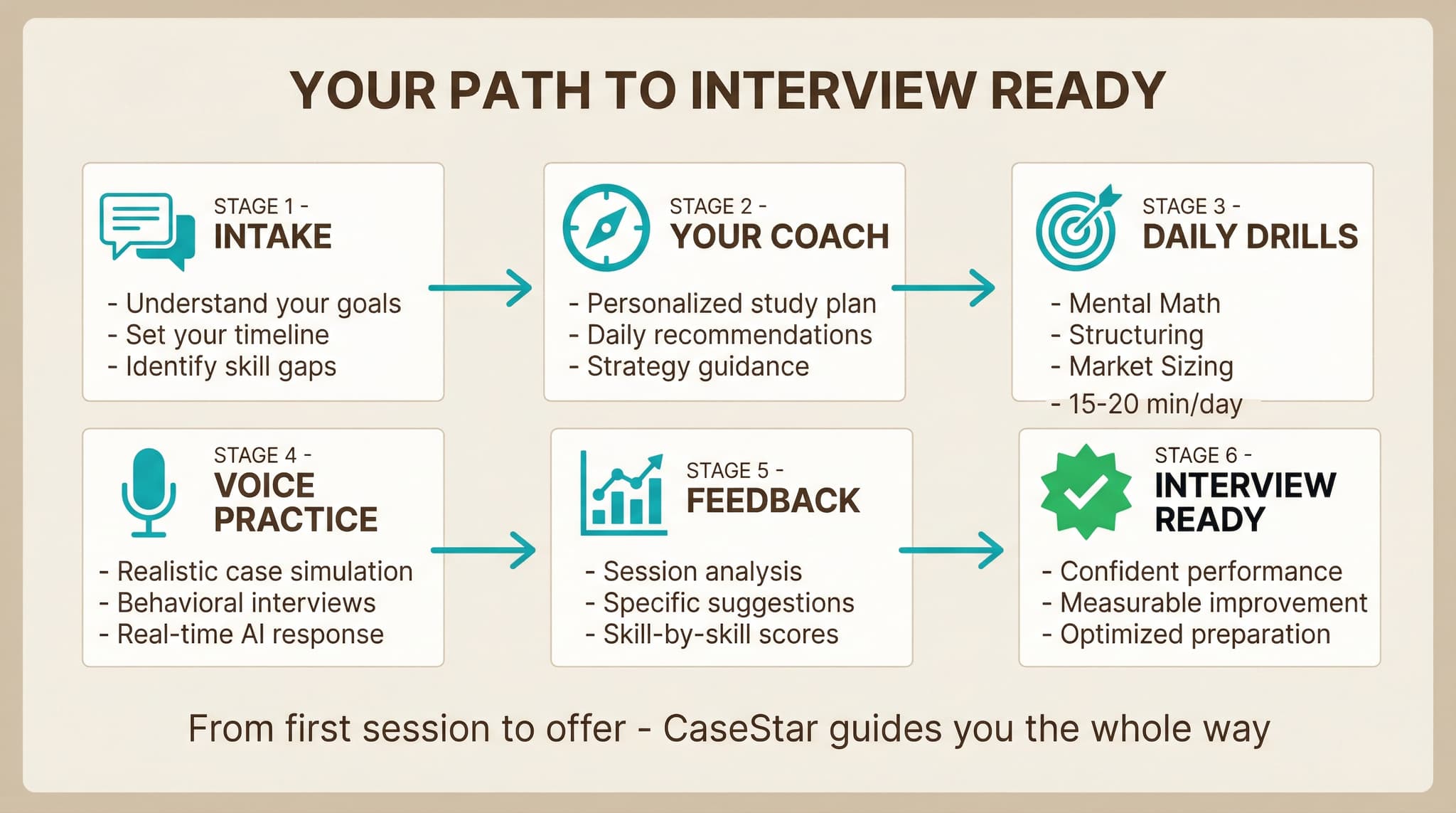
When you first open CaseStar, you have a conversation with your coach. Not a form. A conversation—because preparing for McKinsey with 8 weeks is different from preparing for BCG with 2 weeks.
What your coach learns:
- •Target firms: McKinsey, BCG, Bain? Boutique? Each has different interview styles.
- •Timeline: When is your first interview? This determines intensity and focus.
- •Background: Engineering? Finance? Liberal arts? Your mental math baseline differs.
- •Prior exposure: Have you done cases before? First-timer vs re-applicant need different approaches.
- •Available time: 20 hours a week? 5 hours? Your plan needs to be realistic.
After the intake, you might also run a diagnostic case—a short voice session that helps calibrate your current level across structuring, math, and communication.
Why this matters: Generic prep plans waste time. If you're already strong at mental math but weak at synthesis, why spend hours on percentages? Your coach knows where to focus.
2. Your coach: Personalized guidance that adapts
Your coach isn't a static tool—it's an ongoing relationship. When you open CaseStar, your coach knows your history, your strengths, your weak spots, and what you should work on today.
Your study plan
Based on your timeline and skill gaps, your coach creates a week-by-week plan. Each session, it suggests what to practice based on where you need the most work.
Daily recommendations
Have 15 minutes? Your coach suggests drills. Have an hour? Time for a full case. The recommendations adapt to your available time.
Progress awareness
Your coach tracks improvement across every skill. When you master one area, it shifts focus to where you still need work.
Strategy guidance
Have questions about interview strategy? Your coach answers them in context—knowing your target firms and your specific situation.
Think of it like having a mentor who's done hundreds of cases, knows every firm's quirks, and is available whenever you need them.
3. Daily drills: Building core skills fast
Full cases are important, but inefficient for building specific skills. In a 30-minute case, you might do one math calculation. In 15 minutes of targeted drills, you can do 20.
Mental Math
Percentages, large number multiplication, unit conversions—all under time pressure, out loud. Your coach tracks speed and accuracy, gradually increasing difficulty.
Structuring
Get a business problem, build a custom framework in 2 minutes, explain your logic. Instant feedback on MECE, relevance, and completeness.
Market Sizing
Estimate market sizes, populations, quantities. Practice building structured approaches and sanity-checking your numbers.
Chart Analysis
Look at business charts, extract insights, explain what you see. Consultants read charts constantly—this skill matters more than most candidates realize.
Brainstorming
Generate ideas across categories when asked questions like "How could our client increase revenue?" Strong candidates give 8-10 specific ideas, not 3-4 generic ones.
Synthesis
Practice summarizing analysis into clear recommendations. Many candidates do solid work but stumble at the ending. This drills that specific skill.
How much time? Most users spend 15-20 minutes daily on drills. Some do a quick 5-minute session in the morning, more in the evening. The consistency matters more than any single session length.
4. Voice practice: Realistic case simulation
Reading case books doesn't prepare you for the live interview. You need to practice speaking your thoughts out loud, under pressure, with an interviewer responding in real-time.
CaseStar's voice sessions feel like real interviews. You speak. The AI interviewer responds naturally. It asks follow-up questions, provides data when you request it, and pushes back when your logic is weak.
Types of voice practice:
- 1.Diagnostic cases — Short sessions to assess your current level. Used during intake and periodically to measure improvement.
- 2.Practice cases — Full 25-40 minute cases across all types: profitability, market entry, growth strategy, M&A, pricing, operations.
- 3.
| Peer Practice | CaseStar Voice | |
|---|---|---|
| Availability | When your partner is free | Anytime, 24/7 |
| Feedback quality | Varies with partner skill | Consistent, calibrated to interview standards |
| Realistic pressure | Depends on partner | Always challenging, adapts to your level |
| Case variety | Limited to cases you find | Dynamic cases, never repeated |
Note: CaseStar complements peer practice—it doesn't replace it entirely. Practice with real people for rapport and communication. Use CaseStar for volume, consistency, and to fill gaps when partners aren't available.
5. Behavioral prep: Story library and PEI practice
At McKinsey, the Personal Experience Interview (PEI) counts for roughly half your evaluation. Many candidates spend 90% of prep time on cases and get caught unprepared.
Story library
Your coach helps you identify and refine stories from your experience. Upload your CV, and it suggests which experiences might work for leadership, impact, personal challenge, and influence dimensions.
Voice behavioral practice
Practice telling your stories with voice AI that asks real follow-up questions: "Why did you choose that approach?" "What would you do differently?" "Tell me more about the stakeholders involved."
Feedback on stories
Get feedback on structure, specificity, and depth. Are you giving enough concrete details? Is your role clear? Did you quantify impact where possible?
6. Feedback: What actually makes you improve
Practice without feedback just reinforces habits—good and bad. Every voice session in CaseStar ends with detailed analysis of your performance.
What the feedback covers:
Structure quality
Was your framework MECE? Did it fit this specific case?
Math accuracy
Did you calculate correctly? Was your approach efficient?
Business judgment
Were your assumptions reasonable? Did insights make sense?
Communication
Were you clear? Did you signpost? Was your synthesis strong?
The feedback is specific. Not "work on structuring" but "Your framework covered revenue well but missed the operations angle that was critical for this manufacturing client."
After every session: You receive a full transcript, time-stamped feedback on key moments, an overall score across dimensions, and specific suggestions for what to practice next.
7. Progress tracking: Seeing your growth
Improvement in case interviews is hard to see. You're inside your own head, and each case is different. CaseStar tracks your progress across dimensions so you can see what's actually changing.
1
Skill-by-skill scores
See your performance in structuring, math, synthesis, and communication over time
2
Drill performance
Track accuracy and speed improvements in mental math, market sizing, and more
3
Session history
Review past cases and behavioral sessions with transcripts and feedback
4
Interview readiness
An overall assessment of where you stand relative to interview standards
8. Plan adjustment: Your coach learns with you
Your study plan isn't static. As you practice, your coach sees what's improving and what isn't. The plan adjusts.
Examples of adaptation:
- →You've mastered mental math fundamentals → coach reduces math drills, adds more synthesis practice
- →Your structures are too generic → coach emphasizes custom framework building
- →Your interview moved up → coach accelerates the plan, prioritizes gaps
- →You're struggling with profitability cases → coach queues more profitability practice
You can also talk to your coach anytime. Ask for more of something. Ask for different case types. Tell it you're feeling weak in an area. It listens and adjusts.
The outcome: By interview day, you've practiced exactly what you needed, at the right intensity, with feedback that actually made you better. You walk in knowing you've prepared intelligently—not just put in hours.
FAQ
How does CaseStar compare to paid coaches?
Paid coaches ($100-300/session) give excellent feedback but are expensive and availability-limited. CaseStar gives consistent feedback anytime—think of it as unlimited practice sessions between your paid coaching sessions.
Is practicing with AI as good as practicing with people?
They're complementary. AI gives consistent, calibrated feedback available anytime. People give rapport practice and real interview dynamics. Do both.
How long until I see improvement?
Mental math and structuring show measurable improvement within 1-2 weeks of consistent practice. Full case performance typically improves after 8-10 voice sessions with feedback review.
Can I practice for specific firms?
Yes. Tell your coach which firms you're targeting, and it tailors your practice. McKinsey candidates get more PEI practice and interviewer-led cases. BCG/Bain candidates get more candidate-led practice.
What if I only have 2 weeks to prepare?
Your coach creates an accelerated plan. With limited time, focus shifts to highest-impact areas: mental math drills, one case type deeply, and behavioral story prep. It's not ideal, but CaseStar makes the most of the time you have.
Ready to start?
Your first session is free. Meet your coach, complete your intake, and see exactly what a personalized prep plan looks like.
Start for freeRelated guides
Case Interview Prep: Complete Guide
Everything about case interviews: what they test, how to practice, common mistakes.
Case Interview Frameworks
When to use frameworks, when to build custom structures.
Behavioral & PEI Interview Guide
How to structure stories and what interviewers look for.
McKinsey Case Interview Guide
Interviewer-led format, PEI deep dives, and the Solve game.
Save this guide
Download the infographic version for quick reference.

Last updated: April 2026